En bref
- 🪁 Traction kiting is about using wind power on land with power kites, starting on foot before you ever add wheels or a board.
- 🌬️ Understanding the wind window makes everything feel less “random” and a lot more controllable.
- 🧤 Good kite setup is basically free performance: straight lines, clean bridles, correct lark’s head connections.
- 🚦 Safe sessions come from boring habits: space, clear downwind area, and consistent launching techniques.
- 🎯 Real progress for beginners comes from drills: steady turns, figure-eights, controlled power strokes, and calm landings.
- 🧠 Better kite control is mostly about feeling line tension and steering smoothly, not yanking harder.
- 🧯 The best safety tips are the simplest: stay away from obstacles, avoid crowds, and respect changing wind conditions.
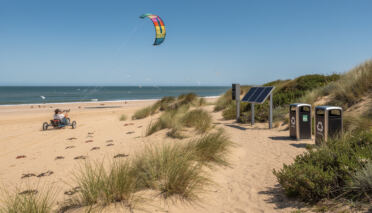
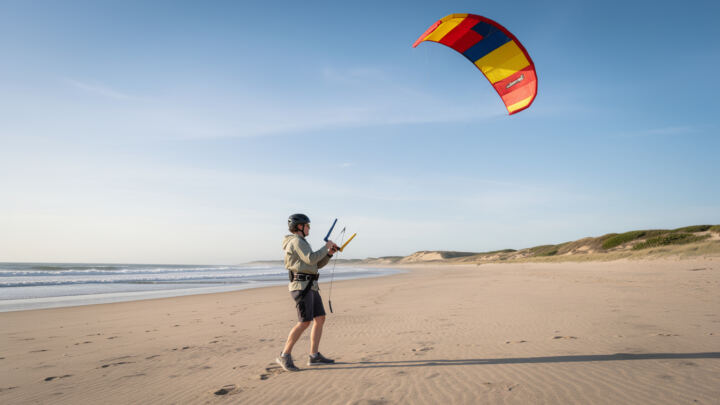
If you’ve ever watched someone casually getting pulled across a wide beach or an empty field and thought, “That looks fun… and slightly chaotic,” you’re not wrong. Traction kiting sits right in that sweet spot where simple gear meets serious physics. It’s one of those outdoor sports that rewards patience fast: the first time you feel a kite load up in the wind window, you instantly get why people get obsessed. But here’s the thing—what looks like raw strength is usually just clean technique. The real magic is learning how to set up the wing without twists, how to read wind like it’s a living thing, and how to move your hands an inch instead of a meter. To make it concrete, we’ll follow a fictional rider, Maya, on her first month of sessions: from unpacking a four-line kite on a gusty afternoon to doing controlled loops without scaring herself silly. Along the way, you’ll pick up practical habits that keep you safe, keep your gear happy, and make every launch feel intentional instead of lucky. Ready to make the kite do what you want, not what it wants?
Traction Kiting Basics for Beginners: What’s Really Happening in the Wind Window
Before you even touch handles or a bar, it helps to understand what the kite is “trying” to do. In traction kiting, the kite isn’t just floating; it’s a wing generating pull. That pull changes depending on where the kite sits relative to the wind direction. This is the famous wind window, and it’s the difference between a mellow first session and a surprise sprint.
Picture the wind blowing straight into your face. The usable sky in front of you becomes a kind of dome. Near the edges of that dome (far left and far right), the kite produces less force because it’s flying more “side-on” to the wind. Put it deeper in the middle area and it loads up—more drive, more tug, more “whoa.” Straight overhead at the top (the zenith) usually feels lighter and more stable, which is why it’s a common parking spot for beginners when they need a second to breathe.
Full power zone vs. edge of window: why it matters for kite control
When Maya started, she kept steering the kite across the center because it felt exciting. It was exciting… and it also yanked her off balance. The fix wasn’t “be stronger,” it was learning where power lives. The center of the wind window is basically the accelerator. The edges are more like cruise control. If you want better kite control, you deliberately spend time at the edge, doing smooth turns and holding position without over-correcting.
Here’s a practical way to feel it: fly the kite slowly from zenith down toward the right edge. As it approaches the edge, the pull softens. Then do the same toward the middle and notice the load building. That sensation—line tension increasing—is your early warning system. When people talk about good kite handling, they’re often talking about noticing tension changes early and responding calmly.
Wind conditions you can actually learn in (and the ones you should skip) ⚠️
Not all wind conditions are “character building.” Some are just a mess. Smooth wind (often found on open beaches or big flat fields with clean airflow) is friendly. Gusty wind (common near buildings, trees, dunes, or cliffs) makes the kite surge and stall unpredictably. If you’re learning, prioritize open space with steady airflow, and treat gusts as a reason to scale down or pack up.
In 2026, more local clubs publish live spot notes and beginner-friendly wind ranges through community apps, but the old-school rule still wins: if the wind feels punchy enough that it surprises you while standing still, it’s not a great day to learn new moves. The insight to carry forward is simple: the wind window explains the pull, and once you get that, everything else becomes teachable instead of mysterious.
Kite Setup for Power Kites: A No-Drama Routine That Prevents 80% of Beginner Mistakes
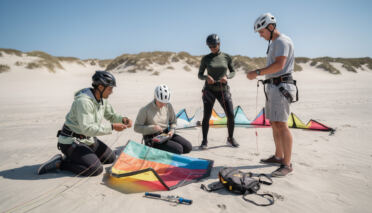
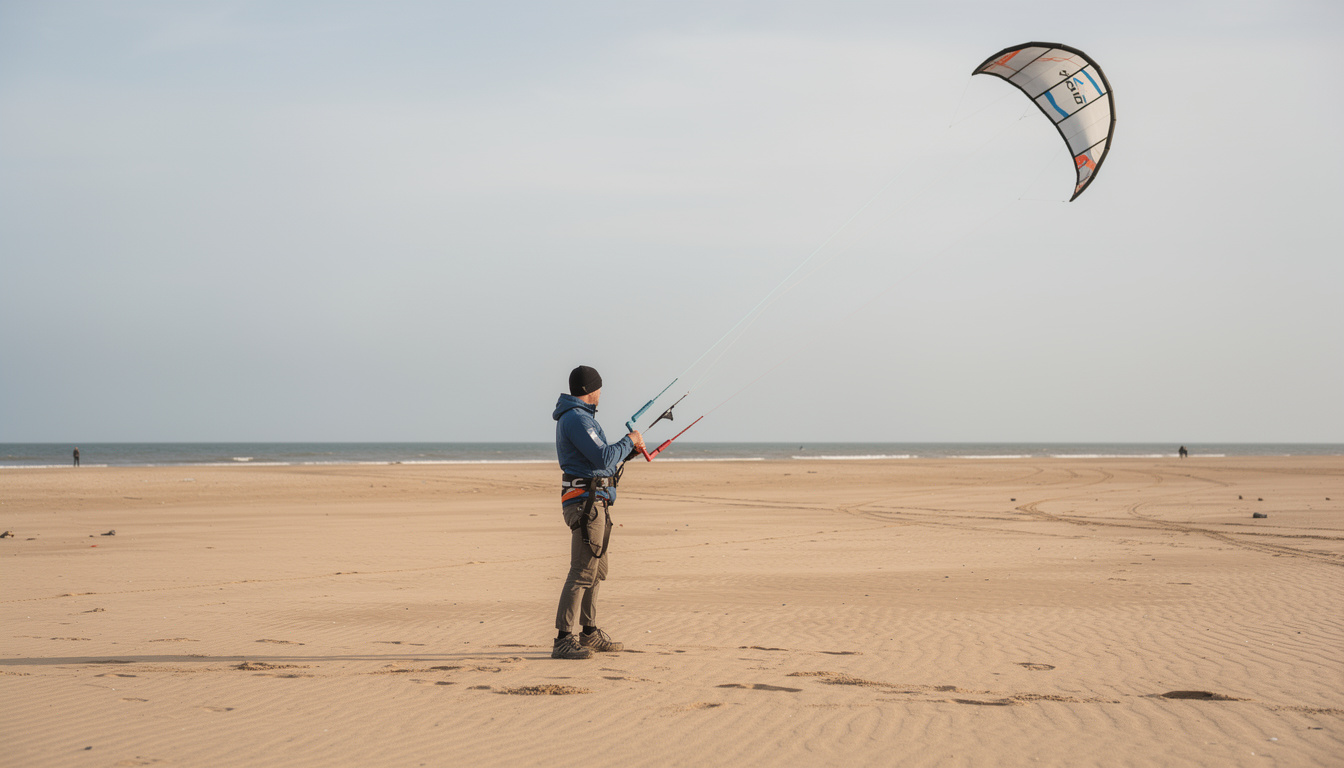
Most frustrating sessions don’t start with “bad flying.” They start with sloppy kite setup. Twisted lines, bridles snagged, wrong connections—these problems can make the kite feel unstable, unresponsive, or downright sketchy. A clean setup is like tying your shoes before a run: boring, quick, and absolutely worth it.
Maya learned this the hard way on her second outing. She rushed, launched, and her kite pulled unevenly to one side. Nothing was “broken”—one line was simply routed wrong. After that, she adopted a simple checklist that made every session calmer.
Pick the right launch area (space is a safety feature) ✅
Start by finding a spot that’s genuinely appropriate for outdoor sports with wind power. Avoid power lines, roads, railways, and airports—seriously, don’t negotiate with that rule. Also avoid crowded beaches. You want a clear buffer downwind because if anything goes wrong, the kite and lines don’t care who’s standing there.
A solid beginner benchmark is having a wide open downwind area free of obstacles. If you can’t confidently say “If I drop the kite, nothing bad happens,” keep looking. This is one of those safety tips that feels obvious until you see someone learn the lesson the loud way.
Unfold, orient, and secure the kite before lines come out
Lay the kite so the underside faces up and the trailing edge is positioned so it won’t catch wind prematurely. Weigh down the trailing edge with sand or a soft weight so it stays put. With foil kites, keeping things controlled before inflation prevents sudden flapping that tangles bridles.
Next, check the bridle area for knots or wraps. Bridles are like a kite’s steering geometry—one snag can change how it flies. Take ten seconds to make sure everything lies clean and symmetrical.
Unwind lines the right way (it’s not just convenience)
Walk lines out slowly while moving upwind so the lines stay tension-free and parallel. Keeping them straight prevents tangles and helps you spot twists early. With four-line setups, the thicker front (power) lines typically run inside, and the thinner rear (brake/steering) lines run outside. If that’s reversed, the kite may feel weird or refuse to behave.
Now connect with a lark’s head knot. It’s secure, quick, and common across power kites. Make sure each connection is snug and correctly seated. Then do the “equal length check”: handles even, lines even, nothing crossed.
A quick adjustment rule that makes kite handling easier
Four-line kites often let you tune front vs. rear line length at the handles using extra knots. If the kite tends to surge forward overhead and feels like it’s “running away,” slightly shorten the rear lines. If it struggles to rise and feels reluctant, slightly shorten the fronts. Small changes go a long way—think centimeters, not drastic re-rigging.
The key insight: a careful setup turns learning into skill-building instead of troubleshooting, and it sets you up perfectly for clean launches.
Once your gear is tidy and your space is clear, the next step is where beginners either gain confidence fast—or develop bad habits they’ll spend months unlearning: the launch.
Launching Techniques for Beginners: Calm Starts, Controlled Power, and Smart Positioning
Launching is not the moment to “send it.” It’s the moment to be methodical. Good launching techniques feel almost uneventful, and that’s exactly the point. The kite should rise because you set it up to succeed, not because you muscled it into the sky.
A simple rule Maya uses: if her heart rate spikes before the kite is even airborne, she’s probably launching in the wrong place in the wind window or rushing her steps.
The 45-degree rule and why it works
For a typical self-launch, position yourself so your lines angle about 45 degrees to the wind direction. This helps the kite inflate and rise without instantly diving into maximum power. Launching deeper in the window produces more pull; launching nearer the edge reduces it. For beginners, “less dramatic” is almost always better.
Keep the kite weighted at the trailing edge until you’re ready. Step back slowly to add gentle tension. As the leading edge lifts and the kite fills, it will start to come alive. If the wind is steady, the wing often climbs toward the zenith on its own once it’s properly pressurized.
Assisted launch: when a helper makes things safer
If you have a friend who knows what they’re doing, an assisted launch can be smoother. The helper holds the kite by the leading edge, lets it fill with air, and releases upward on your signal. Your job is to keep line tension even and steer calmly. This is especially useful when the surface is messy (pebbles, grass clumps) or when you’re still learning how to keep the kite from “snagging” during inflation.
First-flight drills that build kite control fast 🎯
Once airborne, the goal isn’t tricks. It’s accuracy. Pull left to go left, right to go right—yes—but do it smoothly, not abruptly. Think of the handles like volume knobs, not on/off switches.
- 🧭 Park at zenith for 10 seconds without wobbling—feel the tension and relax your shoulders.
- ➡️ Edge holds: fly to the far right edge and hold it there; repeat left. Notice the reduced pull.
- ♾️ Figure-eights high in the window: smooth arcs, no sharp corners, no sudden dives.
- 🛑 Power check: dip slightly toward the center, then steer back to the edge before it loads up too much.
These drills teach kite handling in a way that transfers to everything later—buggy, mountainboard, even snow. The insight to keep: launching well is a skill, not a moment, and it sets the tone for the whole session.
After you’ve launched cleanly a few times, you’ll start craving more pull on purpose. That’s where turns, loops, and power strokes come in—fun, but also the fastest way to get humbled if you skip the basics.
Kite Control and Handling on Foot: Turning, Looping, and Managing Power Without Getting Dragged
The cool part about learning on foot is that it forces honest technique. Without wheels, you can’t hide behind speed; you have to manage power with steering and positioning. That’s why many coaches still recommend foot flying as the foundation for traction kiting.
Maya’s “aha” moment came when she realized the kite responds best to clean inputs. She’d been yanking both hands in panic whenever the pull increased. Once she learned to steer with small, deliberate motions, she felt like she had time again.
Steering basics: the difference between turning and braking
On four-line handles, turning is usually created by pulling a bit more on one side’s rear line—left handle for left turn, right for right. But there’s also braking behavior: adding rear-line tension on both sides can slow the kite’s forward drive, making it sit deeper and generate steadier pull.
This is why “just pull harder” is not a plan. More rear-line input can increase drag and change the kite’s angle of attack. In moderate wind, that can be helpful. In stronger air, it can stall the wing. Great kite control is knowing which sensation you want—turn, slow, or power up—and using the minimum input to get it.
Loops and power strokes: fun tools, not party tricks
Looping a traction kite is basically committing to a continuous turn so it circles and builds power. It’s also the easiest way for beginners to generate more pull than they expected. If you want to practice loops, do it high in the window first and keep the loop size moderate. Start with a single loop, then recover to zenith, breathe, and reset.
It’s normal for lines to twist after loops. The fix is simple: loop the other direction the same number of times to unwind. Keep your left hand on the left and right on the right—switching hands can scramble your steering in a second.
Micro-skills that keep you upright (and make you look experienced) 😎
Small body habits matter. Stand with feet staggered, knees soft, and hips square to the wind. If the kite loads up, don’t fight it with your arms—step slightly toward the kite’s direction of pull to regain balance, then steer it back toward the edge of the wind window to bleed power. That’s “footwork as a safety system,” and it’s way more effective than trying to out-grip the handles.
| Situation | What you feel | Smart response | Why it works |
|---|---|---|---|
| 🌬️ Wind increases suddenly | Pull ramps up fast | Steer toward the edge + take a step to regain stance | Edge position reduces power and buys time |
| 🪁 Kite “runs forward” at zenith | It feels eager, twitchy | Shorten rear lines slightly at the handles | Balances front/rear tension for steadier flight |
| 🧵 Lines twist after looping | Steering feels odd | Loop the opposite direction to untwist | Restores clean line geometry |
| 🛑 Kite won’t climb | It flutters or stalls low | Check bridles + consider shortening front lines a touch | Improves angle of attack and inflation behavior |
The insight to keep here: good kite handling is mostly about positioning the wing where you want the pull to be. Once you can do that on foot, landing safely becomes the next must-have skill.
Safety Tips and Landing Skills: Ending the Session Cleanly (Even When the Wind Gets Spicy)
People spend a lot of time talking about launching, but landing is where smart kiters quietly prove they know what they’re doing. A controlled landing protects your gear, protects everyone downwind, and keeps your confidence intact. With shifting wind conditions, landing is also the moment when you should be most willing to slow down and be cautious.
Maya made it a rule: she never lands “where it’s convenient.” She lands where it’s safe, even if that means walking a bit more.
Core safety habits that stay relevant everywhere ⚠️
Start with the boring rules because they work. Don’t fly near power lines. Don’t fly near traffic. Don’t fly in crowds. Don’t assume people will “see your lines.” And always keep a large downwind buffer free of obstacles. If you’re practicing one of the most accessible outdoor sports around, you also share space with walkers, kids, dogs, and curious onlookers—act like it.
Also, have a plan for what you’ll do if the wind builds. Many beginners wait too long because they’re having fun. A smarter approach is to set a personal limit: “If I’m getting pulled off my stance more than once every few minutes, I land and reassess.” That’s not fear; that’s skill.
Step-by-step landing at the edge of the window
Landing typically starts by steering the kite to the far left or far right edge of the wind window. The pull reduces there, making it easier to bring it down without a hard slam. From the edge, guide it down slowly until it touches on the trailing edge.
Then keep tension on the rear lines so it doesn’t re-inflate and pop back up. If you have a ground stake or a proper sand anchor, secure your handles while maintaining more tension on the brake side. Finally, weigh the kite so the wind can’t get underneath it. The goal is simple: no air inside, no surprise relaunch.
What to do when landing feels difficult
Strong wind can make a kite want to climb again the moment it senses airflow. If that’s happening, don’t wrestle in the power zone. Walk the kite farther to the edge until it feels noticeably softer, then try again. If you’re with a partner, an assisted landing is often the cleanest choice: they approach from upwind, grab the kite at the leading edge, and you keep steady tension until it’s secure.
One last cultural note that still holds true in 2026: communities thrive when people self-regulate. If you’re learning, ask questions, watch experienced flyers land, and use public resources—forums, local groups, and tutorial libraries—so you don’t have to reinvent every mistake.
The insight to end on: the session isn’t “done” until the kite is safely neutralized, and that mindset keeps traction kiting fun for the long run.
What size power kite should beginners start with for traction kiting?
Most beginners do best with a smaller, stable kite that won’t overpower them in typical local wind conditions. The right size depends heavily on your weight and the wind range at your spot, but the guiding idea is simple: prioritize controllability over pull. A shop or local club can help match a beginner-friendly size to your usual wind.
Why does my kite surge forward at the zenith and feel unstable?
That behavior often points to a front/rear line balance issue or gusty wind. First, double-check for crossed lines and bridle snags. If the rigging is clean, slightly shortening the rear lines (or effectively adding a touch more brake) can calm the kite overhead and improve kite control.
Is it normal for lines to twist after looping, and is it dangerous?
Yes, line twist after looping is normal with four-line kites. It’s usually not dangerous if the kite is still flying predictably, but too much twisting can affect kite handling. The standard fix is to loop the kite the same number of times in the opposite direction to untwist, without swapping handles between hands.
What are the biggest safety tips for launching and landing on a busy beach?
The biggest ones are: avoid crowds entirely if you can, keep a large clear downwind buffer, and never set up near hard obstacles like walls, rocks, or poles. If the beach is busy, choose a quieter zone or a different day—traction kiting and crowded areas don’t mix well. Assisted launches and landings can also reduce risk when space is tight.