In brief
- 🪁 Build real kite control with calm, repeatable drills before chasing speed.
- 🌬️ Train wind awareness: read gust lines, terrain effects, and changing weather conditions.
- 🧍♂️ Use smarter body positioning to keep power smooth, edges clean, and fatigue low.
- ⚡ Master power management by working the window, not yanking the bar.
- 🧯 Dial in safety techniques so every session has a “plan B” (and plan C).
- 🚀 Practical launching tips + 🛬 confident landing skills = fewer sketchy moments.
- 🏄 Improve board handling with micro-adjustments and progressive edging, not brute force.
- 🎥 Study sessions with video cues, then copy one thing at a time—consistency beats chaos.
Traction kiting looks simple from the beach: a rider gliding, a canopy steady, a few casual turns like it’s all happening on autopilot. Up close, it’s more like juggling physics—wind gradients, line tension, surface friction, and your own nerves—all at once. The cool part is that the “good” riders aren’t necessarily stronger or braver; they’re usually better at managing small details. They know when to trim, when to edge, when to breathe, and when to call it and land before the sky changes its mind. If you’ve ever had a session where the kite felt twitchy, the board felt like it had a mind of its own, and every gust turned into a mini emergency, you’re not alone.
To make this practical, we’ll follow a fictional rider named Mia, who’s solid on the basics but wants to level up fast without collecting scary stories. She’s not trying to “send it” every run; she wants smoother upwind, cleaner transitions, and the confidence to handle variable conditions. The tips below are built like mini playbooks: what to do, why it works, and how to practice it without turning your session into a yard sale. Ready to make traction kiting feel less like survival and more like control?
Traction kiting kite control: drills that make the kite feel “locked in”
If there’s one skill that unlocks everything else in traction kiting, it’s kite control. Not the flashy stuff—just the quiet ability to park the kite where you want, move it on purpose, and keep line tension clean. Mia started improving when she stopped “riding and hoping” and began doing five-minute drills at the start of every session. It sounds basic, but it changes how your brain maps the wind window.
Anchor your hands and fly with your elbows
A common problem is bar hand chaos: hands sliding around, over-steering, pulling in panic when the kite surges. Try this: set your hands at equal distance from center, relax your grip, and steer by rotating your forearms rather than yanking. The bar should feel like a volume knob, not a panic handle.
Here’s Mia’s cue: “If my shoulders rise, I’m about to overcorrect.” She consciously drops her shoulders, keeps elbows soft, and suddenly the kite stops snaking. The immediate effect is smoother pull; the long-term effect is that transitions become predictable instead of lucky.
The “clock face” precision drill
Park the kite at 11 o’clock for 10 seconds, then 12, then 1—without wandering. Repeat low power first, then moderate. If it drifts, correct with tiny inputs. This drill teaches you to anticipate inertia: the kite keeps moving after your input, so you steer early and gently.
Why it matters? When you later carve or change direction, you’ll already have the muscle memory to place the kite exactly where it supports the move, rather than dragging you through it.
Window sweeps for predictable pull
Do controlled sweeps from 10 to 2, then back, keeping the kite high enough to avoid sudden yanks. Pay attention to when the pull ramps up (usually as you approach the power zone). This is your first taste of power management without even changing gear.
Make it measurable: Mia counts “one-two-three” on each sweep so she doesn’t rush. If you can sweep at a consistent tempo, you can ride at a consistent tempo. That’s the whole secret.
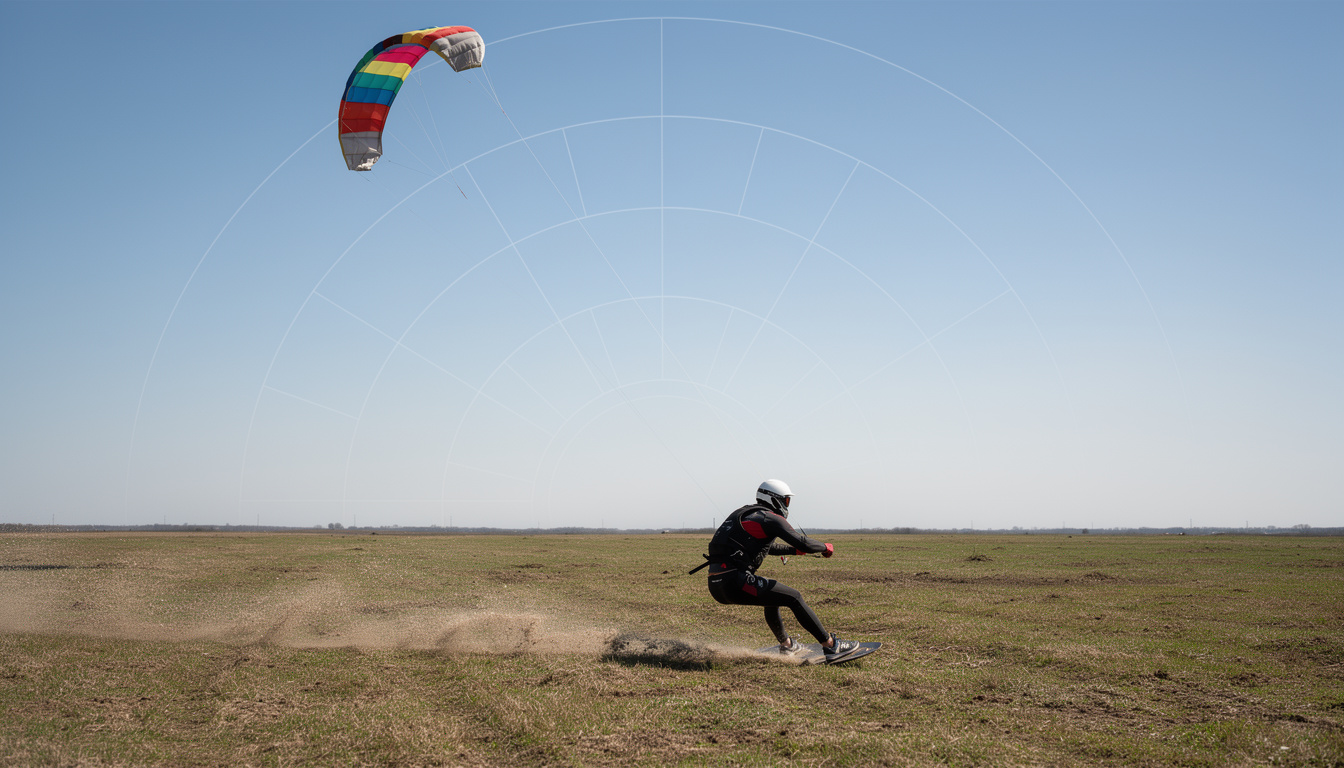
To lock this in, watching a clear demo helps. Look for videos where you can see both the kite movement and the rider’s hands, not just drone shots.
Wind awareness and weather conditions: reading the sky like a local
You can’t negotiate with the wind, but you can get really good at predicting its moods. Strong wind awareness is what separates “I hope this works” from “I saw that coming.” Mia’s breakthrough was treating each spot like a living system: beach shape, dunes, buildings, tree lines, thermal cycles, and incoming fronts all change what your kite feels in your hands.
Gust lines, texture, and the “dark patch” trick
On water, darker patches often indicate stronger wind. On land, you’ll see grass ripple patterns, dust lines, or shifting sound in the lines. If you notice a gust line approaching, you can pre-emptively depower a touch, raise the kite slightly, and square your stance. That one-second preparation often prevents a five-second wrestling match.
Mia started calling it out loud: “Gust in 3…2…1.” It sounds silly, but it trains timing. Soon she wasn’t surprised by surges; she was already in position when they arrived.
Terrain and turbulence: why “smooth-looking” spots can be nasty
Wind flowing over obstacles creates rotors and holes downwind. A flat area behind a dune can feel perfect… until the kite drops into dead air. If you’re practicing launching tips or transitions, avoid the lee side of obstacles. Pick open fetch where airflow is clean and consistent.
A practical rule: if you can see flags or tall grass, watch for inconsistent directions at different heights. If the ground indicators disagree with what your kite is doing at 20–30 meters, you’re in a gradient or shear. That’s not automatically “bad,” but it’s advanced.
Quick field checklist for changing weather
Before rigging, Mia runs a fast checklist. It’s not paranoia; it’s competence. Here’s a version you can steal:
- 🌬️ Is the wind building, fading, or oscillating in cycles?
- ☁️ Any fast-moving clouds or dark bases hinting at squalls?
- 🧭 Is the direction cross-on, side, or drifting offshore?
- 📉 Are lulls deep enough to drop the kite, or just brief?
- 🧑🤝🧑 Who’s launching/landing nearby, and do they look experienced?
These cues shape your gear choice and your session goals. If weather conditions are spicy, maybe today is technique day, not “big power day.” That decision is what keeps the sport fun for years.
Decision-making table: match conditions to session goals
| Condition cue | What it usually means | Smart move 🧠 |
|---|---|---|
| 🌬️ Frequent sharp gusts | Unstable flow or front edges | Focus on high-kite drills, shorten sessions, prioritize safety techniques |
| ☁️ Dark cloud base moving fast | Possible squall line | Land early, don’t “squeeze one more run” |
| 🧭 Wind veering 20–30° | Shifting gradient/thermal | Choose a bigger buffer zone downwind |
| 📉 Deep lulls | Risk of kite stalling | Keep kite slightly higher, reduce aggressive steering |
| 🏜️ Dust devils / swirling debris | Convective turbulence | Pause riding; reset with conservative plan |
The best part about this stuff is that it compounds: once you can read the wind, every other skill—jump timing, edge control, even confidence—gets easier without extra effort.
Body positioning and power management: stop fighting the kite, start partnering with it
When riders say, “I got yanked,” it’s often a body positioning issue disguised as a wind issue. Yes, the wind can be wild, but your stance determines whether power goes into speed, spray, or chaos. Mia used to lean back hard, legs straight, hoping the harness would do the work. She could ride, but she was always tired and always on the edge of losing control. The fix was learning to stack her body so the pull travels through her skeleton, not her lower back.
The stacked stance: hips in, ribs down
Think of a straight line from the kite’s pull through your harness to your board edge. If your hips drift behind your heels, you’ll get that “waterski” feeling where you’re skipping and bouncing. Push hips slightly forward, soften knees, and keep your chest calm. Your core doesn’t need to be rigid; it needs to be organized.
Mia’s practical cue: “Belt buckle toward the kite.” Instantly, her edge engaged with less effort. She stopped over-sheeting because the board was doing more of the resisting.
Use the wind window for power management (not the bar)
Power management isn’t just depower strap and prayers. The wind window is your throttle. Kite higher = less lateral pull, more lift; kite lower = more drive. Sweeping through the power zone is like pressing the accelerator; parking on the edge is like cruising.
A common mistake is pulling the bar in for stability. That often stalls the kite and creates jerky power. Instead, trim so you can ride with a comfortable bar position, then steer the kite to regulate power. The bar becomes fine-tuning, not the main control surface.
Micro-movements that prevent big mistakes
Advanced riding often looks calm because it’s built from tiny adjustments. Here are a few that made a huge difference for Mia:
- 🦵 Slightly increase knee bend right before a gust hits to absorb it.
- 🧠 Exhale during transitions so your shoulders don’t tense up.
- 📏 Keep your head level; if your head bobs, your edge is inconsistent.
- 🪁 Move the kite first, then move your board—sequence beats speed.
Try filming one reach. If your hips are drifting back and your arms are straight and locked, you’re letting the kite decide. If your stance is stacked and your hands are quiet, you’re deciding.
If you want a visual reference for stance, edging, and how riders manage power smoothly, a technique-focused breakdown is worth its weight in gold.
Once your body is organized and the kite is treated like a partner instead of a bull, you’ll feel a weird new sensation: spare attention. And that spare attention is what lets you start refining your board work.
Board handling for traction kiting: edging, transitions, and controlled speed
Good board handling is basically the art of converting pull into direction. Beginners often try to steer with the kite and forget the board is the real rudder. Mia’s riding leveled up when she treated her board like a precision tool: edge angle, pressure distribution, and timing. This matters on water, snow, or land—different surfaces, same logic.
Edging is not “digging in,” it’s angling
Over-edging creates spray, slows you down, and can cause sudden stalls. Under-edging turns your ride into a downwind sprint. The sweet spot is an edge that bites just enough to create resistance without choking speed.
Try this drill: ride with moderate speed and slowly increase edge angle until you feel the board start to “load.” Hold it for three seconds, then soften slightly without changing kite position. You’re teaching your legs to modulate pressure instead of going full on/off.
Transitions: simplify the sequence
Mia’s transitions used to be messy because she tried to do everything at once: move kite, move feet, rotate hips, and look for balance—total overload. The fix was sequencing:
- 👀 Look where you want to go (your shoulders follow your eyes).
- 🪁 Move the kite smoothly to support the direction change.
- 🏄 Flatten the board briefly to reduce edge grip.
- 🦶 Re-engage the new edge progressively, not instantly.
Notice what’s missing: panic. If the kite is doing something predictable, your board can do something predictable too.
Speed control without drama
When you feel overpowered, many riders instinctively send the kite up, then lose drive and wobble. A calmer option is to steer the kite slightly toward the window edge while increasing edge pressure gradually. You bleed power without abrupt changes.
On choppy water, keep the board flatter than you think and use ankles for micro-corrections. On snow, use a slightly higher kite to lighten the board during rough patches. On landboards, be extra cautious: sudden traction changes can launch you forward fast.
Case study: Mia’s “one variable” sessions
Mia started doing themed sessions: one day only edging focus, another day only transitions, another day only speed control. She didn’t chase everything at once. After three weeks, her riding looked smoother because her brain wasn’t constantly switching targets.
That’s the sneaky truth: progression loves boredom. The riders who repeat “easy” drills end up with the stylish, effortless look everyone wants.
Safety techniques, launching tips, and landing skills: the stuff that makes you look like a pro
The best riders are often the ones who never create a scene. Not because they’re timid—because their safety techniques are automatic. Traction kiting is uniquely unforgiving: your wing is a motor you can’t fully switch off, and the environment changes faster than you can explain it to a friend. Mia’s confidence skyrocketed when she stopped thinking of safety as rules and started thinking of it as a routine.
Pre-flight checks that actually prevent incidents
Before you even think about launching, do a quick, consistent scan. Mia uses a simple pattern: gear, lines, area, people, plan. It takes less than a minute but catches the silly stuff that becomes serious later.
- 🔍 Check bridle and pulleys for twists, sand, or ice.
- 🧵 Run your eyes along lines for knots and crossed leaders.
- 🧯 Confirm your quick release is clean and reachable with either hand.
- 📍 Identify your downwind “oh-no zone” (rocks, road, crowd).
- 📣 Agree on clear hand signals with your helper.
That last point matters more than people admit. Most sketchy launches aren’t “bad wind,” they’re miscommunication plus impatience.
Launching tips for clean, boring takeoffs
“Boring” is the goal. Use these launching tips to keep it that way:
Angle: Start with the kite at the edge of the window, not overhead. If it races up, you’ll get lifted; if it drops, it can tumble. Edge launch gives you a safer power ramp.
Hands: Keep one hand near center to avoid accidental over-steer. If you’re shaking, you’re over-gripping—open your fingers a bit.
Patience: Wait for a clean lull-to-steady moment instead of launching mid-gust. Ten seconds of waiting beats ten minutes of apologizing.
Landing skills that work when you’re tired
Landing skills matter most at the end of a session, when fatigue makes you sloppy. Approach your landing zone with the kite high and stable, reduce speed early, and communicate clearly. If solo landing is your only option, learn the method appropriate to your environment (sand, snow, water) and practice it in lighter wind first.
Mia’s rule: if she can’t describe her landing plan in one sentence, she doesn’t start it. “I’ll bring it to the edge, signal, step forward, release tension.” Simple plans survive stress.
When to call it: the underrated pro move
Knowing when to stop is a skill. If weather conditions are trending worse, if your kite is surging unpredictably, or if you’re missing basic movements you nailed earlier, land and reset. The session you end early is often the session that lets you ride tomorrow.
Put it all together and you get the real flex in traction kiting: not bigger risks, but cleaner control under pressure. That’s the kind of confidence you can actually trust.
How can I improve traction kiting faster without overpowered sessions?
Pick one skill per session (like kite control parking drills or a single transition type), and ride slightly underpowered if possible. You’ll get more reps with less panic, which builds real timing and better power management.
What’s the simplest way to build wind awareness at a new spot?
Spend five minutes watching before rigging: look for gust lines (water texture or dust), check how wind behaves near obstacles, and note direction changes. Then choose a conservative launch area with a big downwind buffer in case the weather conditions shift.
Why do I keep getting pulled off my edge even when the kite is high?
Usually it’s body positioning: hips too far back, knees too straight, or arms locked. Stack your stance (hips slightly forward, knees soft) and steer the kite toward the window edge to reduce lateral pull instead of yanking the bar.
What are the most important launching tips for avoiding sketchy starts?
Launch at the edge of the window, keep your hands calm and symmetrical, and wait for a steady moment instead of launching during a gust. Confirm quick release access and agree on signals with your helper—those safety techniques prevent most problems.
How do I know if my board handling is the bottleneck, not my kite?
If the kite feels stable but you still skid downwind, bounce in chop, or stall during transitions, it’s likely edging and pressure control. Practice progressive edging (increase and release pressure smoothly) and simplify transitions into a repeatable sequence.