En bref
- 🪂 Traction kiting is about using wind power for controlled pull—fun, athletic, and surprisingly technical.
- 🌬️ The fastest progress comes from reading wind conditions and matching them to your kite types and skill level.
- 🧤 Strong safety tips start before launch: space, leash systems, and a realistic “what if it spikes?” mindset.
- 🧵 Clean equipment setup prevents 80% of beginner tangles and scary moments.
- 🎯 Real kite control means steering, braking, and depowering on purpose—not just “keeping it in the air.”
- 🏜️ Land kiting is a great training ground: instant feedback, fewer variables than water, and easy repetition.
- ⚡ Understanding power generation (window position, speed, and angle) makes everything feel predictable.
If you’ve ever watched someone casually walk upwind with a kite parked overhead, then suddenly carve across a beach like they’ve got invisible horsepower, you already get the appeal. Traction kiting looks simple from far away—just a canopy in the sky and a person holding lines—but up close it’s more like learning to drive a sporty manual car: the fun is real, and so are the consequences of sloppy inputs. The good news is that beginners can build skills fast when the basics are dialed: clean rigging, smart wind reading, and repeatable drills that turn “survive the pull” into actual control.
To keep things grounded, we’ll follow a fictional new rider, Maya, who’s starting from zero and wants to progress into confident, safe sessions. She’s using common resources like tutorials and how-to references (the kind you’d find in long-running wind sports libraries such as Coastal Wind Sports’ articles and photo albums) and combining them with a simple practice routine. If you want that same “I know what I’m doing” feeling—without the drama—this guide is for you.
How traction kiting works: power generation, the wind window, and smart beginner expectations
At its core, traction kiting is the art of converting moving air into controlled pull. That pull can be mild—enough to tug your arms and make you grin—or strong enough to move you across sand, grass, or snow. The key is that you’re not just “flying a kite”; you’re managing power generation by choosing where the kite sits in the sky and how fast it travels through the air.
Maya’s first “aha” moment is realizing that a traction kite has a usable map in the sky called the wind window. Picture a big dome downwind of you: the edge of that dome (the window’s edge) is where the kite tends to pull less and feel more stable, while the center is where it can generate serious force. Beginners often accidentally steer into the middle and wonder why everything got intense in half a second. That’s not bad luck—it’s geometry and airflow.
Another huge concept is apparent wind. Even if the actual breeze is steady, the kite can create extra airflow over its canopy when it moves quickly. That’s why sweeping the kite (often called “sining”) creates more pull than simply parking it. For a beginner, this is a double-edged sword: moving the kite is how you get power, but it’s also how you can get overpowered if you don’t manage speed and direction.
Reading wind conditions like a local (without pretending you’re a meteorologist)
Wind conditions aren’t just a number on an app. Maya learns to look for texture on water (if nearby), tree movement, flag behavior, and sand drifting along the beach. Gusty wind often shows up as sudden changes in sound and temperature, or as bursts that make grasses “shimmer” in waves. If the wind is pulsing, a smaller kite or a more conservative practice plan wins every time.
She also learns a simple rule: if you can’t comfortably hold your arms out for a minute without strain while the kite is parked near the edge, you’re likely overpowered for skill-building drills. That doesn’t mean “pack up forever,” it means adjust—either reduce kite size, move to a cleaner wind spot, or save it for a coached session.
Choosing kite types that forgive mistakes
There are many kite types, but for early traction practice, stable foil kites are popular because they’re durable and easy to relaunch on land. Many people start on a two-line foil to learn steering, then move to a four-line kite for real depower and braking. Maya follows that progression because it matches how humans learn: first direction, then speed control.
By the end of her first few sessions, she’s no longer asking, “Why did it pull so hard?” She’s asking, “Where was it in the window, and how fast was I flying it?” That question is basically the doorway to mastery.
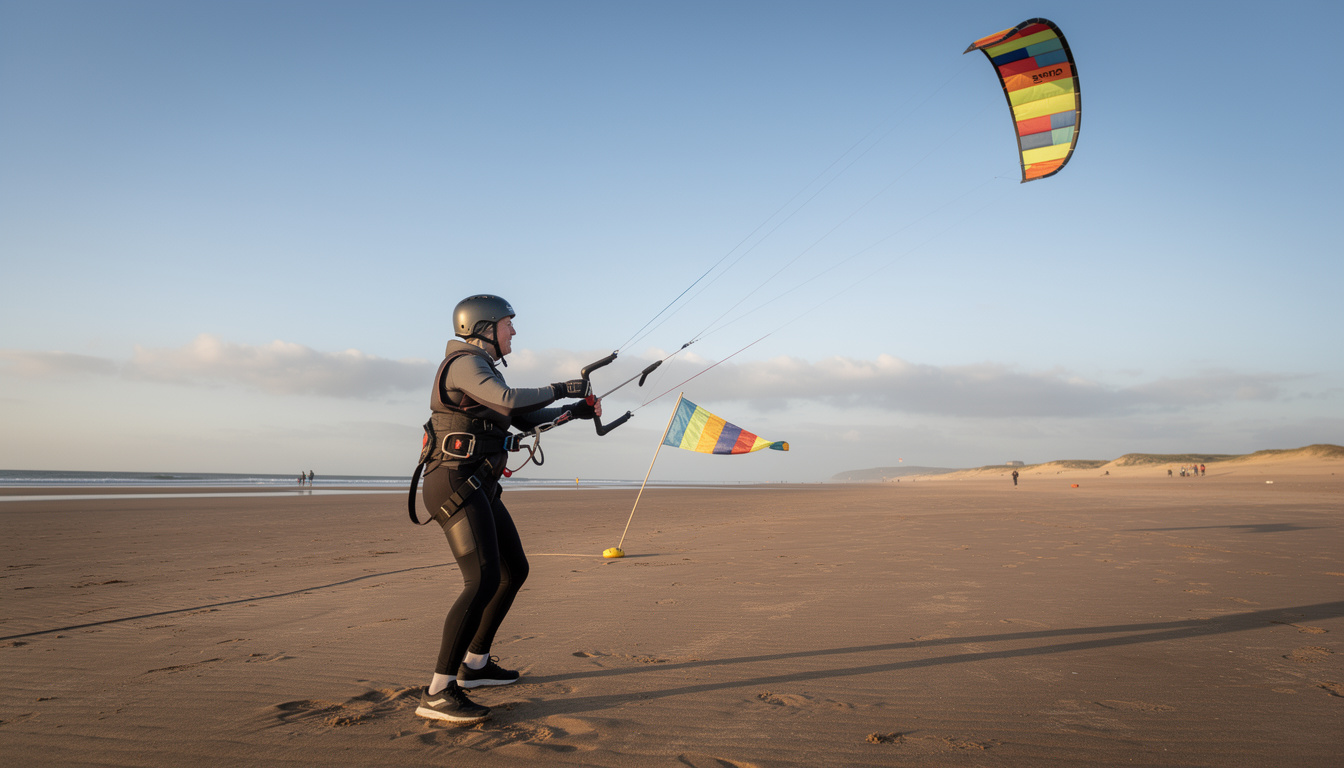
Equipment setup for traction kiting: lines, handles, safety systems, and rigging that won’t betray you
If traction kiting had a boring superpower, it would be this: equipment setup prevents chaos. Maya learns quickly that most “the kite went crazy” stories start with twisted lines, mismatched leaders, or a safety leash clipped to the wrong point. Good rigging feels almost invisible during the session—because nothing weird happens.
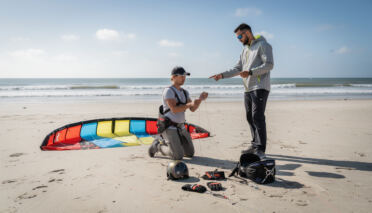
The first mindset shift is treating setup like a pre-flight check. Even casual sessions deserve structure, especially for a beginner. Maya uses a simple routine: lay the kite down, anchor if needed, walk lines straight, check symmetry, then connect in a consistent order. She takes photos the first few times to compare “good” versus “messy” layouts, which is a trick borrowed from the kind of reference photo albums you’ll find in long-running traction-kite tutorial libraries.
Handles vs bar, and why four lines change everything
Two-line kites teach steering, but four-line kites teach kite control. With four lines, you can steer and also brake/depower by changing rear-line tension. On handles, that’s intuitive—pull left to turn left, pull both to brake. On a bar, it’s similar, but the feel is different, and you’ll also manage trim systems depending on the model.
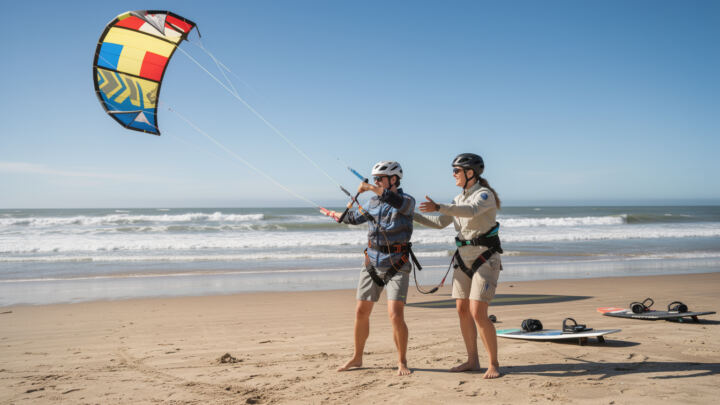
Maya starts on handles because it makes the relationship between hand movement and kite response obvious. Once she can fly stable figure-eights without drifting into the power zone, she tests a bar setup under supervision. The main point isn’t which is “better”—it’s choosing what makes learning safer and clearer.
A safety system you can actually use under stress
Here’s the part people love to skip until they need it: safety releases. The goal is not hero strength; it’s a clean exit. Maya practices activating the primary quick release with her eyes closed (while the kite is not powered) so her hands know what to do when adrenaline shows up. She also checks the leash attachment point every single session—because clipping to the wrong ring can turn a safety into a decoration.
Basic safety tips that matter in the real world include keeping a wide buffer downwind, avoiding crowded beaches, and never launching with lines crossing paths. She also avoids “just one quick flight” in sketchy wind, because gusts don’t care about your schedule.
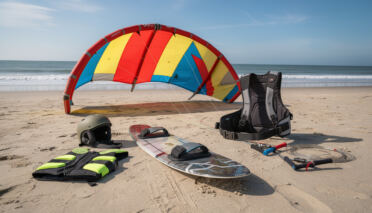
Quick setup checklist you’ll use forever
- 🧵 Lines fully unwound, no hidden loops, no knots near the leaders
- 🔁 Left and right confirmed (color coding helps)
- 🧤 Gloves and helmet on before connecting the kite (not after it’s pulling)
- 🪝 Leash clipped to the correct safety point; quick release tested
- 🌬️ Launch area checked: clear downwind “runout” and clean airflow
- 🧭 Wind direction confirmed with streamers/grass/sand drift, not just an app
When Maya gets this routine consistent, her sessions instantly feel calmer. That calm is not “less fun”—it’s the foundation that lets you push skills without gambling.
With gear sorted, the next step is learning the moves that translate directly into control.
Kite control fundamentals: steering, braking, and the kiting techniques that build real confidence
Kite control is the difference between “the kite stayed up” and “I can place it anywhere I want, on purpose.” For Maya, the turning point is training her inputs to be smaller, earlier, and more deliberate. Big frantic pulls create big frantic outcomes. Smooth hands create a predictable canopy.
She starts with the simplest goal: keep the kite near the edge of the window without overcorrecting. That teaches patience and teaches her what “neutral” feels like. Once that’s stable, she adds controlled movement—slow climbs, slow descents, then gentle side-to-side transitions. The vibe is less “stunt show” and more “precision parking.”
The three drills that make beginners progress fast
First is the “edge hover.” Park the kite low at the side, hold it there, and correct only when it drifts. This builds a calm baseline and helps with safe launching and landing.
Second is the “wide figure-eight.” Maya flies large, slow figure-eights that avoid the dead-center power zone. The goal is consistent speed, not maximum pull. Over time she learns how the kite accelerates as it dives and how braking can manage that acceleration.
Third is the “stop-and-go.” She intentionally stops the kite at different clock positions (10, 11, 12, 1, 2) and restarts smoothly. This teaches timing and reduces panic when the kite momentarily loses pressure or when the wind lulls.
Common beginner mistakes (and the simple fix)
Maya’s most common mistake is staring at the kite nonstop. She learns to scan: kite, lines, space downwind, then back to the kite. This keeps her aware of hazards and helps her sense gusts before they become problems.
Another classic issue is “death-gripping” the handles. Tight grip leads to jerky inputs. She switches to a relaxed hold and uses short pulls, almost like tapping the steering rather than yanking it. The kite suddenly feels less twitchy, even in variable wind conditions.
Finally, she stops “saving” bad dives by pulling harder. Instead, she steps toward the kite slightly to reduce line tension and uses braking to slow it down. That one change prevents a ton of accidental power spikes.
A practical table: what your kite is telling you
| Signal 🧭 | What it usually means 🌬️ | What to do next ✅ |
|---|---|---|
| Kite surges forward and pulls hard ⚡ | You flew into more power or increased speed (apparent wind) | Steer toward the edge, add gentle braking, slow your inputs |
| Kite feels mushy / stalls 🫧 | Too much brake, not enough airflow, or a lull | Ease brake, guide to a higher position, wait for pressure |
| Wingtip collapses briefly 🪁 | Turbulent wind or uneven tension | Move to cleaner air, re-check line balance, fly smoother arcs |
| Kite drifts toward center on its own 🎯 | Uneven pull, gust, or you’re not correcting early | Correct sooner with small steering and re-park at the edge |
| Lines twist after turns 🧵 | Repeated rotation in one direction | Reverse rotation, untwist on the ground, avoid unnecessary spins |
These patterns are basically a language. Once Maya can “read” them, she stops feeling surprised—and surprise is what makes people unsafe.
Now that the kite is obeying, it’s time to put that control to use on the ground.
Land kiting progression: harness skills, body position, and using traction safely on sand and grass
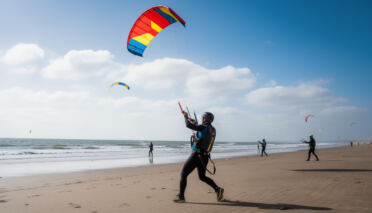
Land kiting is where traction kiting becomes physical in the best way. You’re not just steering; you’re coordinating your stance, your steps, and your kite placement so the pull helps you instead of rag-dolling you. Maya chooses a big open field and a wide beach on low-traffic days. Space is her secret weapon.
She starts without a board or buggy. Just boots, helmet, gloves, and a plan. That may sound “less exciting,” but it accelerates learning because she can focus on body mechanics: knees soft, hips square, shoulders relaxed, and weight shifting like she’s bracing against a friendly shove.
Body position that reduces fatigue (and saves your shoulders)
Maya learns to align her body so the pull travels through her core, not through tense arms. She keeps elbows slightly bent and avoids reaching overhead. When the kite is high, she doesn’t lean back dramatically; she sets a stable base with her feet and lets the harness (if used) take the load.
If she’s flying on handles, she keeps the handles level and avoids “one arm high, one arm low” unless she’s intentionally steering. That symmetry reduces unwanted turns and makes the kite’s behavior feel consistent.
Adding movement: controlled pulls, then short runs
Once she can park the kite and do figure-eights, she practices short power strokes. The idea is to create a small burst of pull, then immediately return the kite to a safer position. This teaches her that power is something she can “dose,” not something that just happens to her.
As she improves, she adds short downwind runs. The rule is simple: if she can’t stop and park the kite calmly, she’s moving too fast for her current control level. That’s one of those safety tips that looks conservative until it prevents a messy tumble near a fence line.
Anchoring, assisted launches, and why humility is a skill
On crowded or gusty days, Maya prefers assisted launches. A friend holds the kite, checks lines, and releases only when Maya signals readiness. When solo, she uses safe anchoring methods appropriate for her kite and location, and she avoids improvising with sketchy objects. The best anchor is the one you don’t need because you chose the right place and wind.
She also builds a habit of stopping early. If wind ramps up or gets turbulent, she ends the session while she still feels fresh. That’s not quitting; that’s long-term progression.
A mini practice plan (repeatable and measurable)
- 🧭 5 minutes: edge hover left and right, low and steady
- 🎯 10 minutes: wide figure-eights, slow pace, avoid the center
- 🛑 5 minutes: stop-and-go at multiple clock positions
- 🏃 10 minutes: short power strokes + reset to the edge
- 🧰 5 minutes: controlled landing and tidy pack-down
After a couple of weeks, Maya notices something big: she’s not “fighting” the kite anymore. She’s collaborating with it, which is exactly where you want to be before adding boards, buggies, or stronger wind sessions.
Next comes the part everyone asks about: how to keep it thrilling without being reckless.
Safety-first mastery: matching wind conditions to skill, managing space, and building kiting techniques that scale
The fastest way to stall your progress is to get scared by a preventable incident. Mastery is not about never crashing; it’s about making your crashes boring. Maya builds a safety framework that keeps sessions fun and keeps “close calls” out of her story.
First, she matches the session to the day. Stronger wind conditions are not automatically “better.” For beginners, moderate steady wind is gold because it gives consistent feedback. Gusty days are where you practice patience, not bravado. If she wants to push herself, she does it with smaller kites, more space, and a clearer exit plan.
Space management: the invisible piece of equipment
Maya treats the downwind area like a safety runway. She chooses spots with no hard obstacles: no parking lots, no fences, no rocks, no beach crowds. She also pays attention to wind direction shifts. A spot that was safe at noon can get sketchy at 2 p.m. if the breeze clocks around.
She sets personal boundaries: if someone walks into her downwind zone, she lands. It’s not about being territorial; it’s about acknowledging that lines and canopies don’t negotiate.
Scaling up kiting techniques without skipping steps
Once she’s comfortable, Maya starts exploring more advanced kiting techniques: tighter turns, controlled dives with immediate braking, and “parking transitions” from side to side. She also experiments with micro-adjustments—tiny steering changes that keep the kite stable in variable air.
If she’s learning on a four-line kite, she practices braking to reduce speed before the kite reaches the power zone. That one habit keeps power predictable and reduces the chance of being yanked off balance.
How Maya decides when to size down (and why that’s a flex)
In 2026, plenty of riders use wind apps and smart watches, but Maya doesn’t let numbers overrule feel. If the kite is consistently pulling her out of stance, if she’s relying on strength rather than technique, or if she’s hesitating to launch because it feels “spicy,” she rigs smaller. Experienced kiters respect that choice because it’s what keeps sessions clean and repeatable.
She also builds a habit of debriefing after every session: what worked, what felt sketchy, and which drill improved. That small reflection loop turns random practice into deliberate training.
The final insight she carries forward is simple: traction kiting rewards people who stay curious. If you keep asking “what caused that?” instead of “why did that happen to me?”, you’ll keep leveling up.
What’s the best traction kite size for a beginner?
Pick a size that lets you practice without being dragged when the kite is near the edge of the wind window. The right choice depends on rider weight, local wind conditions, and kite design, but the beginner-friendly move is usually to go smaller and steadier rather than bigger and punchier.
Should I start with two lines or four lines?
Two-line kites are great for learning basic steering and understanding the wind window. Four-line kites add braking and depower, which improves kite control and safety once you’re ready. Many beginners progress faster by starting two-line, then moving to a four-line traction kite for true control.
What are the most important safety tips before launching?
Check your downwind space, confirm wind direction, untwist and tension-check lines, test your quick release, and launch with the kite at the edge of the window. If anything feels rushed or uncertain, stop and reset—most incidents start with a sloppy launch.
How do I know if wind conditions are too gusty for practice?
If the pull changes sharply every few seconds, the kite surges unexpectedly even when parked, or you can’t hold a stable hover without constant big corrections, it’s likely too gusty for skill drills. Switch to a smaller kite, move to cleaner wind, or save the session for another day.
Can I learn land kiting without a buggy or board?
Yes—and it’s often the smartest way to start. Practicing on foot teaches power management, stance, and emergency reactions with fewer variables. Once your equipment setup and control drills feel automatic, adding a buggy or board becomes much safer and more fun.