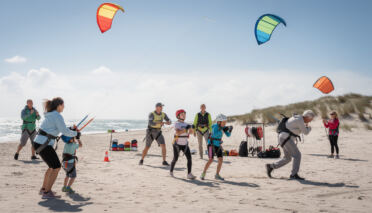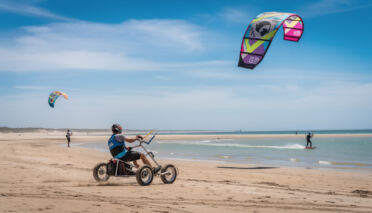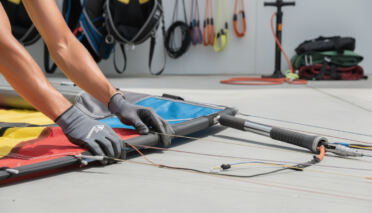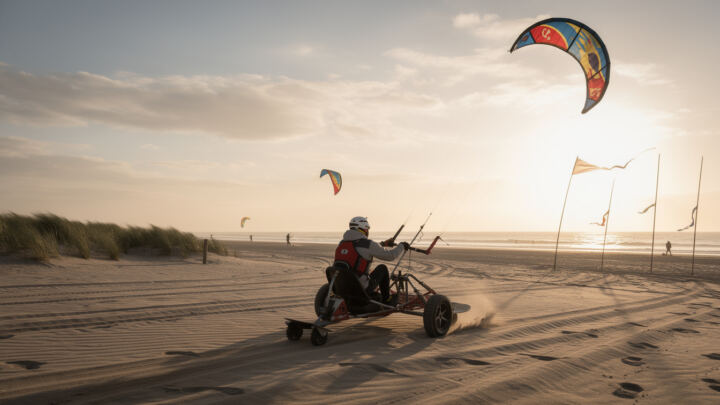
The wind is the boss on a traction kiting day—no debate. It can hand you a smooth, fast session where your lines feel “alive” in a good way, or it can turn the same spot into a twitchy mess where your kite keeps surging, stalling, and dragging you into problem territory. What makes this tricky is that a simple “windy” label doesn’t mean much. Wind speed on an app can look perfect while the beach feels chaotic because of turbulence behind dunes, sudden gust spread, or wind shear that only shows up once the kite climbs. That’s why the riders who progress fastest aren’t always the strongest; they’re the ones who get obsessed with wind reading—watching flags, sand, tree lines, and how the canopy behaves the moment it loads up.
In 2026, we’ve got nicer forecasting tools and more live sensors than ever, but the real edge still comes from knowing how wind works in your hands: where power sits inside the wind window, how wind direction changes safety and surface feel, and why “average wind” can be a trap if gusts spike hard. This article keeps things practical, with a running example rider (Sam) who’s learning to turn data + observation into real kite control. The goal isn’t just better kite performance; it’s fewer sketchy moments and more sessions where you feel like you’re working with the air instead of arguing with it.
En bref
- 🌬️ Wind speed is a range, not a single number—gust spread is where surprises live.
- 🧭 Wind direction decides whether your spot is friendly, turbulent, or straight-up risky.
- 🎯 The wind window is your power map: center = pull, edges = control.
- 🏖️ Terrain creates wind patterns (funnels, shadows, rotors) that apps can’t fully “see”.
- 📉 Wind shear can make the kite feel stronger up high than it did at launch.
- 🪢 Better kite setup (lines, brakes, stake, plan) is real kiting safety, not a chore.
- 📲 Forecasts help, but last-second observation is the final vote on the day’s weather conditions.
Wind Reading Basics for Traction Kiting: Turning Air Into Repeatable Performance
If you want traction kiting to feel consistent, you have to stop treating wind like a background detail and start treating it like the main terrain. The weird part is that wind is invisible, so your brain grabs onto numbers—“It’s 18 km/h”—even though what you actually ride is the way that airflow hits the kite across time. Two sessions can have the same average and feel totally different. That’s why wind reading is basically pattern recognition: you’re looking for steadiness, direction reliability, and clues of turbulence before you clip in.
Sam (our running example) used to show up, check one app, and rig the same kite he used last time. His sessions were a coin flip. Once he started doing a two-minute “wind scan,” things changed fast: he launched calmer, picked better kite sizes, and spent less time doing accidental sprint-drags across the sand.
What wind speed really means when you’re hooked into traction
Here’s the blunt truth: a forecast number is only useful when you also know the gust spread and stability. A steady 18 km/h can be a comfortable learning day. An 18 km/h average with gusts punching into the mid-20s can feel like the kite has mood swings—especially on land where traction spikes translate into instant acceleration.
Instead of thinking “How windy is it?”, ask “What does this enable?” Light air demands finesse (keeping the canopy pressurized). Moderate wind is where skill builds quickly because feedback is clear without being punishing. Strong wind is where mistakes get expensive, fast.
| 💨 Wind band | 📏 Typical feel | 🪁 Practical sizing logic | ⚠️ Risk note |
|---|---|---|---|
| 5–11 km/h 🌱 | Soft pull, kite may feel “floaty” | Bigger canopy helps; lighter fabric matters | Lower danger, but launch/landing can be fiddly |
| 13–24 km/h 🙂 | Clean traction, predictable steering | Mid-size is usually the sweet spot | Great skill-building if your space is huge |
| 26–40 km/h 💪 | Fast, edgy, pull ramps up sharply | Smaller kites; prioritize braking authority | High risk of being dragged or lofted |
| 42+ km/h 🚫 | Overpower territory | Most riders should stand down | Not a “challenge,” it’s a rescue waiting to happen |
Wind direction: the “silent” factor that changes everything
Wind direction decides how clean the flow is, and it decides what happens if things go wrong. Onshore wind can be more forgiving because it tends to push you back toward land, while offshore wind can carry you into open water or into the wrong side of your launch zone. Cross-shore often feels like the dream scenario—consistent pull without constantly being shoved into hazards—assuming you’ve got a wide, empty downwind buffer.
Sam learned this on a day that looked perfect on the forecast. The speed was moderate, but the angle was slightly cross-off and the downwind area ended in a parking lot. He didn’t crash; he just had one sketchy gust that dragged him ten meters too fast. It was enough to make the point: kiting safety starts with geometry, not courage. The insight: the best wind is the one that leaves you room to make mistakes.
Reading Wind Patterns at the Spot: Flags, Sand, Trees, and the “Feels Like” Test
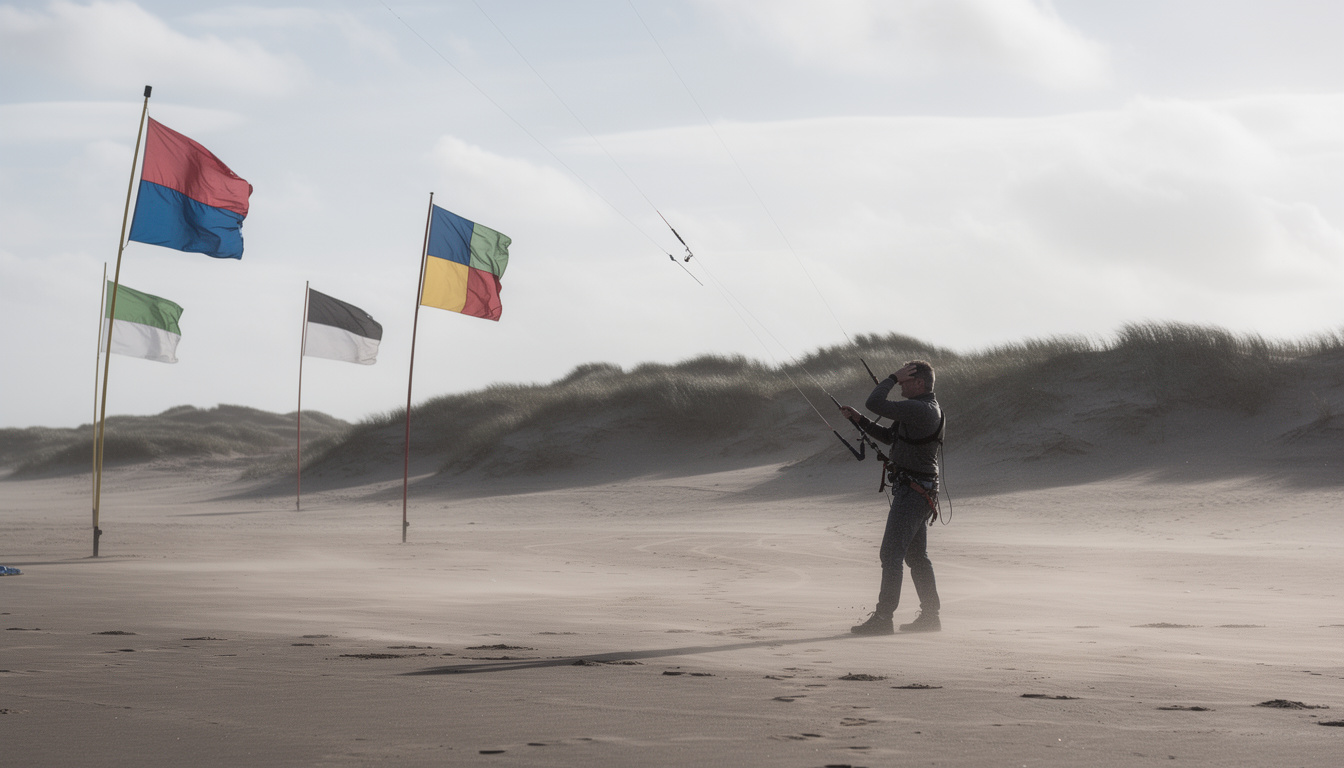
Apps are great for planning, but the spot tells the truth. Real wind patterns show up in micro-signs: the way flags snap then droop, the way sand streaks move in pulses, the way tree tops sway in waves. If you train your eye, you can detect gust structure and turbulence before you ever load the kite. That’s the difference between “I hope this works” and “I know what today is.”
Sam started treating his pre-launch routine like a pilot’s walk-around. Not dramatic, just consistent. Two minutes of observation saved him from rigging too big more times than he wants to admit.
Visual cues that predict stability (or chaos)
Start with simple stuff. Are the flags extended and steady, or are they twitching like a nervous animal? If the flag repeatedly snaps hard then goes limp, you’re likely dealing with gusts or turbulence. On beaches, sand is your free wind tracer. If you see smooth, consistent sand streams, that’s often a sign of steady flow. If the sand lifts in patchy bursts, expect the kite to feel “on/off.”
Tree lines are sneakier. A line of trees upwind doesn’t just block wind; it can create a rotor zone downwind—dirty air that makes the kite luff, surge, or fold. You can watch the canopy of the trees: if movement rolls through in uneven waves, your session may feel like repeated punches rather than a clean pull.
The skin test and the “kite tells the truth” moment
Stand still, close your eyes for ten seconds, and feel the wind on your face and ears. Is it smooth and constant, or is it arriving in bursts? That “burstiness” matters more than most people think because it’s what turns a pleasant average into a tiring, mistake-prone session.
Then there’s the big one: once the kite is up, it often reveals conditions you couldn’t feel at ground level. Wind shear is the classic example. At head height, it might feel mild. At 20–30 meters up, the kite can load up with noticeably more power. That’s why Sam’s rule is simple: first flight is conservative—small inputs, kite kept lower, and a quick check that he has real braking authority. The insight: the wind you feel isn’t always the wind your kite feels.
Spot checklist: fast, practical, and not paranoid
- 🧭 Confirm wind direction with a windsock/flag, not just an app.
- 🏖️ Look downwind: do you have a huge “nothing zone” for mistakes?
- 🏠 Check upwind obstacles (dunes, cars, buildings) that can create turbulence.
- 🌡️ Note thermal triggers: sunny land heating can build sea-breeze strength later.
- 👀 Watch other riders: are their kites folding, yanking, or behaving smoothly?
Once you can read the spot like this, the next step is understanding where that wind becomes pull: the wind window.
Seeing the wind window in motion helps a lot, especially if you’re learning where “safe power” lives.
Mastering the Wind Window for Kite Control: Power Zone, Edges, and Clean Transitions
The wind window is one of those concepts people nod along to, then completely forget the moment the kite starts pulling. But if you want better kite control and better kite performance, the wind window is your map. Imagine an invisible dome of air in front of you when you stand with your back to the wind. Your lines are the radius of that dome. The kite can fly anywhere inside it, but the amount of pull changes massively depending on position.
Sam’s biggest leap wasn’t a new kite or stronger legs. It was realizing he could “place” power instead of fighting it. That’s when sessions started feeling deliberate.
Power zone vs neutral zone: why the center feels like a turbo button
When the kite moves through the center of the window (downwind), it sees stronger airflow and generates maximum traction. That’s why a dive through the middle can yank you forward like a slingshot. Near the edges, the kite sits at a sharper angle to the wind and produces less pull—useful when you’re resting, resetting, or trying not to get dragged during a sketchy moment.
Think of the edges as your volume knob. Want to reduce pull without panicking? Steer toward the edge and calm your inputs. Want a controlled start? Do a smooth power stroke through the center, then climb back out to the edge to manage speed.
A drill that builds control without drama
Sam practiced a simple routine on a wide, empty beach. He parked the kite near the right edge, then flew it up and down along that edge without crossing into the high-power middle. The goal wasn’t fancy tricks; it was steady line tension and clean steering. After a week of doing this for ten minutes per session, launches stopped being wrestling matches and landings became boring (which is a compliment).
Once that felt solid, he added a second drill: a slow dive toward the center, then an immediate climb back out before it fully powered up. It taught him timing, not force. The insight: you don’t “tame” power—you position it.
Why kites fold, stall, or drop (and why it’s often not the kite’s fault)
Kites can lose pressure when they’re flown too far outside the usable edge of the window, too far overhead, or into turbulent air. Beginners often label this “unstable,” but a lot of the time it’s just airflow geometry. The canopy needs consistent flow to stay pressurized. If you pull it into a dead zone, it can collapse, then re-inflate on a gust—sometimes with a nasty surprise tug.
That’s why practicing controlled stalls in safe, moderate wind is actually a performance skill. If you understand how a stall begins, you spot it earlier and you react smoother. This connects directly to kiting safety because surprise re-power is a classic way riders get pulled off balance.
Once the wind window makes sense, forecasts stop feeling like mysterious numbers and start feeling like planning data.
Forecasts and Weather Conditions in 2026: Using Apps, Gust Spread, and Direction Shifts Like a Local
Modern forecast tools are good—sometimes ridiculously detailed—yet they still don’t eliminate judgment. The trick is to stop reading forecasts like permission slips and start reading them like risk maps. For traction kiting, your biggest forecast “gotchas” are gust spread, direction swing, and timing (especially around thermals or approaching weather boundaries). Put simply: weather conditions are a story over hours, not a single line on your screen.
Sam now checks two sources instead of one. Not because he loves apps, but because he loves consistency. If both models agree on speed and direction, his confidence goes up. If they disagree, he treats the day as “uncertain” and plans conservatively.
Gusts: why average wind can be a trap
If the forecast says 18 km/h with gusts to 28 km/h, the question is not “Can I handle 18?” It’s “What happens when it hits 28?” Gust spikes can overload you even if they last a few seconds. On land, that can mean being dragged fast before you can react. Sam’s rule is simple: if the gust number is near his personal “too much” threshold, he sizes down or switches to a low-power trainer kite.
This is also where the “bigger is better” myth falls apart. Bigger canopies can feel fun in light wind, but they can become sluggish to depower and exhausting to correct when gusts punch through. Many experienced riders end up using mid-range or smaller sizes most often because control is performance.
Direction shifts: the hidden reason sessions feel inconsistent
A wind direction that swings 20–40 degrees over an hour can make your wind window feel like it’s sliding around. It also changes your safe downwind corridor. If you launch with a safe buffer and the wind rotates, you may suddenly have “hard consequences” downwind—rocks, people, roads, fences.
Sam got into the habit of re-checking direction every 30 minutes, especially if the sky looks like it’s building something. It’s not obsessive; it’s just keeping the mental map current.
Thermals, trade winds, and local personality
Some spots have daily rhythms. Thermal winds often build when the sun heats the land and cooler air rushes in from the water, typically strengthening through the afternoon before easing later. In tropical regions, trade winds can be steady for days, but still vary seasonally in strength and angle. The key is local knowledge: talk to regulars, learn the “strong at 3 pm” pattern, and respect wind shadows behind cliffs or buildings.
The insight: forecasts tell you the big picture, but locals teach you the plot twists.
Kite Setup and Kiting Safety: A No-Drama Routine That Improves Performance Too
Most traction kiting incidents start before the kite even flies. Rushed rigging, tangled lines, wrong size, poor space selection—these are boring mistakes with exciting consequences. A clean kite setup routine doesn’t just keep you safer; it makes the session smoother because the kite behaves predictably and your reactions stay calm.
Sam used to treat setup like the annoying part before the “real fun.” Now he sees it as the first performance upgrade of the day. When everything is clean, the kite feels clean.
Line symmetry checks that prevent “mystery handling”
New lines can be slightly uneven, and older lines can stretch. If your two power lines aren’t matched, the kite can drift, refuse to sit where you park it, or constantly turn. If brake lines are mismatched, you might get poor stopping power or annoying backstall behavior.
A quick method: stake one end, walk downwind with the other ends, tension evenly, and compare. Adjust at the knots/loops rather than doing anything permanent. The goal is simple: power lines match each other, brake lines match each other. This one habit solves a shocking number of “my kite is weird” complaints.
Stakes, safe parking, and stopping the kite fast
A ground stake is underrated. It lets you secure the kite while you sort lines or take a breather. The key is staking the correct point so the brakes are engaged; otherwise you’re basically anchoring a loaded launcher. Make the stake visible (bright ribbon helps), and weight the trailing edge with sand or smooth stones if needed.
If you’re learning, wrist leashes or “kite killers” connected to brakes are a smart layer. They’re not magic, but they can reduce power if you let go in a panic. And yes, protective gear matters: helmet, eye protection, and supportive footwear are the baseline if you’re buggying or landboarding. Toughness doesn’t stop ankles from rolling.
A simple pre-launch routine (that you’ll actually do)
- 🧭 Reconfirm wind direction on-site (flag/sock + feel).
- 🏖️ Check downwind space: people, roads, fences, rocks—clear means clear.
- 🪢 Run your lines visually and by hand for knots/twists.
- ⚖️ Do a fast symmetry check so the kite won’t pull sideways.
- 🧤 Test brakes/kill system before committing to power strokes.
Do that consistently and you’ll notice something funny: your riding improves because your head isn’t busy managing preventable chaos. The insight: boring setup creates exciting sessions.
What wind speed is best for learning traction kiting?
Most beginners progress fastest in a moderate, steady range where the kite stays pressurized without yanking hard—often around 13–24 km/h, depending on rider weight, kite type, and surface. Prioritize stability (small gust spread) and a huge clear downwind area over chasing a perfect number. 🙂
How do gusts change what kite size I should use?
Treat gusts as the real risk number. If the average seems fine but gusts spike high, size down or stand down. Gusts can overpower you in seconds, especially on land where traction translates into fast dragging. 💥
Why does my kite pull harder when it climbs higher?
That’s often wind shear: wind can be stronger (or slightly different in angle) higher up than at ground level. Launch conservatively, check braking authority early, and be ready to land and resize if the kite loads up more than expected. 📉
What is the wind window in plain terms?
It’s the invisible dome of air in front of you when you stand with your back to the wind. The center is the power zone (most pull), and the edges are the control zones (less pull). Managing power is mostly about where you fly the kite inside that window. 🎯
What’s the quickest kiting safety check before launch?
Confirm a big clear downwind buffer, verify wind direction on the spot (not just the app), and do a fast line symmetry check (power lines match each other, brake lines match each other). If anything feels rushed or messy, reset—rushing is how small mistakes become big ones. 🪖