En bref
- 🪁 Start with weather awareness: steady breeze, clean launch area, and no surprises on the horizon.
- 🧤 Use the right safety gear (helmet, gloves, hook knife, quick-release you can find blindfolded).
- 🧭 Learn kite control before you chase speed: small kite, short sessions, lots of resets.
- 🌬️ Match your kite to real wind conditions, not your ego—most early accidents are “too much kite.”
- 🧰 Nail a consistent kite setup routine and do a pre-flight check every single time.
- 🚦Practice launch techniques and landings with a buddy; solo launching is a “later” skill.
- 🆘 Rehearse emergency procedures on land until it’s automatic, even when you’re stressed.
If traction kiting looks like the perfect mix of calm and chaos, that’s because it kind of is. One minute you’re standing on an empty beach with a kite humming overhead; the next minute a small gust turns into a real pull, and suddenly your “I’ll just try it” plan feels hilariously optimistic. The good news is that traction kiting has a solid culture of safety and skill progression, and you can tap into it from day one. This beginner guide is built for people who want the thrill without the drama: how to pick a sane first setup, read wind conditions like a local, and build kite control that doesn’t fall apart when the breeze gets spicy.
To keep things concrete, we’ll follow Mia, a fictional beginner who’s doing everything right: she starts small, trains the boring stuff (the part everyone skips), and treats safety tips like a skill—not a lecture. Along the way, you’ll get practical launch techniques, a repeatable kite setup checklist, and emergency procedures you can actually remember when your heart rate is up. The goal isn’t to “be fearless.” It’s to be ready. And once you’re ready, traction kiting gets a whole lot more fun.
Traction kiting safety tips and mindset: the foundation before your first pull
Before Mia even unpacks her kite, she decides what kind of rider she wants to be: the one who progresses fast because they don’t get injured. That sounds obvious, but it’s the core mental shift that makes traction kiting safer. Most sketchy moments aren’t caused by “bad luck.” They come from stacking tiny choices: launching in a cramped spot, ignoring gusts, skipping a buddy check, or wearing half the safety gear because “it’s just practice.”
A useful rule is to treat traction kiting like driving a car for the first time, not like flying a toy. You’re managing power, direction, and space. If any of those are uncertain, you slow the whole thing down. Mia starts with safety tips that are boring but lifesaving: she stays well away from walls, roads, and people; she keeps her lines organized; and she has a clear “abort plan” before the kite leaves the ground. That last part matters. When something feels off, you don’t debate it mid-launch—you stop.
Build a personal safety bubble (space + people + plan)
In traction kiting, space is a safety tool. Mia looks for a wide, open area with clean wind and a big downwind buffer. She imagines what happens if she gets dragged 20 meters. Is there water, rocks, a fence, or a stroller? If the answer is anything but “soft nothing,” she relocates. It’s not paranoid; it’s practical.
She also decides who gets to stand where. Spectators love to wander into the “it’s probably fine” zone. Mia makes it simple: nobody downwind, nobody near the lines, and if someone approaches, she lands the kite. Social awkwardness is cheaper than a hospital bill.
Safety gear that actually matters (and how to use it)
Safety gear isn’t a vibe; it’s a system. Mia wears a helmet because head impacts don’t need high speed to go badly. She wears gloves because line burns happen fast, especially during early fumbles. And she carries a hook knife because entanglement is rare, but when it happens you don’t get a second chance.
The biggest “gear” is the release system. Mia practices finding and activating her quick-release with her eyes closed. She does it standing, kneeling, and while turning her body, because stress makes simple tasks weirdly hard. She also rehearses what comes next: after releasing power, she secures the kite so it doesn’t re-power in a gust. The insight she writes on her phone: “If I can’t release instantly, I’m not ready to launch.” ⚠️
Wind conditions and weather awareness for traction kiting: reading the sky like a local
Mia’s first big skill isn’t steering. It’s weather awareness. Traction kiting is basically a conversation with moving air, and the air doesn’t care that you’re new. The trick is learning what “friendly” wind conditions look like—and what “nope” looks like—before you clip in.
She starts by checking two sources: a forecast model and a real-time wind meter nearby. Forecasts tell the story; meters tell the truth right now. If the forecast says 12–16 knots but the meter shows gusts to 25, she trusts the meter. Gusty wind isn’t just stronger; it’s unpredictable. That unpredictability is what yanks people off their feet when they’re least ready.
What beginner-friendly wind conditions feel like
For a beginner guide baseline, Mia looks for steady wind with small gust spread. Smooth wind feels like a consistent pull you can modulate. You can practice kite control without constantly reacting to spikes. She avoids “frontal” days where the wind swings direction and strength quickly, and she’s cautious with thermals because they can build fast in the afternoon.
She also learns the wind window by watching the environment. Flags snapping hard, sand streaming low across the beach, or whitecaps appearing fast are clues that it’s building. The best beginners aren’t the ones who power through; they’re the ones who call it early and come back tomorrow.
Terrain, obstacles, and turbulence (why your spot matters)
Even “good” wind can be ruined by a bad spot. Buildings, dunes, trees, and cliffs create rotor and turbulence. That’s the gusty, punchy stuff that makes kites surge and stall. Mia chooses launch zones with clean, laminar wind: open fields or beaches where the wind comes in smoothly and has a clear path.
Here’s her simple filter: if she can feel the wind pulsing in her face while standing still, the kite will feel it even more. She moves upwind and away from obstacles until the airflow steadies.
A practical wind-to-kite sizing table (keep it conservative)
This table isn’t a replacement for a local instructor, but it gives you a cautious reference for early sessions using a trainer kite or small traction kite. Mia uses it as a “maximum comfort” guide, not a dare. ✅
| 🌬️ Wind (knots) | 🪁 Suggested beginner kite size | ✅ Session goal | ⚠️ Red flags |
|---|---|---|---|
| 6–10 | 1.5–2 m trainer | Learn window edges, smooth turns | Stalling, falling out of sky (too light) |
| 10–16 | 2–3 m trainer / small traction kite | Controlled pulls, walking drills | Gust spread > 6 knots |
| 16–22 | Downsize or skip as a beginner | Only with coaching + big open area | Sand blasting, rapid wind shifts |
| 22+ | Not beginner conditions | Pack up, watch, learn | “I’ll just try once” thoughts 😅 |
Once Mia can reliably pick safe wind conditions, the next step is getting her equipment and routines dialed, because even perfect weather can’t save messy rigging.
Kite setup and safety gear checklist for beginners: your no-drama pre-flight routine
Mia learns fast that kite setup is where confidence is built—or lost. You can have great wind and a quiet beach, but if your lines are crossed or your safety leash is clipped wrong, you’re rolling dice. The goal is to make setup boring and repeatable. The more “automatic” it becomes, the less brainpower you burn before you even start flying.
She uses a simple ritual: lay out, untwist, verify, test. And she does it in the same order every session. If a friend talks to her mid-rigging, she pauses and then resumes from the last verified step, not from memory. That one habit prevents a lot of “Wait… did I check that?” moments.
Step-by-step kite setup (the way careful people do it)
First, she anchors the kite safely (sand, bag, or a dedicated anchor point) so it can’t slide. Then she walks her lines straight downwind, keeping them separated. She checks for knots, nicks, or wrapped bridles. Small damage becomes big damage under load, and traction kiting loads are no joke.
Next comes the connection check. Mia confirms left/right line orientation and makes sure each pigtail is matched correctly. She gives each connection a gentle tug. Not a heroic pull—just enough to confirm it’s seated and secure.
Then she checks the control system: bar movement, depower strap, and the big one—quick-release. She resets it properly and tests it (unhooked, low tension) so she knows it’s seated. She clips her leash exactly as recommended by the manufacturer for her setup. “Close enough” is how people end up attached to the wrong part when they need to eject.
Beginner guide: a practical checklist you can screenshot
Here’s the list Mia runs before every launch. It’s short on purpose, because long lists get ignored. 📋
- 🧠 Weather awareness: wind direction stable, gusts reasonable, no storm cells building
- 🧤 Safety gear: helmet on, gloves on, hook knife accessible
- 🪢 Lines: straight, no knots, no wraps around bridle
- 🧷 Connections: correct left/right, seated and tug-checked
- 🧨 Quick-release: visually confirmed + test and reset
- 🧍 Zone: clear downwind, buddy briefed, spectators moved back
- 🗣️ Signals: agreed hand signs for launch/abort/land
A small real-world case: the “one crossed line” problem
On Mia’s third session, she almost launches with a crossed steering line because she chatted while walking the lines out. Luckily, her buddy notices the bar looks “wrong” and calls a stop. They reset, re-walk, and find the cross. That would’ve caused the kite to loop hard right after launch—classic beginner accident scenario.
The lesson isn’t “don’t talk.” It’s: have a routine so solid that distractions don’t break it. The key insight she keeps: “If anything looks unusual, I land or I don’t launch.” Next up: the part everyone wants to skip—launch techniques and controlled landings.
Launch techniques and kite control drills: building skill without getting yanked
Mia’s sessions are structured like a gym workout: warm-up, drills, cool-down. That structure is what turns “random flying” into real kite control. She isn’t trying to dominate the wind; she’s trying to predict it. And the best place to do that is in the low-power zones at the edge of the window.
She starts each day with five minutes of calm flying at the edge, then small figure-eights, then controlled power strokes. If the kite surges, she doesn’t fight it by pulling harder—she eases input, steps toward the kite to reduce line tension, and steers back to neutral.
Safer launch techniques (assisted beats solo at the start)
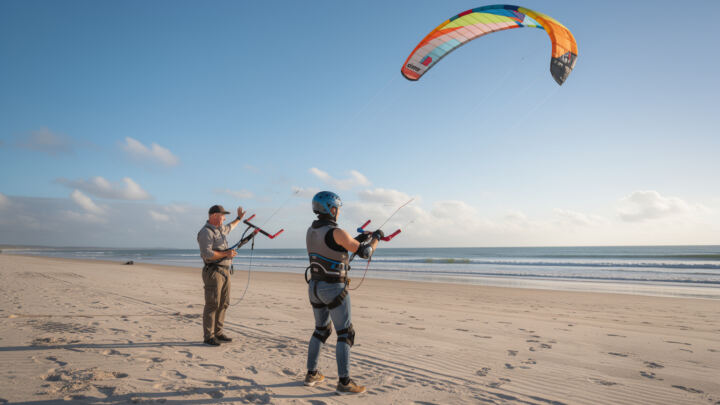
Early on, Mia avoids solo launches. Assisted launching gives you a second set of eyes on line routing, bridle snags, and wind lulls. Her buddy holds the kite, Mia signals “ready,” and they do a slow, deliberate release. If anything feels off, she gives the abort signal and her buddy holds the kite down.
When she eventually practices a self-launch (only in wide open space), she keeps the kite positioned for minimal power and ensures the area downwind is empty. She also commits to a simple rule: if the kite starts to surge during launch, she steers it down and kills the attempt rather than “saving it” mid-air.
Drills that create control fast (and keep your ego quiet)
Mia uses drills that isolate one skill at a time. That’s what makes progress feel almost unfairly fast.
- 🎯 Edge-hold drill: park the kite near the window edge for 20–30 seconds without drifting
- 🔁 Slow figure-eights: keep constant speed, avoid sudden dives
- 🧭 “Clock positions”: move the kite to 10, 11, 12, 1, 2 o’clock on command
- 🚶 Walk-toward drill: step toward the kite to reduce power when it loads up
- 🛑 Controlled drop: bring the kite down to the edge and set it gently, no slam
She’s especially obsessed with the walk-toward drill, because it teaches a body response that reduces tension without panic. In gusts, people tend to lean back and pull harder, which increases load. Stepping forward feels counterintuitive, but it can save you.
Mini story: the first “surprise gust” that didn’t become a disaster
One afternoon the wind ticks up suddenly. Mia feels the kite load, hears the lines sing, and for a split second her brain says, “Hold on!” Instead, she executes the plan: kite up to neutral, step forward, then park it at the edge. Nothing dramatic happens. That’s not luck—that’s practice turning into reflex.
The closing insight of her training block is simple: control is not strength; it’s timing. With launches and steering getting consistent, it’s time to cover the part nobody wants to need—but everyone eventually does: emergency procedures.
Emergency procedures and risk management: what to do when traction kiting goes sideways
Talking about emergency procedures can feel like jinxing yourself, but Mia treats it like learning to swim before boating. If traction kiting has one hard truth, it’s this: when things go wrong, they go wrong quickly. The point of rehearsal is to remove hesitation. You want your hands to do the right thing while your brain catches up.
Mia practices three “tiers” of response: depower, release, and secure. Depower is what you do when you still have control. Release is for when control is fading or you’re being dragged. Secure is what keeps the kite from re-powering or becoming a hazard to others.
The critical actions (in plain language)
Depower: steer to the edge of the window, raise to neutral if safe, reduce pull using your trim/depower system, and step toward the kite to soften tension. Depower is often enough for small problems like a gust, a stumble, or a wobbly launch.
Release: if you’re being dragged toward danger or the kite is looping, don’t negotiate—activate the quick-release. Mia practices this with zero shame. People sometimes wait because they don’t want to “waste” a launch. That’s how a minor issue becomes a big incident.
Secure: after release, she moves to a safe position, watches the kite, and if conditions allow, approaches carefully from upwind to secure it. If lines are messy or tension remains, she doesn’t grab random sections—she avoids wrapping lines around hands and uses gloves and caution. If entangled, the hook knife is there for a reason.
Common emergencies and what Mia does
Dragging is the classic. If she’s sliding and can’t regain footing within a second or two, she releases. If the kite starts looping, she releases even faster because loops accelerate. If a spectator enters the danger zone mid-session, she lands immediately and resets the area—no debate.
Another underrated scenario is equipment failure: a snapped line or a jammed safety can change how the kite behaves. That’s why Mia regularly inspects wear points and replaces parts early. Saving a few dollars on worn lines is a terrible trade.
Risk management habits that keep sessions fun for years
Mia keeps her progression conservative: she increases power or complexity one variable at a time. New spot? Smaller kite. Stronger wind? Shorter session. New board or skis? Calm conditions. This is how experienced riders stay healthy: they don’t stack “new” on top of “new.”
She also logs sessions—quick notes on wind conditions, kite size, what felt sketchy, what felt great. Patterns show up fast. The insight she ends on is: your best safety tool is the decision to stop early. And once you own that decision, traction kiting stops being scary and starts being addictive—in a good way.
What’s the safest first kite for traction kiting?
For most people, a small trainer kite (often 1.5–3 m) is the safest place to start because it builds kite control with manageable pull. Match size to wind conditions, choose steady wind, and prioritize a kite with a dependable safety system if you’re moving beyond a basic trainer.
How do I know if wind conditions are too gusty for a beginner?
If the wind strength swings a lot within minutes, if you see sudden whitecaps or sand blasting, or if nearby wind readings show a big gust spread (for example, 12 knots average with gusts near 20+), it’s not beginner-friendly. Gusts create unpredictable power spikes, which is where many early mistakes happen.
What safety gear is non-negotiable?
Helmet, gloves, and a hook knife are strong basics, plus a quick-release you can activate instantly and confidently. The most important part is practicing with your release system until it’s automatic, because emergency procedures only work if you can do them under stress.
Can I learn launch techniques by myself?
You can practice some ground handling alone with a small trainer kite in a wide open area, but assisted launching is safer when you’re starting with more powerful kites. A buddy helps spot crossed lines, bridle snags, and poor angles, and can stop a launch before it becomes a problem.
What should I do first if I’m being dragged?
Try to depower by steering to the edge of the window and stepping toward the kite, but if you’re moving toward hazards or losing control, activate your quick-release immediately. Then secure the kite carefully to prevent it from re-powering, and reset only when the area is safe.