En bref
- 🪁 A solid launch guide starts with reading the wind conditions, not with pulling lines.
- ✅ A clean kite setup (bridle, lines, handles/bar) prevents most “mystery” launch failures.
- 🧤 Use safety tips like gloves, clear zones, and a rehearsed release plan—especially with a traction kite.
- 🤝 Assisted launches reduce chaos for bigger wings and first sessions in kiteboarding-style gear.
- 🎯 Better kite control comes from tension management, not aggressive steering.
- 🔧 Troubleshooting is faster when you diagnose one variable at a time: wind, angle of attack, line symmetry.
- 📈 A simple practice routine turns this beginner guide into real muscle memory within a few sessions.
On paper, launching a traction kite looks like a quick “clip in and go” moment. In real life, it’s the part of the session where tiny mistakes get loud fast: a half-twist in the lines, a gust bouncing off a dune, a helper who lets go a second early, or that one bridle knot you didn’t notice because you were hyped. The good news? Launching isn’t magic. It’s a repeatable sequence—more like pre-flight checks than a leap of faith—and once you treat it like a system, your kite flying becomes calmer, cleaner, and way more fun.
This step-by-step approach is built around what actually happens on the beach, field, or snow spot in 2026: crowded launch zones, mixed skill levels, and modern traction designs that generate serious pull. We’ll follow a simple thread with a fictional rider, Maya, who’s learning to launch confidently without relying on luck. Each section is a mini playbook: read the wind, rig clean, launch smart, steer with intention, land safely, and improve fast—without turning every session into a stress test.
How To Launch a Traction Kite Like a Pro: Wind Reading That Actually Works
If your launch goes wrong, people often blame the kite. Most of the time, it’s the wind conditions. A traction kite is basically a wing that converts airflow into pull, so the air is the “engine.” Maya learned this the hard way on her second weekend: she picked a grassy field bordered by trees, and the wind looked steady… until the kite repeatedly stalled and dropped. The trees were creating turbulence, so her kite was flying in messy air.
Start with direction. Face into the wind and feel it on your cheeks and ears. If you’re near obstacles—buildings, dunes, parked vans—assume the airflow is distorted downwind of them. A simple rule: launch with as much open space upwind as possible, and avoid “wind shadows.” If you have to use a spot with obstacles, walk farther out into the open before you even unpack.
Next comes speed. For many beginner-friendly kites, 5 to 15 mph is a comfortable band, but traction models vary a lot. The trick is to match the kite size and design to the day. No anemometer? Watch the environment: flags snapping hard, sand lifting, or tree branches bending are signs the wind may be too punchy for a relaxed first launch. If the wind is light, you’ll need cleaner technique and possibly a larger canopy with a good power-to-weight feel.
Micro-gusts, lulls, and why your kite “suddenly” misbehaves
Wind isn’t steady; it breathes. A lull right at release can cause a nose-down flop. A gust can yank the kite into the power zone before you’re ready. Maya’s fix was to pause for 60 seconds and just observe: does the wind come in pulses? Are there rotating swirls near the ground? That minute of patience prevents ten minutes of untangling.
Also, pick your launch lane. You want a clear downwind area because traction kites pull—sometimes like a shopping cart with a jet engine. Keep distance from people, roads, and especially power lines. This isn’t optional. It’s the baseline of safety tips for any serious kite flying session.
In the next part, we’ll get hands-on with kite setup, because even perfect wind can’t save a rigging mistake.
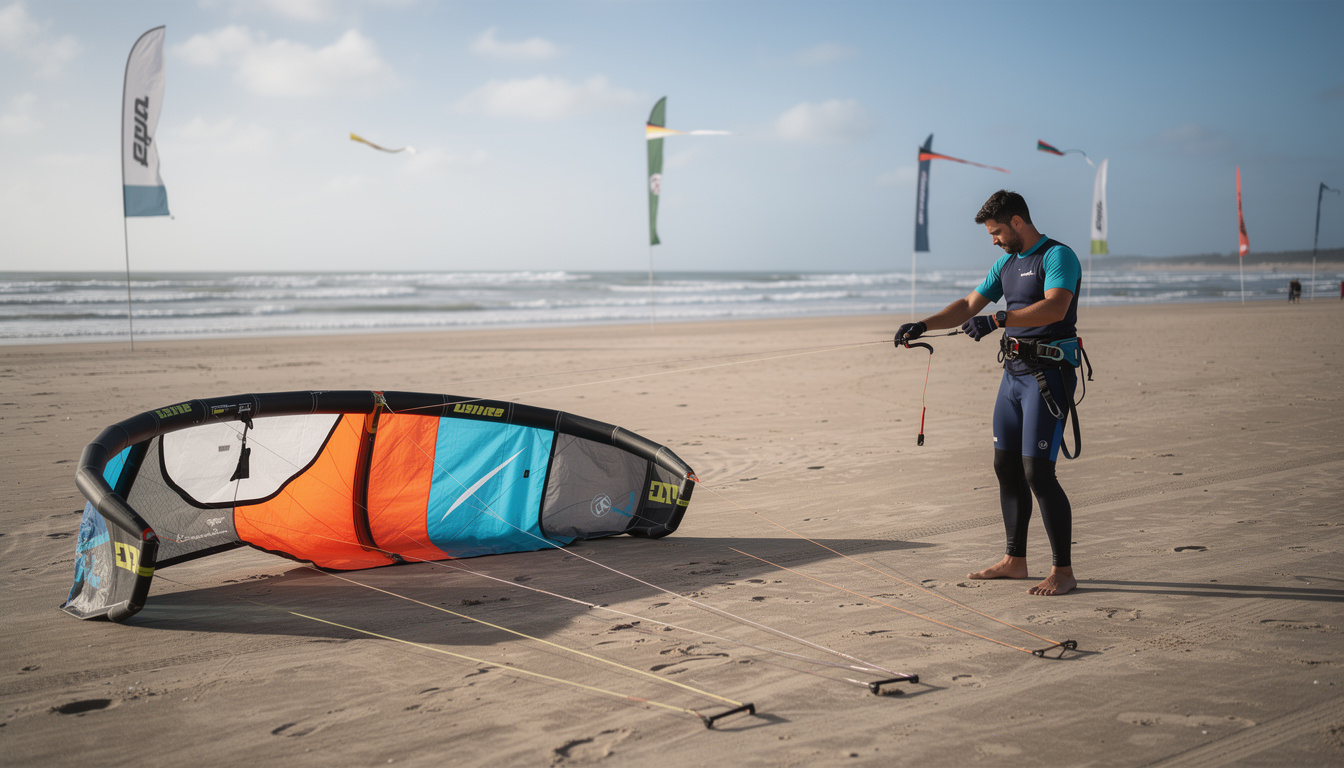
Step-by-step Kite Setup for a Clean Launch: Lines, Bridle, Handles, and Safety Checks
A good launch starts on the ground. Maya now treats rigging like tying climbing knots: slow is smooth, smooth is fast. With a traction kite, small errors scale up because the kite can generate real power even before it’s fully overhead.
Begin by laying the kite out cleanly with the leading edge (or intake side for foils) oriented correctly for the wind. Keep sand, grass, or snow from bunching the fabric. Then sort your lines. This is where most beginners lose time: they walk the lines out while chatting, step over them, and end up with twists that only show up once the kite loads.
Essential gear checklist (and why each item matters)
Gear isn’t about looking legit; it’s about preventing avoidable problems. Gloves stop friction burns when the wind spikes. A winder or reel keeps line tension controlled. An anchor can hold a kite steady during pre-launch checks, but only if used smartly and never as a substitute for awareness.
| Item | Why it helps | Quick check |
|---|---|---|
| 🧤 Gloves | Prevents line burns and improves grip | Any worn palm spots? Replace soon |
| 🧵 Lines (correct strength) | Handles load without snapping | Look for frays, knots, uneven lengths |
| 🌀 Winder/Reel | Stops tangles and keeps tension consistent | Line winds evenly without crossing |
| 🧷 Safety system (QR/leash) | Lets you dump power fast | Practice the motion before launch |
| ⚓ Optional anchor | Holds position during checks in steady wind | Anchor point solid and away from bystanders |
A practical step-by-step rigging flow you can repeat every time
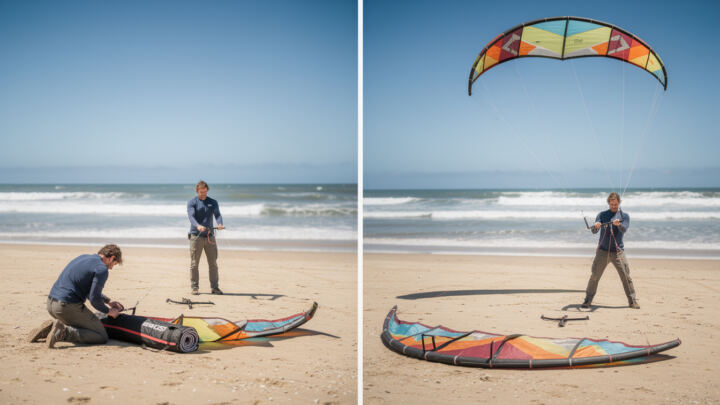
- 🧭 Set the kite down with a clear upwind edge and secure it lightly (sand, weights, or a helper’s hand).
- 🧵 Walk lines straight downwind, keeping them separated and not crossing.
- 🔗 Attach lines to the correct points (color coding helps). Double-check left/right symmetry.
- 🪢 Inspect the bridle: no knots, no wraps around the kite, and correct attachment points.
- 🧰 Test your safety release with zero load. Make sure it’s not jammed by sand.
Here’s the part people skip: do a tension test before launch. Maya gently loads the lines by leaning back a step. If one side tightens first, something is wrong—twist, mis-clip, or uneven line length. Fix it now, not when the kite is already trying to sprint downwind.
Next up: the actual launch methods—self-launch versus assisted—and how to choose without ego getting in the way.
Seeing the sequence helps a lot, especially for first-time four-line users.
Launching Techniques: Self-Launch vs Assisted Launch (And When Each Makes Sense)
This is the moment your launch guide earns its keep. Launching is basically controlled inflation and controlled commitment. You’re trying to get the kite into clean airflow with the right angle of attack, while keeping tension steady and your body ready to move.
Self-launch step-by-step for calmer days and smaller kites
Self-launch works best when the wind is steady and the kite isn’t oversized for the conditions. Position the kite so the wind can catch it gradually. Hold the bridle point (or handles/bar set to neutral) and feed line out in a controlled way. Walk backward to create tension, not yanks. Slack is the enemy because it lets the kite fold or spin, then load unpredictably when the line snaps tight again.
Maya’s “no drama” rule: if the kite doesn’t rise within a few seconds, she resets instead of forcing it. Forcing usually means pulling harder, which is how kites jump into the power zone.
Assisted launch step-by-step for bigger traction kites and crowded spots
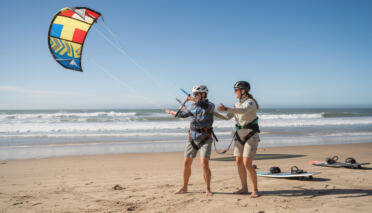
Assisted launch is underrated. A helper can hold the kite correctly, stop it from tumbling, and release on signal. The key is communication. Agree on simple signals: thumbs up for “ready,” a clear shout for “release,” and a stop signal if anything looks off.
Here’s a reliable assisted sequence:
- 🤝 Helper stands upwind holding the kite stable, facing into the wind.
- 🧵 You stand downwind with lines tensioned but not maxed out.
- 🗣️ You confirm: “Lines clear?” Helper confirms: “Clear.”
- 🟢 On your signal, helper releases cleanly and steps away from the lines.
- 🎯 You guide the kite gently to the edge of the window before bringing it higher.
That last bullet is a big deal for traction use and kiteboarding crossover. Keeping the kite at the edge reduces sudden pull. Maya compares it to easing a car off the clutch instead of flooring the gas.
If you want to see what “edge of window control” looks like in motion, a visual demo makes it click.
Once the kite is up, the real skill is staying relaxed while maintaining authority. That’s what we’ll tackle next: kite control that feels precise rather than frantic.
Kite Control After Launch: Tension, Steering Inputs, and Line Length Strategy
After the canopy is airborne, most beginners over-steer. The kite reacts, they panic, then they correct too hard the other way. That’s how you get the classic zig-zag dive. Control is mostly about tension and timing, not strength.
Single-line control: body movement is your steering wheel
With single-line kites, you don’t have left/right inputs, so you steer by shifting your position relative to the wind. Keep steady pull in the line. If the kite sinks, a gentle tug can restore airflow over the sail. Move a few steps left or right to coax direction changes, especially when the wind is slightly angled.
Two-line stunt control: clean inputs, small ranges
Two-line kites respond directly to differential tension. Pull right to turn right, pull left to turn left. Pull both lightly to climb, ease both to descend. Maya’s breakthrough was using “half pulls” instead of full-arm yanks. Smooth inputs reduce stalls and keep the kite predictable for loops or gentle figure-eights.
Four-line traction control: precision, brake, hover, reverse
Four-line traction models unlock advanced moves: hovering, quick stops, even reverse flight. The trick is treating the back lines like brakes. Too much brake and the kite back-stalls. Too little and it surges forward. A neutral stance with tiny finger movements often works better than big handle swings.
Line length matters too. Shorter lines give snappier response and are great for learning. Longer lines allow higher altitude but can amplify turbulence higher up, especially near cliffs or buildings. Maya keeps a “training set” that’s shorter for drills, then switches to standard length once she’s consistent.
Ask yourself mid-flight: is the kite stable because you’re controlling it, or because the wind is doing you a favor? If it’s the second one, you’ll feel it the moment conditions change. That’s why the next section focuses on fixes: diagnosing issues fast, landing safely, and caring for your gear so tomorrow’s launch is easier than today’s.
Troubleshooting, Safe Landing, and Post-Session Care for Traction Kite Reliability
Even with good technique, sessions get weird. A gust shows up. A line wraps. The kite noses in. The goal isn’t perfection; it’s a calm response that keeps people safe and keeps the gear intact.
Common launch and flight problems (and what to do first)
If the kite won’t lift, check the basics before you blame the design: are you truly facing into clean wind, and is the kite angled correctly? Increase tension gradually by stepping back, not by snapping the lines. If it still refuses, inspect the bridle attachment points. A misrouted bridle changes the angle of attack and can make the kite feel “dead.”
If the kite dives hard or drops quickly, look at stability factors. A tail can help, but too much tail weight can drag the kite down. For traction models, uneven line tension is a frequent culprit. Maya once spent 20 minutes fighting a “pull to the left” problem that turned out to be a tiny overhand knot shortening one line. Remove knots, check symmetry, and test again.
Tangles happen. Don’t yank. Lay everything down, walk the lines methodically, and undo one crossing at a time. Gloves matter here, because line friction under load can cut skin fast.
Step-by-step safe landing (the part everyone rushes)
- 🧭 Bring the kite to the edge of the wind window where pull is lower.
- 🧵 Maintain light tension while you walk toward it or reel in smoothly.
- 🛑 For four-line setups, apply gentle brake to settle it down without a slam.
- 🤲 Catch it if you can do so safely, or let it land softly on grass/sand (avoid rocks and hard surfaces).
- 🔒 Secure the kite before disconnecting anything, especially if the wind is still active.
In stronger wind, prioritize the safety system. If things escalate, a clean quick release is better than a “hero save.” That’s not drama; that’s mature kite handling.
Maintenance that makes your next launch easier
Dry the kite before storage if it’s wet. Damp fabric can mildew and weaken coatings. Check spars for hairline cracks and replace damaged pieces early; waiting usually means a break at the worst moment. Store lines without tight knots, and keep the set in a protective sleeve so the bridle doesn’t turn into a spaghetti puzzle.
Maya keeps a simple habit: after every session she does a 2-minute scan—fabric, stitching, bridle, lines, safety. That tiny routine keeps her launches boring in the best way possible.
What wind speed is best for a first traction kite launch?
Aim for steady wind rather than strong wind. Many beginners feel comfortable around 5–15 mph, but match it to your kite size and design. If you see frequent gusts, turbulence near trees, or sand blasting across the ground, pick a calmer time or a safer spot.
Is an assisted launch safer than a self-launch?
Often, yes—especially with larger traction kites or when you’re using kiteboarding-style bars and safety systems. A helper can stabilize the canopy and release on a clear signal, reducing accidental power spikes. Communication and a clear launch lane still matter most.
Why does my kite pull hard to one side right after launch?
It’s usually line asymmetry (unequal lengths, a knot shortening one line, or a mis-attachment) or a bridle snag. Lay the kite down, remove tension, check for twists and knots, confirm left/right connections, then do a gentle tension test before relaunching.
How do I improve kite control quickly as a beginner?
Use shorter lines for practice, keep inputs small, and focus on steady tension. Drill simple patterns like slow figure-eights at the edge of the window before trying loops or dives. Consistency beats intensity for building control.
What should I do if the kite crashes and lines look messy?
Don’t yank. Activate your safety system if needed, then walk toward the kite to reduce load. Lay everything out and untangle systematically one crossing at a time. Check the bridle and line condition before attempting another launch.