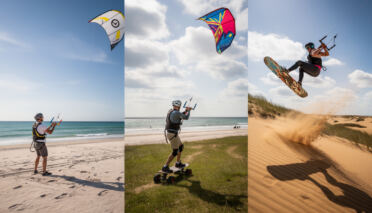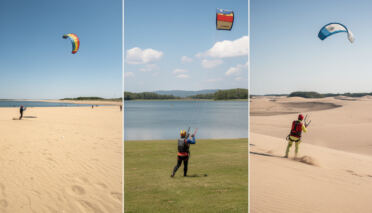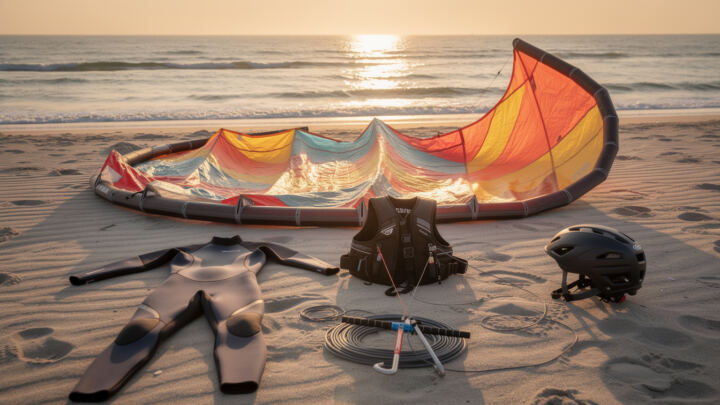
Traction kiting has that “looks easy from the parking lot” vibe: a kite parked at the edge of the wind window, someone gliding along, and a casual wave like nothing could possibly go wrong. Then you try it, the kite surges, your feet forget what friction is, and suddenly you understand why a good kite gear investment plan matters. The tricky part isn’t buying everything at once—it’s buying the right few items first, so your sessions feel controlled instead of chaotic.
This kiteboarding gear guide is built for the moment right after lessons (or a trainer-kite phase) when you want to be independent. We’ll follow Mia—a fictional rider who kites on gusty beaches and occasional shallow water—because her decision-making is exactly what most people face: “Do I rent or buy?”, “What if my spot is light wind?”, “Do I really need safety stuff if I’m not jumping?” and the big one: “What’s the smartest order to purchase beginner kiting equipment?” If you set up your first kit around your spot’s wind range and your body comfort, traction kiting gets way more fun, way faster.
- 🪁 Prioritize a traction kite setup that matches your local wind (lulls AND gusts), not a random “popular size”.
- 💸 Your best early kite gear investment is usually a stable beginner-friendly kite + a trustworthy kite control bar safety system.
- 🧰 Used gear can be smart—if you inspect canopy, seams, bridles, valves, and line wear like you mean it.
- 🪢 A properly fitted kite harness reduces fatigue and makes edging/control feel “automatic”.
- 🪖 kiting safety gear (helmet + impact vest) isn’t “beginner only”—it’s “ride more days per year” gear.
- 🗓️ End-of-season deals (often late summer) can cut costs by 25%–50% on last-year new models.
Traction kiting gear guide: decide what to buy first (and what can wait)
Let’s get brutally practical: if you buy things in the wrong order, you’ll either overspend or end up with gaps that force you back into renting. Mia’s first mistake was thinking a board was the “fun purchase” she should grab first. On her second session, she realized the board didn’t matter much when her borrowed kite felt twitchy in gusts and the quick-release was gritty with sand. The session ended early—not because she lacked courage, but because her setup didn’t feel predictable.
So here’s the simplest way to think about priorities in traction kiting: control beats performance, and repeatability beats “one epic day.” Your first purchases should make it easy to rig safely, manage power, and reset after mistakes. That means focusing on your kite, your control system, and the gear that keeps your body comfortable enough to practice for hours.
A no-drama buying order for beginner kiting equipment
You can absolutely tweak this list depending on whether you ride land, snow, or water more. But for most people building a first real kit, this order avoids the classic money traps.
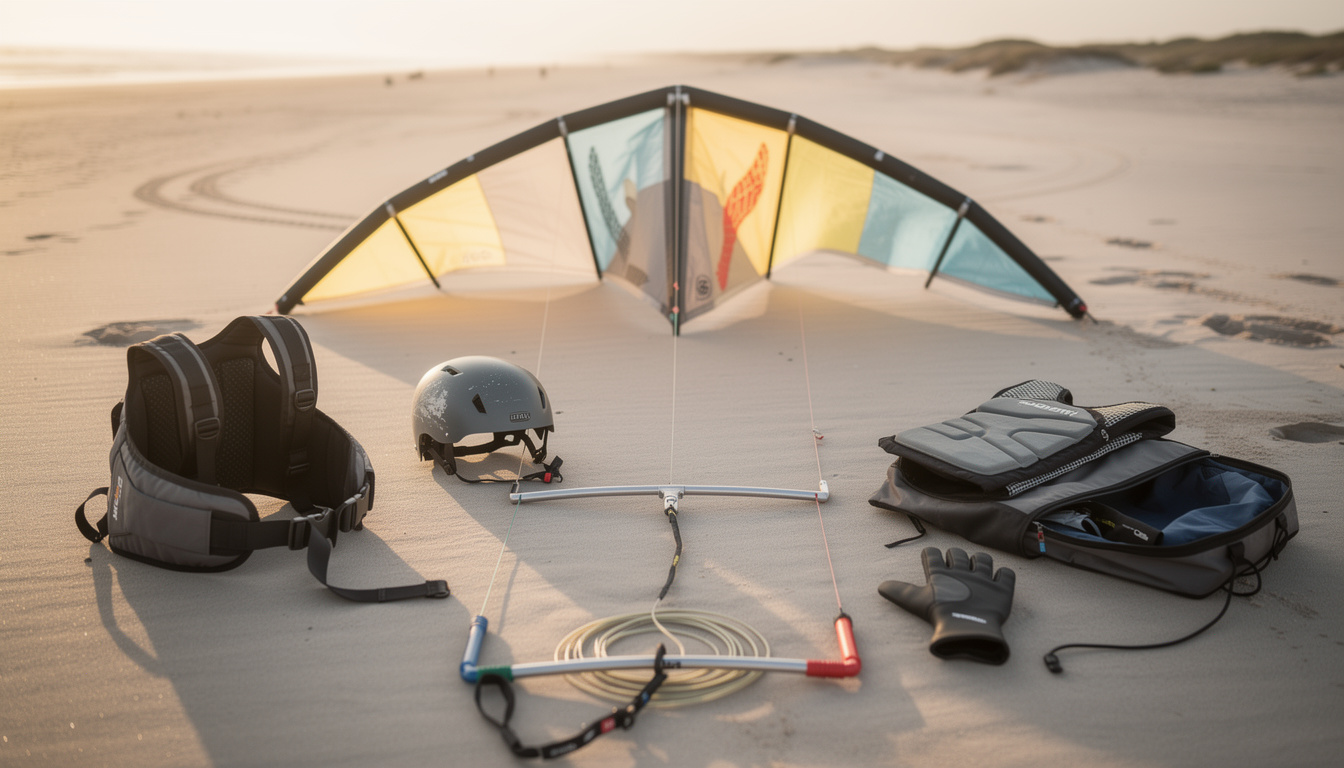
- 🪁 Kite chosen for your spot’s wind range (the “engine”).
- 🧯 Kite control bar + leash with a clean, testable safety release (your “panic button”).
- 🪢 Kite harness that fits under load (your “power management”).
- 🪖 Kiting safety gear: helmet first, then impact vest (your “longevity plan”).
- 🧤 Gloves / wetsuit / layers to extend sessions (your “consistency boosters”).
- 🏄 Board (or landboard/buggy), once you’re sure about where/how you’ll ride most.
Notice what’s missing early: fancy boards, carbon parts, and “pro” upgrades. Those can wait until your technique and local conditions are truly dialed. The insight worth keeping: the best first kit is the one you can use safely in the widest range of normal days at your home spot.
Choose the right traction kite first: size, shape, and wind-range logic that saves money
If traction kiting had a universal rule, it’s this: your local wind is the boss. Mia rides a beach where the forecast says 16 knots, but gusts can punch into the low 20s. When she tested a bigger kite because “bigger equals easier,” she got that classic surprise acceleration—fun for two seconds, stressful for the next ten minutes. She didn’t need more power; she needed more control.
Start by answering two questions before you even look at brand names: Where will you ride most? and What are the usual conditions there? The first one is on you. The second is easy: ask locals, check spot groups, and look at wind history tools. Don’t focus only on the average wind—look at the gusts, because gusts are what load the kite and expose weak decisions.
Delta vs C-shape: the beginner-friendly call
For a first kite, prioritize a shape and design tuned for easy relaunch, predictable depower, and decent upwind ability—basically the stuff that makes practice less chaotic. In many brands’ lineups, that points you toward a delta-style freeride/all-around kite. These tend to feel stable, have broad usable wind ranges, and don’t punish small steering mistakes as much.
On the flip side, classic C-shape kites are often built for technical freestyle/wakestyle. They can feel amazing in the right hands, but they typically demand cleaner technique and can be less forgiving during early progression. If your goal is to stack safe hours and build fundamentals, a more forgiving profile gets you there faster. The insight: choose the kite that makes your worst days manageable, not your best days legendary.
One kite or two? The “quiver” reality
Most regular riders end up with two kites to cover a typical spot: a larger size for lighter days and a smaller one for strong wind. If you can only start with one, many instructors push riders toward the larger option because it’s often easier to keep flying smoothly in marginal wind and can feel less “twitchy.” That said, “larger is safer” only holds if the gusts at your spot don’t routinely push you into being overpowered.
Mia’s compromise was smart: she bought a kite sized for her spot’s most common mid-range days and promised herself she’d skip sessions when the gusts were clearly beyond her comfort. That one choice saved her from the “I bought too big, now I’m scared to use it” trap.
New vs pre-owned vs used: what you gain, what you risk
Buying new is the cleanest story: warranty support (often two years in many markets), known history, and fewer surprises. It’s also the most expensive route, and breaking brand-new gear hurts your soul a little.
“Pre-owned” (current-year or last-season with light use) is the sweet spot if you’re willing to shop carefully. People sell nearly-new kites because they’re upgrading, changing disciplines, or simply not riding enough. Negotiation is common, and you can often land excellent value.
“Used used” (older, patched, or heavily ridden) can be perfect if you’re still unsure about committing or you only ride a few times a year. Just be honest: older gear may demand repairs sooner. The insight: cheap can be smart, but only if you can inspect it properly.
Now that the kite choice is clear, the next make-or-break purchase is the control system—because power without a reliable release is just gambling.
Kite control bar and safety system: the gear that decides whether sessions feel safe
Your kite control bar is your steering wheel, throttle, and emergency exit all at once. People obsess over kite models and then treat the bar like an accessory. Mia did that once—she paired a solid kite with an old bar that had a sticky quick-release and lines with minor fuzzing near wear points. Nothing failed that day, but she spent the entire session thinking, “If this gets weird, will my safety actually work?” That’s not the vibe you want.
For traction kiting, the minimum standard is simple: your quick-release should fire cleanly with one hand, under load, even when your fingers are cold or sandy. Then your leash and flag-out system should do what the brand intended—usually dumping power to a single front line so the kite stops pulling hard.
Compatibility: buy the bar with the kite (when you can)
Beginners often mix brands because they found a deal. It can work, but it also creates weird trimming issues, unequal line lengths, or safety behavior you didn’t expect. Until you’re confident tuning line geometry, it’s typically easier to buy kite + bar from the same brand or at least from a known-compatible setup. It’s not about brand loyalty; it’s about reducing variables.
Line inspection habits that prevent “mystery looping”
Lines are like climbing ropes: they look fine until they don’t. Before launching, Mia does a quick routine: she checks for knots, runs her fingers along high-wear sections, and confirms equal tension. If a kite starts pulling to one side, she doesn’t “ride around it”—she measures and tunes. That’s how you prevent the classic problem where a kite suddenly wants to turn harder one direction.
Used gear checklist: what to inspect before you pay
- 🔍 Trailing edge wear: especially the center area where fatigue shows up first.
- 🧵 Seams: look for separation, sloppy stitching, or odd puckering.
- 🪢 Bridles and pulleys: abrasion, stiff pulley movement, or damaged attachment points.
- 💨 Leaks: pump hard, wait, and listen—small pinholes are fixable; failing valves often mean more valves are next.
- 🧯 Quick-release: test it multiple times; it should be smooth, not “sometimes.”
- 🧶 Lines: frays, nicks, uneven length—replace if questionable.
If you’re curious what this all costs in the real world, here’s a practical snapshot for planning your kiteboarding essentials budget. Prices vary by region, but these ranges are common in Europe-style markets and still make sense in 2026 as ballparks.
| Category | Typical price range | Buy new or used first? | Why it matters |
|---|---|---|---|
| 🪁 Kite + bar (top brands, new) | €1000–€1900 | New if budget allows | ✅ Warranty + known history reduces early headaches |
| 💸 Kite + bar (pre-owned) | €600–€1000 | Often best value | 🔥 Near-new performance without full retail hit |
| 🧰 Kite + bar (well-used) | €200–€600 | Used, but inspect in person | ⚠️ Repairs likely; good for learning if condition is honest |
| 🪢 Kite harness | Used €30+ / New €80–€200 | Try before you buy | 🎯 Fit affects control, comfort, and stamina |
| 🏄 Board | Used €150+ / New up to €1000+ | Used beginner/freeride | 📈 Right size accelerates progression more than “fancy” tech |
| 🧥 Wetsuit | Used €40+ / New €100–€400+ | Don’t go cheapest | 🧠 Warmth keeps reactions sharp and sessions longer |
Once your kite and bar are sorted, the next thing that transforms traction kiting from exhausting to sustainable is the harness—because your arms shouldn’t be doing a full workout every session.
Kite harness investment: waist vs seat, fit tricks, and how comfort improves technique
A kite harness is the quiet hero of your setup. Without one, you’ll muscle the pull through your arms, your posture collapses, and you fatigue fast. With a good harness, you can keep your hands light on the bar, maintain a stable stance, and ride longer—meaning you get more useful practice per session.
Mia started her course in a seat harness, which is common because it stays low and doesn’t ride up as easily. When she switched to a waist harness that actually fit her torso, she felt more mobile and started edging upwind more naturally. The catch? A waist harness that’s the wrong size can climb into your ribs and make you hate life after twenty minutes. So fit is everything.
Seat harness vs waist harness: pick for your reality, not your ego
Seat harnesses tend to stay put because they’re anchored around the hips and legs. That stability can be gold for early sessions, long cruising, or land traction where consistent pull angles matter. Waist harnesses feel freer and can make transitions and body movement easier once you have technique. Both are valid; the “best” choice is the one you’ll happily wear for two hours.
Fit checks you can do in two minutes
- 📏 Tighten it so it’s snug before riding—if you rely on tightening mid-session, it’ll already be uncomfortable.
- 🪝 Check the spreader bar stays centered when you lean back under load.
- 🫁 Make sure you can breathe deeply; rib pressure leads to sloppy riding fast.
- 🔁 Do a few squats and twists—if it pinches on land, it’ll be worse with pull.
Small harness features that make a big difference
Ignore flashy graphics and focus on structure: back support, comfortable edges, and a spreader bar system that matches your riding. Some setups use rope sliders for a smoother side-to-side pull, others use a classic hook. The best move is to test with a kite pulling—not just a fitting room mirror.
When Mia finally stopped adjusting her harness every run, she noticed something interesting: her technique improved without “trying harder.” That’s the harness effect—comfort creates control, and control creates progression. Next up is the layer that keeps the inevitable wipeouts from turning into time off: safety gear.
Kiting safety gear that’s worth buying early: helmet, impact vest, gloves, wetsuit strategy
People love to pretend protective equipment is optional until a gust proves otherwise. The reality is that most injuries don’t happen during big tricks—they happen during normal riding: awkward falls, missed steps during launch, unexpected lulls, or crowd/obstacle mistakes. Buying kiting safety gear early isn’t about fear; it’s about getting more consistent practice because you’re less hesitant and you recover faster from minor mishaps.
Mia used to leave her helmet in the car on “easy days.” Then she watched a competent rider trip during a launch and smack the hard-packed sand. Nothing dramatic, but enough to change her habits permanently. Now her rule is simple: helmet on before the kite goes up. That one habit made her feel calmer, which weirdly made her ride better.
Helmet and impact vest: the boring purchases that keep you kiting
A helmet should fit snugly and stay stable when you shake your head. If it wobbles on the beach, it’ll shift during a crash. Watersports helmets are designed to drain and resist repeated impacts better than random skate lids, so pick something appropriate for your environment.
An impact vest protects ribs and torso and can add flotation on water. It’s especially useful when you’re learning transitions, riding in chop, or practicing anything that increases fall frequency. Think of it as “session insurance”: you’ll commit to drills more easily if your body isn’t bracing for pain.
Gloves, layers, and wetsuits: comfort is a performance feature
Cold hands make everything harder: bar control, safety release operation, line handling, and even decision-making. Gloves reduce rope burn and help you keep a secure grip when the bar is wet. Don’t buy the thickest mitts possible; buy something that keeps dexterity so you can still feel what the kite is doing.
If you’re on water (or even doing wet launches in shallow lagoons), a good wetsuit extends your season and keeps reactions sharp. It’s tempting to go cheap, but the cheapest suit often means shorter sessions and more time “warming up” instead of practicing. Mia learned to choose a suit based on wind chill during rigging, not just water temperature—because setup time is part of the session.
Renting vs buying: a quick reality check
Rentals can make sense when you travel, or when you’ll only kite one or two days and don’t want to transport a full setup. But relying on rentals to “learn” can be stressful because you’re responsible for expensive gear and whatever happens around you. Mia felt that pressure immediately: she was so worried about damaging a rental kite that she avoided practicing the exact drills she needed. Once she bought her own setup, she stopped tiptoeing and started improving.
The final insight for this section: protective gear isn’t a vibe—it’s a strategy for stacking hours, which is how traction kiting actually gets fun.
What should I invest in first for traction kiting: kite, board, or harness?
Start with the kite and control system: a stable beginner-friendly kite matched to your local wind + a reliable kite control bar (especially the quick-release). Next, get a properly fitted kite harness. A board can wait until you’re sure about your main terrain and conditions.
Is buying used beginner kiting equipment actually safe?
Yes—if you inspect it properly. Check trailing edge wear, seams, bridles/pulleys, and inflate the kite to test for leaks. On the bar, test the quick-release repeatedly and inspect lines for frays or cuts. If you can’t inspect in person, stick to trusted shops or verified sellers.
How do I choose kite size for my spot without guessing?
Base your choice on typical wind plus gusts, not just the average forecast number. Ask local riders what sizes they use, review wind history for the spot, and consider your weight and terrain (water vs sand vs grass). Many riders eventually use two kites to cover a normal wind range.
Do I really need kiting safety gear if I’m not jumping?
Yes. Most injuries happen during launches, transitions, unexpected gusts, or simple falls—not during big tricks. A helmet and impact vest reduce risk and make you more willing to practice, which speeds up progression.
When is the best time to buy kiteboarding essentials for a lower price?
End-of-season is often the best window, when new models arrive and shops discount previous-season stock. It’s common to find new gear marked down around 25%–50% depending on availability, and the used market also gets more active as riders upgrade.