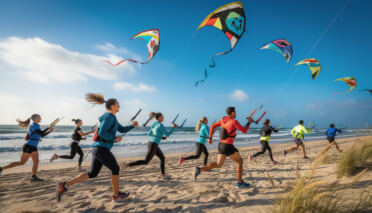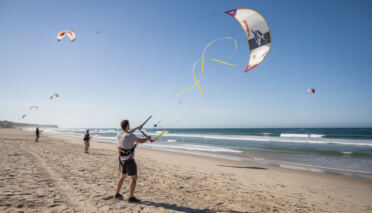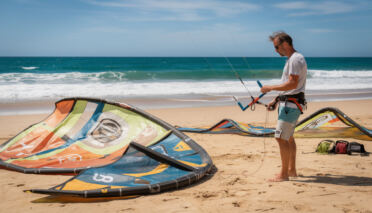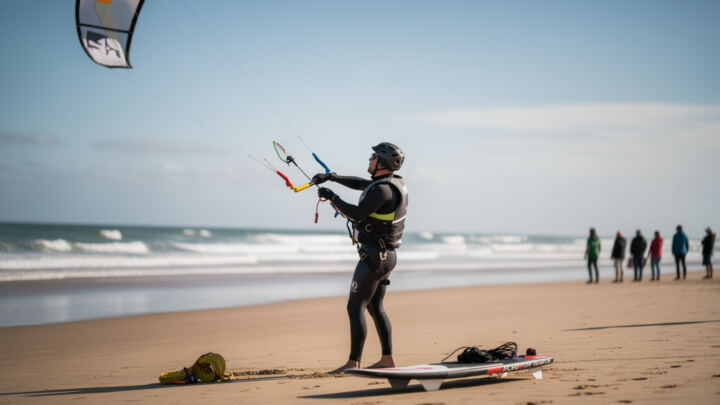
Traction kiting has this sneaky way of looking simple from a distance: a kite, some lines, a wide-open beach, and a rider gliding like they’ve got a secret deal with the wind. Up close, it’s more like managing a compact engine you can’t turn off—one gust can flip “easy cruise” into “why am I sprinting sideways?” in a heartbeat. That’s why the best riders aren’t just brave; they’re consistent. They treat rider safety as part of the sport’s fun, not a buzzkill, and they build habits that still work when their pulse spikes.
This is a practical, real-world take on traction kiting safety tips that hold up across sand, snow, and hard-packed dirt. We’ll follow Mia—a fictional beginner who’s determined to progress fast by not getting injured—as she learns the stuff that keeps sessions smooth: wind awareness that goes beyond “it feels windy,” kite control drills that don’t rely on luck, and an emergency release routine that’s automatic. It’s not about being fearless. It’s about being ready, so “safe riding” becomes your default instead of something you remember after a close call.
- 🧭 Wind awareness first: choose stable weather conditions, clean airflow, and a big downwind buffer.
- 🪖 Protective gear that matters: helmets, gloves, hook knife, and a quick-release you can trigger under stress.
- 🧰 Build a no-drama setup ritual: lines straight, connections verified, release tested, area cleared.
- 🤝 Assisted launches beat solo: a buddy catches mistakes before they turn into kite loops.
- 🆘 Rehearse the emergency release on land until it feels boring—boring is good.
- 🚦 Progress without ego: smaller kite, shorter sessions, more resets, fewer surprises.
Traction kiting safety tips start with mindset: build a “safety bubble” that travels with you
If traction kiting had a cheat code, it would be this: decide what kind of rider you want to be before you even unroll your lines. Mia’s rule is blunt—she wants to progress quickly by staying uninjured. Sounds obvious, but it changes everything. It turns “Should I try anyway?” into “Do I have enough margin to be wrong?” That margin is what keeps small mistakes from becoming ambulance-level problems.
A lot of early incidents aren’t freak accidents; they’re stacks of tiny choices. Launching in a cramped spot, trusting a gusty forecast because the beach is empty, skipping gloves because it’s “just practice,” or letting spectators hang around downwind because you don’t want to be awkward. In traction kiting, awkward conversations are cheaper than medical bills. Mia learns to treat space, people, and a plan as a single package: her personal safety bubble.
Space is a tool, not a luxury
Mia picks a location like she’s planning for failure, not success. She asks one question: “If I get dragged 20 meters, what do I hit?” If the answer is rocks, waterline debris, a road, a fence, a parked car, or (worst) people, she moves. She wants a wide, boring downwind area—flat sand, open field, or soft snow—because it buys her time to depower or use her emergency release.
She also learns that “wide” isn’t the same as “clean.” A beach can look open but still have wind turbulence from dunes, buildings, or tree lines. That messy airflow creates sudden surges and lulls, which can break your rhythm right when you’re learning kite control. Her safety bubble includes airflow, not just square meters.
People management is part of rider safety
Most spectators don’t understand the danger zone. They see a kite and drift closer like it’s a street performer. Mia keeps it simple: nobody downwind, nobody near the lines, nobody stepping over the bridle. If someone walks into the area, she lands the kite. No debate. No “Just a second.” That’s not being dramatic; it’s how you protect others and protect the sport’s reputation.
She uses one clear script: “Hey, for safety, could you stay behind me and away from the lines?” Almost everyone cooperates when you sound calm and confident. And if they don’t? She packs down. That’s what safe riding looks like in real life.
Have an abort plan before the kite moves
Mia’s best habit is deciding what she’ll do if the launch feels wrong. She doesn’t wait to “see how it goes.” If the kite tugs unexpectedly, if she sees a line snag, or if a gust slams in during setup, she calls it and resets. The trick is removing hesitation. When you’re mid-launch, you don’t have spare attention for negotiations with yourself.
Her takeaway after a few sessions is simple: rider safety is proactive, not reactive. Next up, she builds the skill that makes all of this work—reading wind like a local, not like an optimist.
Wind awareness and weather conditions: how to read the sky before it reads you
Mia expects her first big challenge to be steering. Turns out, it’s wind awareness. Traction kiting is a conversation with moving air, and the wind doesn’t care that you’re new. She learns to stop calling it “windy” and start describing it: steady or gusty, clean or turbulent, increasing or fading, and—crucially—predictable or sketchy.
Her rule is to check two sources before rigging: a forecast model and a nearby real-time reading (a local station, beach anemometer, or reliable spot report). Forecasts tell the story; real-time sensors tell the truth right now. If the model says 12–16 knots but the meter shows gusts punching higher, she trusts the meter. Gust spread is the danger, not just average wind.
Beginner-friendly wind feels boring (and that’s perfect)
For learning kite control, Mia looks for steady breeze with small swings. Smooth wind gives you time to think: you can practice edging the window, gentle turns, and controlled power strokes without getting slapped by surprise acceleration. Gusty wind forces you into constant reaction mode, which is where beginners tend to overcorrect and pull too hard.
She also avoids “weird days” that experienced riders might tolerate: fast-moving fronts, unstable direction shifts, and stormy-looking cloud build-ups. In 2026, with better consumer forecasts and radar apps than ever, there’s no excuse for getting surprised by an obvious squall line. Her phone isn’t just for filming—it’s for staying off the injury list.
Spot choice: obstacles turn decent wind into chaos
Mia learns about rotor the hard way—standing near a dune line, she feels the wind pulse on her face. The kite reacts even more dramatically: surging, stalling, then surging again. That’s turbulence from wind flowing over and behind obstacles. Buildings, cliffs, trees, even parked vans can create dirty wind that makes a kite feel “possessed.”
Her filter becomes practical: if the wind feels inconsistent while she’s standing still, the kite will amplify it. She walks upwind and away from obstacles until the airflow steadies. It’s not superstition—it’s aerodynamics you can feel with your skin.
Conservative wind-to-kite sizing (the ego-free version)
Most beginner mistakes come down to “too much kite.” It’s tempting to rig bigger because you want speed, but speed is meaningless if you can’t stop. Mia uses a conservative reference to pick her kite, and she treats it as a maximum comfort guide, not a challenge. When in doubt, she downsizes or shortens the session.
| 🌬️ Wind (knots) | 🪁 Beginner kite size | 🎯 Safer session goal | ⚠️ Red flags |
|---|---|---|---|
| 6–10 | 1.5–2 m trainer | Window edges, gentle turns | 🧊 Frequent stalls = too light, not worth forcing |
| 10–16 | 2–3 m trainer / small traction kite | Controlled pulls, walking drills | 💥 Gust spread > 6 knots = spicy for beginners |
| 16–22 | Downsize or skip solo | Coaching + huge open area | 🏜️ Sand blasting, rapid shifts, “hanging on” feeling |
| 22+ | Not beginner conditions | Pack up and learn by watching | 🧨 “Just one run” thoughts = do not listen |
The insight Mia writes down after a couple of smart “nope” decisions: your best session is sometimes the one you don’t ride. With weather dialed, she moves on to the next safety layer: gear and a setup routine that catches mistakes early.
Want a visual refresher on reading the wind window and basic handling? This kind of video search is a good place to start before your next session.
Protective gear and pre-flight checks: build a setup routine that prevents dumb injuries
Mia notices something funny at the beach: the most confident riders are often the most methodical. Not because they’re nervous—because they’re experienced enough to respect how fast things can go sideways. She starts treating protective gear as a system, not a shopping list. Each item covers a specific failure mode, and together they reduce consequences when mistakes happen.
Her baseline is simple: helmets, gloves, a hook knife, and a release system she can trigger instantly. She also learns to value “small” gear choices, like sunglasses that won’t fly off, or footwear that gives traction when she has to step toward the kite to depower. Little things matter when you’re suddenly moving faster than planned.
Non-negotiable rider safety gear (and why it’s not optional)
Helmets aren’t just for high-speed crashes. A short drag into hard sand or ice can be enough to cause a head injury. Mia picks a helmet designed for action sports with proper coverage and a snug fit. It’s not a fashion statement; it’s a brain protector.
Gloves stop line burns, which can happen in a blink if you grab lines during a fumble. That matters because pain makes people do irrational things—like letting go suddenly or twisting awkwardly. The hook knife is for rare but serious entanglement scenarios. If a line wraps around you under load, you don’t want to “think creatively.” You want a clean cut option.
The quick-release you can find blindfolded
Mia’s most important “skill item” is her emergency release. She practices finding it with her eyes closed, standing up, kneeling, and with her body rotated. Stress makes simple actions feel weirdly complicated, and traction kiting emergencies don’t arrive with a countdown.
She also practices what happens after releasing: keeping distance, watching how the kite settles, and approaching from upwind when it’s safe. The point is to avoid a second surprise when the kite re-powers in a gust. Her personal standard is strict: if she can’t release instantly, she doesn’t launch.
A repeatable pre-flight routine (boring on purpose)
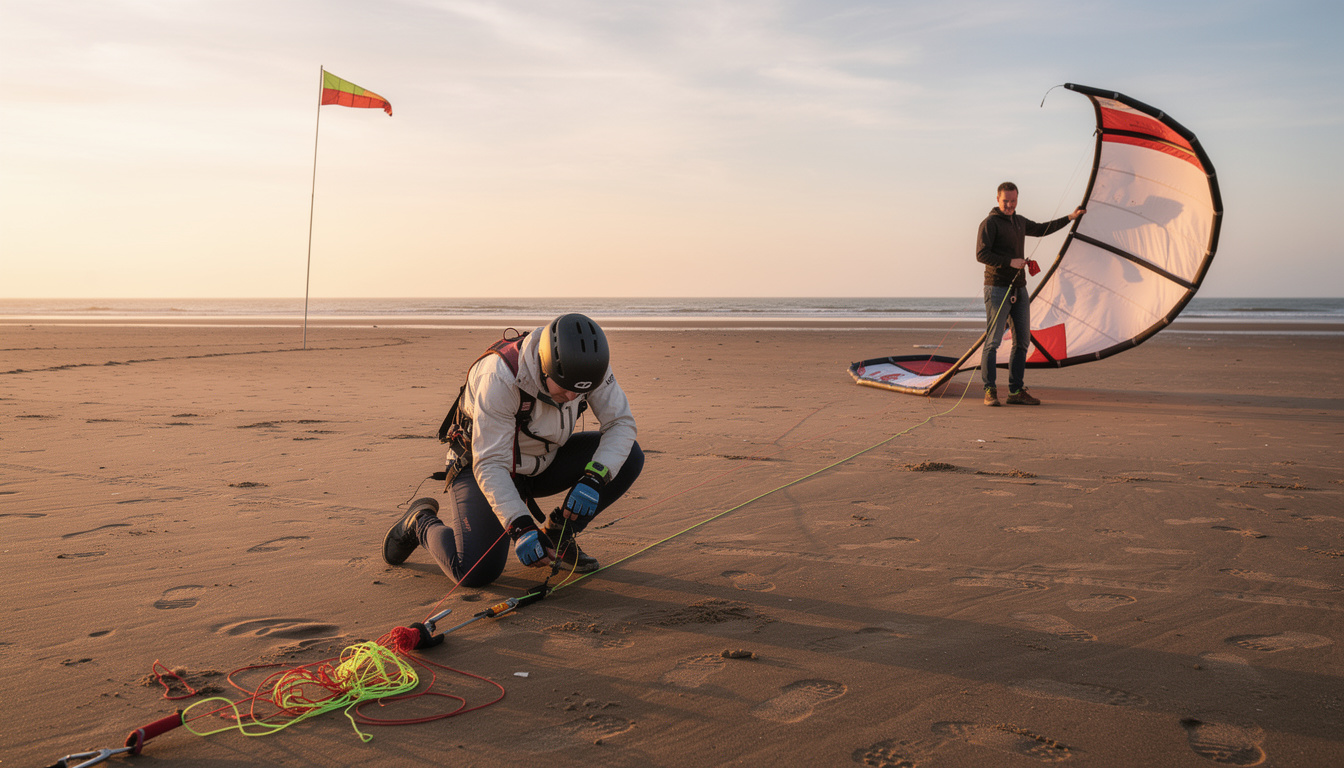
Even perfect weather conditions won’t save sloppy rigging. Mia adopts a ritual: lay out, untwist, verify, test. Same order every time. If someone talks to her mid-rig, she pauses and resumes from the last confirmed step, not from memory. That’s how you avoid the classic “I think I checked it” problem.
- 🧭 Check wind awareness: direction stable, gusts reasonable, no storm build-up.
- 🪖 Gear check: helmets on, gloves on, hook knife reachable.
- 🪢 Lines straight: no knots, no wraps, bridle free, nothing snagged.
- 🔗 Connections verified: correct left/right, each attachment tug-checked.
- 🧨 Test the emergency release: trigger and reset (low tension, controlled).
- 🚦 Clear the zone: big downwind buffer, no bystanders, no pets, no surprises.
- 🤝 Buddy brief: agree on launch/abort/land signals.
Case study: the “one crossed line” near-miss
On Mia’s third session, she chats while walking out her lines. Everything looks fine until her buddy notices the bar orientation is slightly off. They stop, re-walk the lines, and find one crossed steering line—exactly the kind of mistake that can trigger a hard loop right after launch.
That near-miss becomes her favorite lesson: the routine is what saves you when your attention slips. With gear and checks locked in, she’s ready for the part everyone wants to rush: launching, landing, and building control without getting yanked.
If you want to see what a clean pre-flight check looks like in practice, this search will pull up solid step-by-step walkthroughs.
Kite control and launch/landing technique: safer skills that scale with your confidence
Mia structures her sessions like training, not like chaos. That’s the secret. Random flying creates random outcomes. A simple plan builds repeatability, and repeatability is what makes safe riding feel natural. She starts every session with low-power handling, then adds complexity only if everything feels calm and predictable.
She also learns a counterintuitive truth: strength doesn’t equal control. Timing does. When the kite surges, pulling harder usually makes the pull worse. She trains herself to soften inputs, step toward the kite to reduce line tension, and steer back to neutral rather than trying to “fight” the wind.
Assisted launches: the beginner superpower
Solo launches look cool, but they remove a critical safety layer: another set of eyes. Mia sticks with assisted launches until her setup and reactions are consistent. Her buddy holds the kite, she does a final scan (lines clear, zone clear), then signals a slow release. If anything feels off—kite tugging weird, bridle snag, gust slamming in—she aborts immediately and the buddy pins the kite down.
That “abort without shame” habit is huge. Beginners often try to save a sketchy launch because they don’t want to look timid. Mia decides she’d rather look cautious than get dragged across a parking lot.
Landing cleanly is part of rider safety (not an afterthought)
Landings are where people get lazy: tired arms, end-of-session excitement, friends chatting. Mia treats landing as seriously as launch. Assisted landings make it predictable—her buddy approaches from the correct side, she parks the kite at the edge, and they secure it immediately so it can’t flip and re-power.
When she does a self-landing drill (only in wide open space), she keeps it slow and keeps her body positioned so she can step forward if the kite loads up. “Slow is smooth” isn’t a cliché here—it’s physics.
Drills that build kite control fast (without drama)
Mia focuses on drills that isolate one skill at a time. She measures progress by consistency, not by speed. That mindset keeps her learning curve steep and her injury risk low.
- 🎯 Edge-hold: park the kite near the window edge for 20–30 seconds without drifting.
- 🔁 Slow figure-eights: constant speed, no sudden dives through the power zone.
- 🕰️ Clock calls: move to 10, 11, 12, 1, 2 o’clock on command.
- 🚶 Step-in depower: when it loads up, step toward the kite instead of leaning back.
- 🛬 Controlled set-down: bring it down to the edge and place it gently, no slam.
Mini moment: the gust that didn’t become a story
One afternoon the breeze spikes. Mia hears the lines sing and feels the pull increase. Old instincts say “lean back and hold on.” Instead, she runs the script: kite to neutral, step forward to soften tension, then park it at the edge. Nothing dramatic happens, which is exactly the point.
Her end-of-session insight is the one that keeps showing up in good riders: control is a habit you practice when nothing is going wrong. Next comes the stuff nobody wants to need—but everybody should rehearse.
Emergency release, risk management, and what to do when traction kiting goes sideways
Talking about emergencies doesn’t jinx your session. It makes you less likely to have one. Mia treats emergency practice like learning to swim before going on a boat: you hope you never need it, but you’d be silly not to prepare. In traction kiting, problems escalate fast because wind power doesn’t politely pause while you think.
She organizes her response into three tiers: depower, release, secure. The key is knowing when to stop trying to “fix it” and switch to the next tier. Hesitation is the enemy. She wants the decision to feel automatic.
Tier 1: Depower before you panic
Depower is for moments when you still have some control: a wobble during launch, an unexpected tug, or a small gust. Mia steers toward the window edge, eases inputs, and steps toward the kite to reduce line tension. If her setup has trim or depower adjustment, she uses it early rather than waiting until she’s overloaded.
This is where kite control drills pay off. When you’ve practiced neutral positioning a hundred times, your hands do it without drama. The wind might be stronger, but your response is smoother.
Tier 2: Emergency release when control is fading
If Mia is being dragged, if the kite loops, or if she’s moving toward hazards, she triggers the emergency release immediately. No negotiation. Beginners sometimes delay because they don’t want to “waste” a run. That’s how minor trouble turns into major injury.
She also respects a harsh truth: you might only have one good second to make the right choice. That’s why she practices the release on land until it feels boring. Under stress, boring muscle memory beats clever ideas.
Tier 3: Secure the kite so it doesn’t re-power
After releasing, Mia prioritizes everyone’s safety, not her gear’s dignity. She keeps distance, watches how the kite settles, and approaches from upwind if it’s stable. She avoids grabbing random lines or wrapping anything around her hands. If there’s entanglement risk, gloves and the hook knife exist for a reason.
She also learns that “secure” includes other people. If someone is near the lines, she shouts a clear warning and tells them to stay back. A flapping kite can look harmless until a gust loads the lines again.
Risk management: don’t stack “new” on top of “new”
One of Mia’s smartest habits is progression discipline. New spot? Smaller kite. Stronger wind day? Shorter session. New board or skis? Calm conditions only. She avoids stacking variables because stacked variables create confusing failures. When something goes wrong, you want to know why.
She also keeps a simple session log: spot, wind range, kite size, what felt sketchy, what felt great. Patterns show up quickly—like which locations get turbulent in certain directions, or how her comfort changes with gust spread. Her closing insight for this section: the decision to stop early is a skill, not a mood.
What’s the safest first kite for traction kiting?
For most beginners, a small trainer kite (often around 1.5–3 m) is the safest starting point because it builds kite control with manageable pull. Match the size to real weather conditions, and only move up in power once your launches, landings, and emergency release practice are consistent.
How do I know if weather conditions are too gusty for a beginner?
If the wind strength swings a lot within minutes, if you see sand blasting along the beach or sudden whitecaps, or if local readings show a big gust spread (for example, a low-teens average with gusts near 20+), it’s not beginner-friendly. Gusts create unpredictable power spikes, which is where many early mistakes happen.
Which protective gear is non-negotiable for rider safety?
Helmets and gloves are strong basics, plus a hook knife and a quick-release you can activate instantly and confidently. The gear only works if you practice with it—especially the emergency release—until you can do it under stress without thinking.
Can I learn launch techniques by myself?
You can do basic ground handling alone with a small trainer kite in a huge open area, but assisted launching is safer when you step up to more powerful traction kites. A buddy can spot crossed lines, bridle snags, and bad angles, and can stop a launch before it becomes a problem.
What should I do first if I’m being dragged?
Try to depower by steering to the edge of the window and stepping toward the kite, but if you’re moving toward hazards or losing control, activate your emergency release immediately. Then secure the kite carefully so it doesn’t re-power, and only reset when the area is clear and safe.