On a traction kiting day, the wind is basically the boss. It decides whether you’ll be cruising smoothly, sweating through sketchy gusts, or standing around wondering why your kite won’t stay up. And the tricky part is that “windy” isn’t one thing: wind speed can look fine on an app while the beach feels chaotic because of turbulence, wind shear, or the way the terrain funnels airflow. The more traction kiting you do, the more you notice how wind has personality—steady and cooperative one minute, then punchy and weird the next.
This is why riders who progress fast aren’t always the strongest athletes; they’re the ones who get obsessed with reading the sky, the sand, the trees, and their own kite. In 2026, we’ve got better wind forecast tools than ever—high-resolution models, live sensors, even community reports—but there’s still no substitute for understanding the mechanics: how lift builds in the wind window, why wind direction changes everything, and what “gusts” actually mean when you’re hooked into real pull. Get those right, and you’re not just safer—you’re having way more fun.
En bref
- 🌬️ Wind speed alone doesn’t tell the whole story—stability matters just as much.
- 🧭 Wind direction determines whether your spot is smooth, choppy, or straight-up dangerous.
- 💥 Gusts are the reason “average wind” can be a trap; learn to read the spread.
- 🎯 The wind window is your power map: center = maximum pull, edges = lighter load.
- 🏖️ Turbulence and obstacles (dunes, trees, buildings) create sneaky lulls and spikes.
- 📉 Wind shear can make the kite feel different at 20 m up than at ground level.
- 🪖 Real kiting safety starts before launch: gear, space, and a plan to stop the kite fast.
Wind Speed for Traction Kiting: What the Numbers Really Mean (and What They Hide)
Let’s talk wind speed the way traction kiters actually experience it: not as a clean number, but as a range that hits your body through the lines. A forecast that says “18 km/h” can feel mellow if it’s steady, or brutal if it’s pulsing 12–26 with sharp gusts. For traction kiting—especially buggying or landboarding—that spread matters because pull ramps up fast with wind. A small change in speed can feel like a big change in load.
A practical way to frame it is by “what it enables.” Light wind sessions are about kite handling and finesse: keeping the canopy pressurized, generating apparent wind with movement, and working the kite without yanking yourself around. Moderate wind is where most people learn best: enough pressure for clean feedback, but not so much that mistakes turn into emergency situations. Strong wind is where the gear choices get ruthless, because a kite that felt fun yesterday can become a problem today.
Wind ranges that match real sessions (with a safety-first vibe)
These bands aren’t laws, but they line up with what many kiters experience across common traction kite sizes. Your weight, your kite type (foil vs framed), and your surface (hard sand vs grass) will shift things. Still, they’re a solid sanity check before you even unroll lines.
| 💨 Wind band | 📏 Typical feel | 🪁 Kite sizing logic | ⚠️ Risk note |
|---|---|---|---|
| 5–11 km/h 🌱 | Soft pull, easy to walk with | Bigger kites tend to help; light materials matter | Low danger, but launching/landing can be fiddly |
| 13–24 km/h 🙂 | Clean traction, predictable steering | Mid-size is usually the sweet spot | Ideal learning window if space is huge |
| 26–40 km/h 💪 | Fast, edgy, mistakes get expensive | Smaller kites; strong braking control | High risk of being dragged or lofted |
| 42+ km/h 🚫 | Overpower territory | Most riders should stand down | Not a “challenge,” it’s a rescue waiting to happen |
The “bigger is better” myth (and why the smallest kite can be the fastest)
New traction kiters often assume a bigger canopy equals more fun. In reality, bigger often equals “harder to manage,” especially when the wind picks up. Many experienced riders keep a quiver ranging from small to large; it’s not unusual to see someone’s most-used kite sitting around the middle of their range, with the biggest one collecting dust.
Here’s a concrete scenario. A rider—let’s call him Sam—has a set from 2 m to 9 m. On a strong wind day, his 2 m kite can generate crisp acceleration and controllable power. The 9 m might technically pull harder, but it can also become sluggish to depower and exhausting to correct during gusty spikes. Speed isn’t just raw pull; it’s how precisely you can place the kite and keep it in the efficient part of the window. The insight: control is performance, not the other way around.
Wind Direction and Spot Choice: The Difference Between a Fun Session and a Bad Story
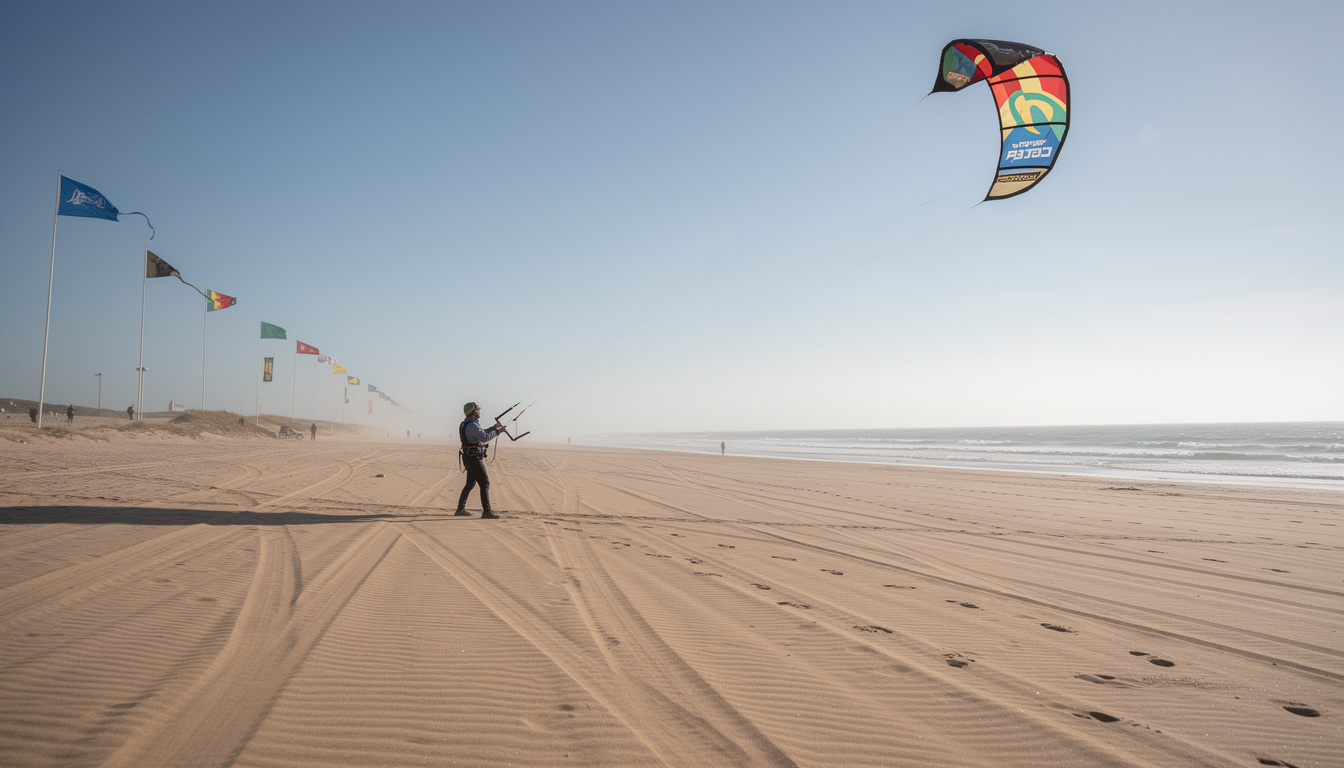
Wind direction is the part beginners underestimate the most, because it doesn’t look dramatic in an app. Yet it decides whether the airflow arriving at your kite is smooth or scrambled. An onshore breeze at a wide beach might be friendly, while the same speed cross-onshore at a spot with dunes and parking lots can be a mess of turbulence. For traction kiting on land, direction also determines your safe downwind area—the space you’ll slide into if something goes wrong.
A “perfect” direction depends on your terrain and your discipline. Buggy riders often like clean cross winds that let them build speed along a long, open stretch. Landboarders may prefer slightly different angles depending on how they plan to ride and stop. Recreational flyers can tolerate more directions, but traction power changes the consequences. If you’re getting pulled, you need a runway of emptiness downwind—no roads, no rocks, no people, no fences.
Reading the terrain: how obstacles create turbulence
Wind doesn’t travel like a flat sheet. It bends, accelerates, and breaks up when it hits dunes, trees, buildings, or even a line of parked cars. That broken-up flow is turbulence, and it’s one reason your kite can surge, stall, or fold even when the forecast looks steady. The closer you are to obstacles, the more “dirty air” you’ll feel, especially low to the ground.
Sam learned this the hard way at a popular park. The wind was a comfortable mid-range number, but it was blowing over a row of tall pines. Every time his kite climbed above a certain height, it felt solid; when he flew lower to practice handling, it started doing weird luffs and sudden yanks. Nothing was “wrong” with the kite—he was flying in a turbulence zone. The takeaway: pick space first, then fly.
Wind shear: why the kite can feel stronger up high
Wind shear is the change in wind speed and sometimes direction with height. On some days, the air at head level feels mild, but the kite—20 to 30 meters up—catches stronger flow. That can lead to a classic trap: you launch thinking it’s fine, then the kite climbs and suddenly loads up with way more pull than expected. This is also why surface indicators (like grass movement) must be combined with how the kite behaves once it’s airborne.
When shear is present, smart kiters keep the first minutes conservative: kite low, small movements, check braking authority, and be ready to land and resize. The insight: the wind you feel isn’t always the wind your kite feels.
To make all this more practical, it helps to translate direction into a quick spot checklist.
- 🧭 Is the wind direction giving you a huge clear downwind buffer?
- 🏠 Are there buildings/trees upwind that could inject turbulence?
- 🌊 If you’re near water, is the wind crossing a warm/cool boundary that could amplify gusts?
- 🚧 Are there “hard consequences” downwind (roads, rocks, crowds)? If yes, don’t rig.
The next piece is where the theory turns into hands-on control: the wind window.
Want a visual refresher before we go deeper? This search usually pulls up solid demos:
The Wind Window Explained for Traction Kiting: Where Lift Lives (and Where Kites Fall Out)
The wind window is one of those concepts that feels abstract until you feel it in your arms. Imagine a big invisible dome of air in front of you when you stand with your back to the wind. Your lines define the radius of that dome. Anywhere your kite sits inside that space, it can generate pull—yet the amount of lift and traction changes massively depending on where it is.
Near the center of the window (straight downwind), the kite sees the strongest, cleanest flow and produces maximum power. Near the edges (far left or right), the kite is at a sharper angle to the wind, so the pull drops off. That’s why “parking” a kite near the edge is a classic way to rest, reset, or teach someone without them getting yanked across the field.
Power management: using the edges like a volume knob
A lot of beginners try to solve everything with brute force: pulling harder on the brakes, leaning back, or fighting the kite. The better move is usually positional. If you want less pull, steer toward the edge and slow your inputs. If you want more traction for a start, fly a smooth dive through the center and then climb out to manage speed.
Sam practiced this with a simple drill: set the kite at the right edge, step forward to create a bit of line tension, then gently fly it up and down along the edge without crossing into the high-power center. That gave him muscle memory for “low drama control.” After a week, his launches got calmer and his landings stopped being wrestling matches. The insight: you don’t tame power—you place it.
Why kites fold or drop: leaving the wind window
If you try to fly too far overhead, too far behind you, or outside the usable edge, many kites will lose pressure and collapse. People often misread this as “the kite is unstable,” but it’s frequently just geometry. When you pull the canopy beyond where it can keep airflow, it stops flying.
This matters for kiting safety. A collapsing kite can re-inflate suddenly if a gust hits, and that surprise re-power can yank a rider off balance. Practicing controlled stalls and relaunches in appropriate wind builds confidence without chaos. The insight: stalling is normal—surprise stalling is the problem.
To see how experienced riders use the window during launches and power strokes, this search is helpful:
Gusts, Turbulence, and Wind Forecast Tools: Turning a Sketchy Day into a Smart Decision
Gusts are the most common reason sessions go sideways, because they’re sneaky. The forecast might show a friendly average wind, but the gust number tells you how violent the spikes can get. If the spread between average and gusts is large, you should treat the day like it’s stronger than the average suggests. In traction kiting, that’s not paranoia—it’s physics, because short spikes can still overload you and your gear.
Turbulence adds another layer: you can have minimal gust spread in the forecast but still experience sharp on/off pull because airflow is being disrupted locally. That’s why riders who rely only on an app get surprised more often than riders who also “read the spot.” Both data sources matter; one is the big picture, the other is the truth on the ground.
How to read a wind forecast like a traction kiter
Modern wind forecast apps in 2026 often give you hourly wind, gusts, direction shifts, and sometimes stability indicators. Use them like a decision matrix, not a promise. If you see direction swinging 20–40 degrees across an hour, expect the wind window to feel inconsistent and your safe downwind zone to shift. If you see gusts peaking close to your “too much” threshold, don’t rationalize it—choose a smaller kite or don’t rig.
Sam’s rule became simple: if the gusts are high enough that he wouldn’t want them at the beach while teaching a friend, he doesn’t fly a big traction kite. He either sizes down dramatically or swaps to a low-power trainer. The insight: your forecast is a planning tool, not a permission slip.
Micro-signs that beat the app every time
Right before launch, check real indicators: are flags snapping hard then drooping? Are sand streaks consistent or patchy? Do you feel steady pressure on your face, or pulses? If trees are swaying in irregular waves, that’s often gust structure or turbulence rolling through. Even better, watch other kiters: if their kites are luffing at the edge, collapsing mid-window, or yanking them unexpectedly, that’s your free warning.
And don’t forget the “hidden hazards” list: storm fronts, thermal transitions near late afternoon, or sea breeze boundaries can all sharpen gusts. You don’t need to be a meteorologist—you just need to respect patterns. The insight: if the wind looks moody, fly like it’s moody.
Kiting Safety Essentials: Lines, Stakes, Killers, and the No-Drama Setup Routine
Traction kiting is ridiculously fun, but kiting safety isn’t optional gear—it’s a mindset. Most incidents start before the kite even leaves the ground: poor spot choice, tangled lines, wrong kite size, or no plan for what happens if you have to let go. A clean setup routine lowers your stress and makes your flying smoother, even on easy days.
Line checks: boring, quick, and unbelievably important
New kites aren’t always perfectly tuned out of the bag, and lines can stretch. If your flying lines aren’t equal where they should be, your kite may constantly turn, backstall, or refuse to brake cleanly. The simple habit: check that the two power lines match each other, and the two brake lines match each other. Power and brake sets don’t necessarily need to be identical to each other—many designs use different lengths—but symmetry within each pair is key.
A practical method is to stake one end, walk downwind holding the other ends, tension them evenly, and compare lengths. If one is long, adjust at the knots/loops rather than cutting anything immediately. Leave a tiny bit of excess once you’re sure, because you’ll appreciate that later if you re-tune. The insight: most “my kite flies weird” problems start at the handles.
Stakes and safe parking: how to stop a kite from launching itself
A ground stake is one of the most underrated tools in traction kiting. It lets you secure the kite while you rest, sort lines, or help someone else. The key detail: stake through the correct loops so the brakes are applied. If you stake the wrong connection point, the kite can launch unexpectedly—exactly the kind of surprise that ruins a day.
Use a solid stake (large tent peg or screw-in style), and make it visible—tying a bright ribbon to the top helps prevent people from tripping over it. If the kite flaps or tries to creep, weight the trailing edge with sand or smooth stones. The insight: a parked kite should look boring.
Kite killers, helmets, and the “non-negotiables”
If you’re learning, wrist-leash “kite killers” (that connect to brakes) can save you when you panic and let go. They’re designed to apply braking input so the kite drops with less power. They’re not magic, but they’re a smart layer, especially when you’re building reflexes.
And if you’re buggying or boarding: helmet, eye protection, and boots with ankle support are the baseline. Not “for later,” not “only when it’s windy.” One unexpected gust and a stumble can turn into a long recovery. The insight: protecting your head and ankles is cheaper than being tough.
What wind speed is best for learning traction kiting?
Most beginners progress fastest in a moderate, steady range where the kite stays pressurized without yanking hard—often around 13–24 km/h, depending on rider weight and kite size. The real target is stability: low gust spread and plenty of open downwind space matter more than hitting a perfect number.
How do gusts change how I should size my kite?
Treat gusts as the ‘real’ risk number. If the average wind seems fine but gusts jump high, size down or don’t ride. Gust spikes can overpower you even if they only last a few seconds, especially on land where you can get dragged fast.
Why does my kite pull harder when it climbs higher?
That’s often wind shear: wind speed (and sometimes direction) can increase with height. Your body feels mild wind at ground level while the kite catches stronger flow higher up, so always do a cautious first flight and be ready to land and change kite size.
What is the wind window in traction kiting, in plain terms?
It’s the invisible dome of air in front of you when you face away from the wind. The center of the wind window produces maximum lift and pull; the edges produce less. You manage power mostly by where you fly the kite inside that window.
What’s the quickest kiting safety check before launch?
Confirm you have a clear downwind area, verify wind direction on the spot (not just the app), and do a fast line symmetry check (power lines match each other, brake lines match each other). If anything feels rushed or messy, reset—rushing is how small mistakes become big ones.