Traction kiting looks simple from a distance: a kite, some lines, and a person grinning like they just discovered free horsepower. Up close, it’s more like learning a new language—wind, space, timing, and your own reflexes all start talking at once. Before you even think about getting dragged across a beach or field, you’ll want a few things locked in: kite control, the ability to read wind conditions without guessing, and a realistic plan for your first sessions that won’t end with shredded fabric or a bruised ego. The good news? You don’t need to be fearless—you need to be methodical.
In 2026, getting started is easier than it used to be: manufacturers label lines better, schools have tightened teaching standards, and weather apps are wildly more detailed than the “stick a finger in the air” days. But the sport hasn’t become “safe by default.” The same fundamentals still rule: the wind window still creates a power zone, lines under tension still bite, and gusts still show up uninvited. If you’re about to try traction kiting for the first time, think of this as the stuff people wish they’d been told before that first sketchy launch—practical beginner advice, real safety tips, and a clear-eyed look at hazards, equipment, and training.
En bref
- 🧭 Pick steady wind conditions first; “just a bit gusty” is a trap.
- 🪁 Choose beginner-friendly kite sizes; smaller doesn’t mean boring, it means controllable.
- 🧤 Wear the boring stuff: gloves + eye protection + helmet if you’ll be pulled or dragged.
- 🧱 Your site matters: give yourself a clear wind window and stay far from power lines and crowds.
- 🧠 Learn the wind window and power zone before you “send it.”
- 🛟 Use safety leashes (“kite killers”) and practice bailing out on purpose.
- 📚 Short, structured training beats random attempts—especially if you plan to buggy, board, or snowkite.
Traction Kiting Safety Tips You Actually Need Before Your First Launch
The biggest mindset shift is this: traction kites aren’t “toys that fly,” they’re wings that pull. That pull can be playful in light wind and seriously dangerous when you’re overpowered. So before you talk tricks or speed, start with safety tips that stop minor mistakes from becoming real injuries. If you take only one idea from this section, make it this: the pilot is responsible—for their own body and everyone downwind.
Let’s make it concrete with a tiny story. Imagine a beginner named Jamie. Jamie shows up at a wide beach, sees whitecaps, and thinks “sweet, plenty of wind.” Ten minutes later Jamie is doing the classic “superman” dive—arms forward, feet off the ground—because the kite surged through the power zone. Was Jamie reckless? Not necessarily. Jamie was just missing the mental model: strength of wind + kite size + launch angle = risk. That’s why you start light, build skill, then scale up.
Personal protection and “small” precautions that matter
Eye protection sounds optional until a line snaps or a handle whips around. Gloves sound fussy until you instinctively grab a tensioned line and learn how fast it can burn or cut. A helmet sounds dramatic until you get dragged a few meters and your head discovers how hard packed sand really is.
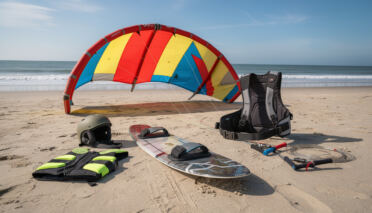
Here’s the basic kit most experienced riders quietly treat as non-negotiable for beginners:
- 🕶️ Protective eyewear to shield from line snap-back and glare.
- 🧤 Gloves (sailing gloves or fingerless lifting gloves) for line handling and emergency grabs.
- 🪖 Helmet if you expect to be pulled (skudding) or you’re adding a board/buggy later.
- 👟 Proper shoes (not flip-flops); you may slide on your feet to bleed off force.
- 🧴 Sunscreen + water, because staring at the sky is a fast track to dehydration and bad choices.
Also: tie up long hair. It’s not a fashion note; it’s a line-management note. Tangled hair around handles or lines is an annoying problem that can become a fast hazards problem.
Hard “no” zones: where you do not fly
Some rules are boring until you see why they exist. Don’t fly near power lines. Don’t fly near airports or in flight paths. Don’t fly in storms—lightning and long lines are a terrifying combo. And don’t fly close to people. Even a soft foil kite moving quickly can hit like a bag of bricks, and lines under tension can injure badly.
What’s “close”? Close is anywhere someone could wander into your line radius. If your lines are 20–25 meters, your “keep-out bubble” is huge. That’s why smart beginners choose empty fields or wide beaches at low tide, not the crowded postcard spot.
Next up, let’s talk about the wind itself—because weather awareness is where good sessions begin.
Choosing Wind Conditions and Weather Awareness for Beginner Traction Kiting
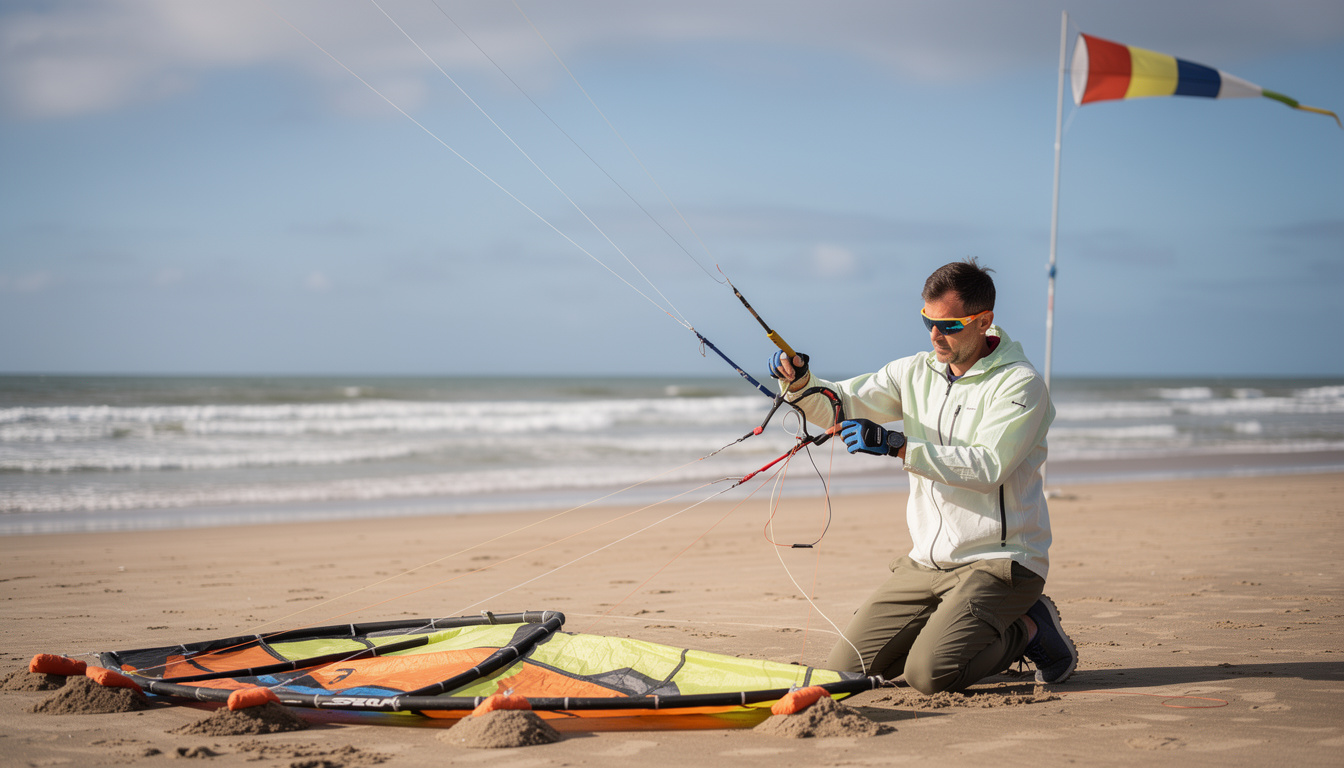
If traction kiting had a secret cheat code, it would be “pick the right day.” Not the windiest day, not the warmest day—the right day. Beginners progress faster (and break fewer things) in steady breeze, plenty of space, and no drama in the forecast. In 2026, you can check wind models, gust charts, and radar on your phone in seconds, but the skill is translating that data into a simple go/no-go decision.
A practical starting point for many beginners with common 4-line foil kites is a steady breeze around the “easy” range—roughly the kind of wind that moves leaves and small branches but doesn’t feel like it’s shoving you. Historically, people described that as Beaufort Force 3. That reference is old (early 1800s maritime origin), but it still maps nicely to what you feel on your skin. Manufacturers still use these ranges on spec sheets because they’re intuitive once you learn them.
Why gusty wind is worse than strong wind
Strong wind is obvious—you feel overpowered immediately. Gusty wind is sneaky. Your kite may feel manageable for 20 seconds, then a gust hits and suddenly the same kite feels two sizes bigger. That’s where beginners get yanked, lose stance, and accidentally steer into the power zone while panicking. If the forecast shows big gust spread (for example, average wind moderate but gusts much higher), that’s a flashing warning sign.
Weather awareness also means looking around. Are trees upwind swaying irregularly? Are flags snapping and then going limp? Are buildings or dunes upwind creating turbulence? Wind shadow and rotor behind obstacles can make your kite stall, surge, or collapse unpredictably—super frustrating for kite control practice.
Pick your site like you’re planning a safe landing, not a cool photo
A solid rule: stay far enough downwind of obstacles (trees, buildings, dunes) that the airflow smooths out. Many riders use a rough guideline of several times the obstacle height as a minimum buffer. More space is never a mistake.
Beaches add one more variable: tide. Low tide often gives you the wide, flat runway you need, while high tide squeezes everyone together near dunes and vegetation (hello, snags and tears). If you’re practicing in a field, make sure your “semi-circle” (your wind window radius equal to your line length) stays clear of fences, parked cars, and footpaths.
A quick wind-day decision table (beginner-friendly)
| Signal 🧠 | What it usually means 🌬️ | Beginner move ✅ |
|---|---|---|
| Leaves moving, small branches lightly swaying 🍃 | Likely steady learning breeze | Great for first sessions with conservative kite sizes |
| Wind “pulses” (strong then weak) 🔄 | Gusty/variable, often turbulent | Skip it or relocate; prioritize weather awareness |
| Whitecaps on water 🌊 | Enough wind to overpower beginners | Downsize and only fly if trained; otherwise wait |
| Dark clouds, storm risk ⛈️ | Rapid changes, lightning hazard | Do not fly |
Once the day and place are right, the next question is gear—because the “wrong” setup can make a perfect day feel impossible.
If you want a visual refresher on wind window basics and reading wind, this kind of video search usually turns up clear demonstrations:
Equipment and Kite Sizes: What to Bring (and Why It Saves Your Session)
Let’s talk equipment without making it feel like you’re packing for an expedition. The goal is simple: reduce chaos. Beginners struggle most when they’re juggling a kite that won’t stay put, lines that twist, and a launch spot that’s half improvised. A small checklist turns your setup into a repeatable routine—basically the foundation of good training.
Kite sizes: start smaller than your ego wants
New riders often assume bigger kite equals easier flying. In traction kiting, bigger usually equals more pull and faster consequences. A smaller kite will still be fun later—it becomes your “high wind” option as you level up. That’s why experienced people rarely regret owning a conservative size early on.
Also, not all kites feel the same at the same square meters. Aspect ratio, bridle design, and profile all affect how “lifty” or “grunty” a kite feels. So treat size as a starting point, not a promise.
The practical carry list for first flights
Here’s a beginner-friendly set of items that prevent the most common problems (runaway kite, messy launch, sun fatigue, and minor injuries):
- 📌 Ground stake (for securing by brake lines when landed)
- 🧱 Weights (sandbags, water bottles, bean bags) to hold the trailing edge down
- 🧭 Wind direction indicator (simple ribbon on a stick works)
- 📏 Optional: anemometer to verify wind conditions while you learn
- 🩹 First aid kit (scrapes happen; line nicks happen)
- 🥤 Water + snack, because concentration drops fast when you’re cooked
One underrated tip: avoid abrasive “weights” like rocks on kite fabric. They can scuff or snag bridles. Smooth, rounded objects (like filled water bottles) are surprisingly effective and roll away cleanly on launch.
Lines, colors, and the left-right confusion trap
Modern sets often mark left/right clearly (and some even number lines). Still, confusion happens—especially if you’ve flown 2-line stunt kites before and your habits conflict with the traction-kiting convention. Many power kiters follow the nautical tradition: red = left, blue/green = right. The key isn’t which tradition you choose; the key is consistency, especially if you share gear.
Line strength matters too. Undersized lines can snap under load, and that snap-back is one of the nastier hazards. Oversized lines add drag and weight, making the kite feel sluggish. When in doubt, follow the manufacturer’s recommendations for that kite size.
Now that you’ve got the gear sorted, the next step is understanding what the kite is “trying” to do in space—because that’s where real control starts.
For line setup visuals and four-line handling, these tutorials are usually a good starting search:
Kite Control Essentials: The Wind Window, Power Zone, and Why Beginners Get Yanked
Kite control isn’t about strength. It’s about placing the kite where you want it, predicting how it’ll accelerate, and having enough “range of motion” in your arms and stance to correct mistakes. The wind window model makes that predictable. Without it, traction kiting feels random; with it, it feels like you can finally read the game.
The wind window in plain English
Stand with your back to the wind. Imagine a giant half-dome in front of you, with the radius equal to your line length. That dome is your wind window. The kite produces different pull depending on where it sits in that window.
Near the edges (off to your left and right, and up high), the kite pulls less. Low and central—downwind and closer to the ground—is where the pull ramps up fast. That area is the power zone, and it’s exactly where beginners accidentally fly during “hot” launches.
Hot launches, cold reality
A hot launch happens when the kite lifts from directly downwind and shoots upward through the power zone. In light wind it’s manageable; in stronger wind it’s how you get dragged before your brain catches up. This is why choosing gentle wind conditions is not “being cautious,” it’s being smart.
If you feel the pull building and your feet start doing that unwilling shuffle, you’ve got options: steer toward the edge of the window, apply brakes smoothly (on four-line setups), or—if you’re truly out of control—use your safety system.
Body position: the boring detail that fixes half your problems
Most first-time errors come from the same place: people tense up and bring their hands to their chest. Now they can’t steer because there’s no room to pull or push. Keep your hands in front of you, not glued to your torso. Elbows slightly bent. Feet apart. Lean back against the pull. If you get dragged, sliding on your feet (“skudding”) is often safer than sprinting.
Here’s a quick self-check question: can you still move each handle independently without twisting your shoulders? If not, reset your stance before the kite speeds up.
Parking at zenith: helpful, but not magical
Directly overhead (zenith) is often lower pull, so it feels like a “rest” position. But gusts can lift you unexpectedly, then drop you just as quickly. That’s why “parking overhead with an oversized kite” has a reputation for ugly surprises. The safe version is: correct kite size, steady wind, and active attention even when the kite looks stable.
With control basics in mind, you’re ready for the practical part: setup, launch, landing, and how to bail out without drama.
First Session Training Plan: Setup, Launch, Landing, and Bailing Out When Things Go Sideways
Unstructured practice is how beginners collect confusing experiences. Structured training is how you stack small wins. A solid first session isn’t about distance or speed—it’s about repeatability: you can set up cleanly, launch without panic, park the kite safely, land without slamming it, and end the session on your terms.
Setup routine: reduce tangles before they exist
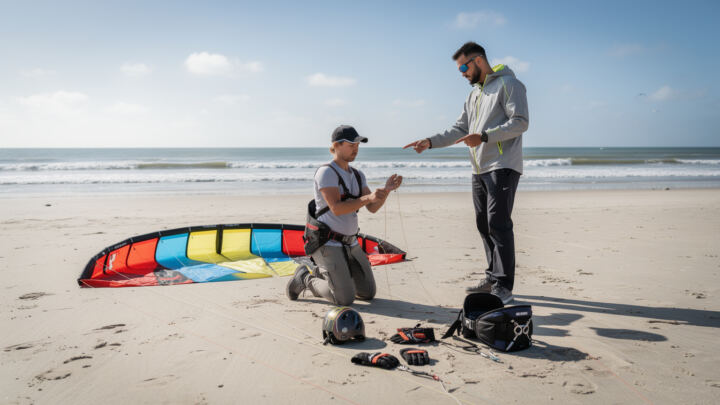
Start by placing a stake on the ground as a marker (don’t impale it yet—tripping on a stake is an unforced error). Walk downwind a bit more than your line length, unfold the kite with the trailing edge closer to you and the inlets downwind. Use weights or sand to hold the trailing edge so the kite can’t inflate prematurely.
Sort bridles patiently. New bridles can look like a mess, but they’re often just stuck together from storage. Separate the attachment points, make sure nothing is crossed, and lay everything neatly. This one habit saves you the “why does my kite turn weirdly?” mystery later.
Attaching lines and leashes: make safety automatic
Attach power and brake lines consistently, then add safety leashes (often called “kite killers”). The whole point is simple: if you let go of the handles, the kite should lose power and fall rather than keep flying as a weaponized shopping bag.
Practice a controlled “let go” drill in light wind: kite low-power position, hands relaxed, then intentionally release. Watch how the kite behaves. It’s better to learn that behavior on purpose than during a surprise gust.
Launching and the first 10 minutes of flying
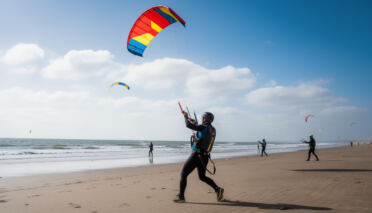
Clear your pockets of anything sharp or bulky. When you launch, keep the kite out of the power zone as much as possible. Fly it around 60 degrees above the horizon, left and right, getting a feel for steering inputs. Small movements. Don’t “saw” the handles wildly. If the wind is light, keep the kite moving to generate apparent wind; if it’s stronger, your job is to slow things down, not to prove you’re tough.
Expect a few spins and line twists. It’s not a failure. You can unwind by flying a controlled spin the other way, or by parking overhead and turning your body to untwist. The trick is staying calm enough to remember which direction you twisted.
Landing: the skill that ends sessions safely
Four-line kites have a nice superpower: you can back them down for a gentle landing. Bring the kite to a stable position, then apply brakes evenly so it stops and reverses downward. Make small corrections so it doesn’t drift or slam. Once it’s down, keep brake tension and secure it—ideally by staking the brake lines—so a gust can’t relaunch it while you’re distracted.
Bailing out: no shame, just good judgment
If things feel wrong—wind rising, control slipping, lines misrigged—bail early. The cleanest method is letting go while on safety leashes, allowing the kite to depower and settle. Then pack up and wait for better wind conditions or switch to smaller kite sizes. Knowing when to stop is part of the sport, not a detour from it.
And if you’re wondering whether lessons are worth it, especially if you plan to kiteboard or snowkite: they usually pay off fast because they compress weeks of trial-and-error into a few focused hours.
Lessons and course formats: what “good training” looks like
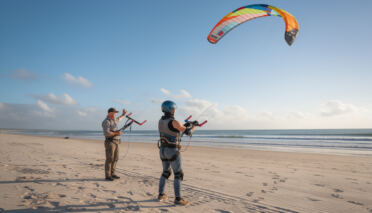
Many schools now teach in small groups, often around one instructor for up to three students, so you get real-time corrections. Some programs mirror the first day of kiteboarding training (on land) so you don’t burn a holiday learning basic handling at an expensive destination. You’ll typically rotate through trainer kites, foil kites, and sometimes inflatables, focusing on safe setup, wind window control, and emergency procedures.
One simple way to evaluate any course: do they insist on suitable conditions and teach “stop skills” (landing, bailing, self-management), not just flying around? That’s the difference between entertainment and real preparation.
With that, you’ve got the practical toolkit—now let’s answer the questions beginners keep asking right before they buy gear or book a first session.
What kite sizes are best for beginners in traction kiting?
Start with conservative kite sizes that match your weight and typical local wind conditions, prioritizing controllability over power. A smaller kite is not wasted money; as your skills grow, it becomes your high-wind option. Always follow the manufacturer’s wind range guidance and downsize when gusts are strong.
How do I know if wind conditions are too risky for a first session?
Avoid gusty or rapidly changing wind, stormy forecasts, and any session where you feel consistently overpowered. If the wind is turbulent behind obstacles, or gusts spike far above the average, it’s a bad learning day. Solid weather awareness means choosing steady wind and a wide, obstacle-free area.
What are the biggest hazards beginners underestimate?
The main hazards are launching through the power zone (hot launch), flying near people or obstacles, line cuts or snap-back, and being dragged unexpectedly on hard ground. Overhead parking can also be risky if a gust lifts and drops you. Good safety tips—space, protective gear, and using safety leashes—reduce these risks dramatically.
Do I really need safety leashes (kite killers) and gloves?
Yes. Safety leashes are your emergency depower option: letting go should kill the kite’s pull instead of creating a runaway kite. Gloves protect your hands from burns or cuts if you have to manage lines under tension. Together, they’re basic equipment for safer learning.
Is formal training worth it if I only want to fly on land?
Structured training is still valuable because it accelerates kite control, improves weather awareness, and teaches safe setup/landing/bailing habits. Even a short lesson in a small group can prevent the most common beginner mistakes and prepares you if you later move to buggying, landboarding, or kiteboarding.