In brief
- 🪁 Traction kites speak their own language: once you get the basics, everything from setup to your first ride feels less chaotic.
- 🌬️ The wind window is the map for power and safety—learn it and you’ll stop getting surprised by sudden pull.
- 🧵 Words like lines, bridle, cells, and aspect ratio explain why two kites of the same size can feel totally different.
- 🧰 “Two-line,” “four-line,” and “three-line” aren’t just numbers; they change how you launch, land, and kill power fast.
- 📏 Size matters: for a first traction kite, small-to-mid sizes usually mean more control and fewer scary moments.
- 🎛️ A bar feels familiar if you’re eyeing a board sport, but handles often give better finesse—especially in light wind.
- 🧯 Terms like kite killers, leash, and safety systems aren’t optional vocabulary; they’re the difference between “fun session” and “why is my kite in the parking lot?”
Traction kiting has a funny way of sounding simple until you’re standing on a beach or field and someone casually says, “Park it at the edge of the wind window, check your lines, don’t let it luff, and if it powers up, dump it on the brakes.” If you’re new, that can feel like overhearing cockpit chatter. The good news is: it’s not secret code, it’s just shorthand for real stuff you can see and feel. Once you know the words, you start predicting what the kite will do instead of reacting late.
This matters because traction kites can look like harmless fabric until a gust turns them into a very convincing towing machine. Even “fun” foils can yank hard in the wrong wind, and the terminology is basically the safety manual people speak out loud. To make this practical, we’ll follow a fictional beginner, Sam, who wants a kite that’s exciting but not sketchy, and eventually wants to ride a board. Along the way, each term will connect to a moment Sam actually faces: rigging on the ground, the first clean launch, the first time the kite surges, and the first time someone says “don’t even think about jumping.”
Traction kiting basics: the core terminology that stops the confusion
Start with the big umbrella terms. People say traction kite and power kite like they’re different things, but in everyday talk they’re basically interchangeable: a kite designed to generate pull, not just look pretty in the sky. You’ll also hear foil, because many traction kites have an airfoil-like profile—meaning the wind inflates and shapes them so they act like a wing.
Now the key design phrase you’ll see in beginner-friendly gear: fixed bridle, open-cell foil. “Fixed bridle” means the bridle geometry isn’t designed to slide around on pulleys to change power. “Open-cell” means the leading edge has inlets so air rams in and inflates the canopy during flight. This style is popular for land use because it’s simple, predictable, and doesn’t force you into advanced systems early.
Sam walks into a shop and the salesperson asks: “Two-line or four-line?” That’s a language checkpoint. A two-line kite uses left/right power lines attached to the front bridles. Steering is straightforward: pull left to go left, pull right to go right. A four-line kite adds left/right brake lines connected to the trailing edge bridles. That extra pair gives you a whole new toolkit: tighter turns, controlled landings, reverse launches, and better emergency power kill.
There’s also the “in-between” you’ll hear about: three-line trainer setups. Usually it’s a bar with a third line to a brake bridle or safety point, letting you stall the kite more cleanly in a panic and sometimes enabling reverse launch. It’s not magic; it’s just another control pathway that changes how the canopy behaves when you let go.
Then comes the term beginners misread: depower. In traction-kite conversations, “depower” typically refers to kites and bars that let you vary the kite’s angle of attack significantly (often via a moving bridle with pulleys). That’s common in kiteboarding rigs, where you might hear sheeting—pushing the bar away to reduce pull, pulling it in to increase pull. On fixed-bridle foils, you don’t truly “depower” the wing the same way; you manage power by kite position, edging, and braking input (if you have it).
One more term that keeps Sam from buying the wrong thing online: LEI (leading edge inflatable). Those are the inflatable kites you see in many water disciplines, shaped like C or bow designs. They’re built to relaunch from water and handle harness-based control systems. Great when taught properly, but not the easiest “mystery used deal” for a first traction session on land.
Get these core labels right and you’re already ahead: you’ll know what category you’re shopping in, what safety assumptions are baked in, and why a bar on one kite isn’t the same experience as a bar on another. Next up is the term that basically governs everything you do: the wind window.
Wind window terminology: power zones, zenith, edge, and why launches go wrong
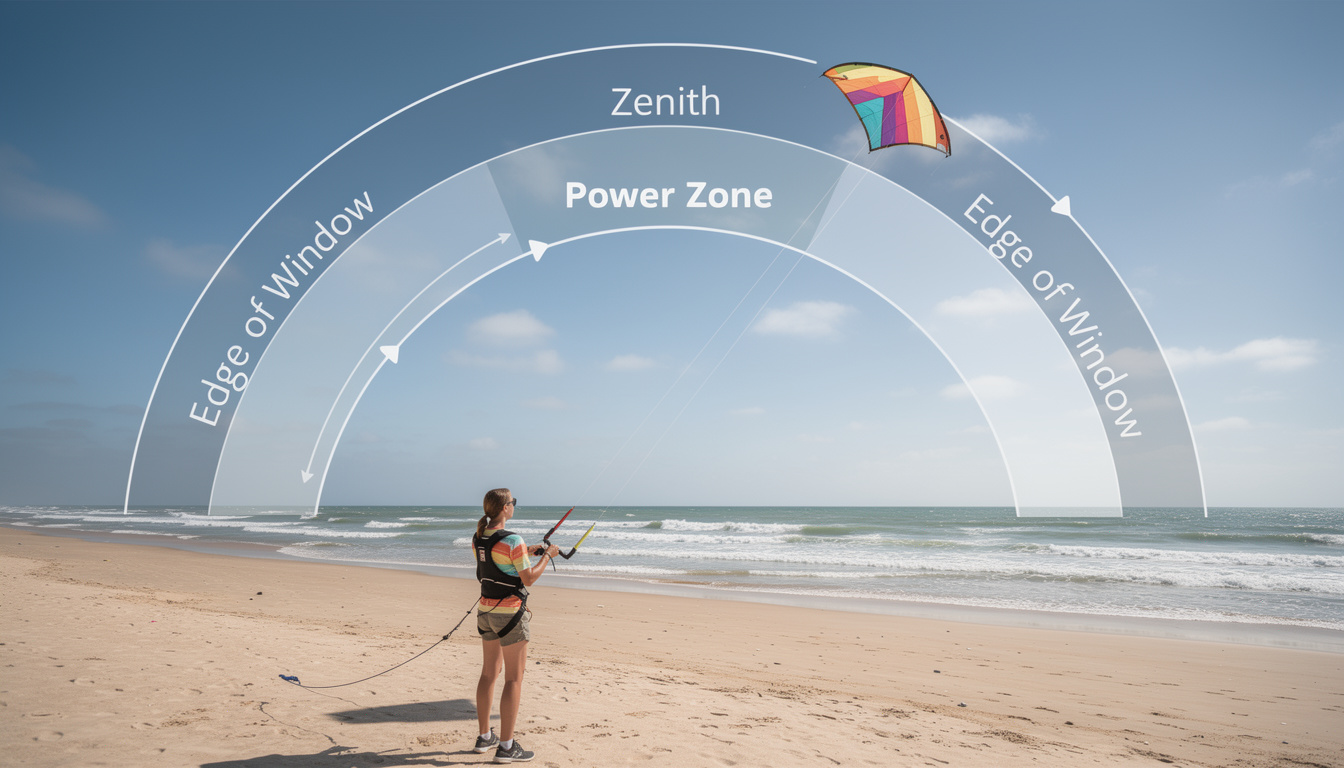
The wind window is the invisible dome downwind of you where the kite can fly. If you only learn one concept, make it this. Sam’s first “whoa!” moment comes when the kite crosses the middle of the window and suddenly pulls like it found a turbo button. That’s not random—it’s the geometry of where the kite sits relative to the wind.
Picture the window as a half-sphere. Straight downwind from you, low to the ground, is the power zone. Fly through it and the kite accelerates and generates maximum pull. Along the left and right sides is the edge of the window, where the kite has less apparent wind and less power. Straight overhead is the zenith. Beginners often think zenith is “safe,” but that depends on gusts and kite size—if a gust hits, overhead lift can become the problem.
This leads to a set of directional terms you’ll hear constantly: upwind, downwind, and crosswind. They’re not just compass words; they tell you where the safer walking paths are when you’re handling a powered wing. If Sam needs to reduce pull during a shaky moment, stepping slightly upwind can help move the kite toward the edge and soften the load.
Another term that shows up during messy sessions is luffing. A kite “luffs” when airflow becomes unstable and the canopy starts to flutter or partially collapse. In practical terms, Sam notices the wing tips folding inward or the kite hesitating like it forgot how to fly. Luffing often happens at the edge of the window, during bad line tension, or in turbulent wind behind dunes, trees, or buildings.
Then there’s bowtie—a more dramatic fold where the kite partially inverts or collapses in a way that tangles the shape. It’s not a fashion term; it’s usually a sign of gusty air, poor technique, or a kite that’s out of its happy range. Knowing the word helps because experienced riders will tell you how to avoid it: keep clean tension, fly smoother, and don’t try hero moves in lumpy wind.
Now, about the word launch. Launching isn’t just “get it in the air.” It’s a controlled transition from a flapping canopy to a loaded wing, and it should happen near the edge of the wind window, not straight in the power zone. If Sam launches too deep downwind, the kite may surge and yank—classic beginner mistake.
Landing has its own vocabulary too. “Park it” usually means holding the kite steady at the edge. “Stall it” means reducing airflow so it loses lift and settles (often by braking on a four-line kite). “Hot launch” is the one you don’t want: launching with too much power too fast.
The cleanest sessions come from treating the wind window like a map: do powerful stuff briefly and intentionally, do setup and resets at the edges, and don’t assume overhead is automatically chill. With that mental model, the next set of terms—size and shape—will finally make sense instead of sounding like spec-sheet trivia.
Watching a few demos makes the window concept click faster than any diagram, so here are two useful search-based videos to pull up before your next session.
Notice how the pilot keeps the kite near the edge during setup and walks it into a stable position before committing to power. That’s the difference between “controlled” and “surprise towing.”
Size, area, and aspect ratio (A/R): terminology that predicts how a kite feels
When people say “Size matters,” it can sound like gatekeeping. In traction kiting it’s just physics. Kites are commonly sized by area in square meters (m²), especially four-line foils. That number is a rough indicator of potential pull. Sam sees kites advertised at 8 m², 10 m², even bigger, and thinks “more value.” In reality, bigger wings can narrow your comfortable wind range and raise the consequences of mistakes.
A practical beginner range for many adults on land is often around 2 to 3.5 m² in a fixed-bridle foil, depending on body weight, wind quality, and your local spot. That’s not about limiting fun; it’s about control. Once Sam gets confident, the same kite that felt spicy in 12 mph becomes the “high wind” option later, while a larger wing joins the bag for lighter days. This is why people end up with expanding kite bags: you can’t control the wind speed, but you can swap canopy size.
Here’s where terminology gets sneaky: some manufacturers list size by wingspan (meters across) instead of area. So a “2.7 m” kite might not be 2.7 m². For shopping, you want to know which measurement you’re looking at; otherwise you’ll compare apples to watermelons and wonder why the pull feels different than expected.
Another spec term you’ll hear: projected area vs “flat” area. Flat area is measured when the kite is laid out on the ground. Projected area is what the wing “shows” to the wind when it’s curved in flight, and it’s always smaller. On some inflatable shapes, the difference can be huge. On many moderate foils, it’s less dramatic, but it still matters if you’re comparing designs across categories.
Now the real personality spec: aspect ratio, often written as A/R. It’s basically “long and skinny” versus “short and chunky.” Low A/R kites (around 2 to 3) tend to be stable, turn faster, and handle gusty, messy wind better. Medium A/R (roughly 3 to 4) is a common sweet spot: good stability with better upwind travel. High A/R (over 4) can feel like a race car: more efficiency and speed, more sudden power in gusts, and more skill required to keep it behaving.
Sam tries two different mid-sized kites in similar wind. One pulls smoothly and forgives sloppy steering; the other accelerates hard and feels twitchy. That difference often tracks with A/R and design intent. Racing-focused wings often go high A/R because they slice upwind efficiently, but beginners don’t need “maximum upwind” on day one—they need predictable load and easy recovery when things go wrong.
To make the terms usable, here’s a quick reference table Sam keeps on his phone while shopping. It’s not a law of nature, but it’s a solid heuristic for fixed-bridle foils in typical recreational conditions.
| Term / Range | What it usually feels like | Typical use case | Beginner friendliness |
|---|---|---|---|
| 🪁 Small (≤ ~2 m²) | Fast, playful, lower pull until wind builds | Skill building, travel kite, higher wind practice | ✅ High (with space and supervision) |
| 🌬️ Mid (~2–3.5/4 m²) | Noticeable traction, can drag an adult in decent wind | Training, light buggy/board sessions, progression | ✅/⚠️ Depends on wind quality and spot |
| 💪 Large (≥ ~5 m²) | Big pull in light air; can lift in gusts | Buggy power, snowkiting engines, experienced pilots | ⚠️ Low without coaching |
| 🧩 Low A/R (≈2–3) | Smoother power, gust tolerant, quick turning | Gusty beaches, learning control | ✅ High |
| 🏁 High A/R (>4) | Accelerates fast, strong upwind, sudden power spikes | Racing, high performance buggy | 🚫 Not ideal early on |
Once these sizing and shape terms are clear, you’ll stop being dazzled by marketing and start predicting behavior: speed, stability, gust response, and how tiring the pull will feel. Next comes the vocabulary of what actually connects you to the wing: bridles, handles, bars, and the small features that make sessions smoother.
Lines, bridles, cells, and safety: the terminology hidden under the kite
Flip a traction kite over and you’ll see a spiderweb: the bridle. The bridle is the network of small lines that supports the canopy and connects it to your main flying lines. Beginners often focus on the big lines because they’re what you hold, but bridle terminology matters because it affects stability, drag, and how easily the kite recovers from mistakes.
You’ll hear about bridle loops being knotted or sewn. A knotted loop is simple and cheap, but knots add bulk and can snag other bridle segments during a collapse or messy relaunch. Sewn loops are cleaner and usually snag less. It’s a small detail, but Sam learns to appreciate it the first time he untangles a bridle in cold wind with sand blasting his ankles.
Another term: cells. A foil kite is divided into cells by internal ribs (often called profiles). More cells can help the kite hold a cleaner shape, especially at larger sizes, but “more cells” doesn’t automatically mean “better.” What matters is how the design scales across sizes: some brands increase cell count as the wing gets bigger to preserve handling rather than just enlarging the pattern.
Designers also talk about diagonal ribs (sometimes “V ribs” or “D ribs”). The point is to reduce the number of bridle attachment points (less drag) while still supporting the canopy. You’ll see this mostly on kites aiming for better efficiency without becoming too twitchy.
At the leading edge, you might hear about meshed air vents. Mesh can help maintain a cleaner inlet shape while still letting air in, but it can also snag debris depending on your spot. At the tips, some kites keep outer cells closed to reduce luffing during turns, which can trap sand. That’s why dirt-outs exist: little Velcro-sealed openings near the trailing edge to shake out sand. If you fly beaches a lot, dirt-outs are one of those “boring” features that feels genius later.
Safety vocabulary is where traction kiting stops being a hobby and becomes a discipline. On four-line handle setups, a common system is kite killers (safety leashes). They connect from your wrists to the brake leaders so that if you let go, the kite flips onto the brakes, collapses, and loses power. On a bar setup, a comparable safety leash usually dumps the kite onto the rear/brake lines, again killing pull. The point is the same: if Sam panics, “letting go” should be a controlled shutdown, not a runaway canopy.
Color-coded line sets are another practical term. You’ll often see red on the left, which is a nautical tradition. In snow or flat light, colored lines can be the difference between a quick fix and a 20-minute spaghetti session. People debate whether colored coatings feel “stickier,” but the real win is sorting faster and rigging correctly when you’re tired.
Handles vs bar terminology (and why it changes your muscle memory)
Quad handles give you separate leverage over power and brake. That means you can steer with subtle brake taps, stall the wing, and land with finesse. A control bar is simpler in some ways—especially if your end goal is to use a board on water—because it matches the “hands on a bar” feel you’ll later use in kiteboarding. Bars can also free one hand briefly, which landboarders love for balance and grabs.
But there’s an important language trap: not every bar implies sheeting and not every setup provides true depower. A fixed-bridle trainer on a bar often uses geometry (sometimes pulleys) to translate bar input into brake input for turning. That’s different from a harness-based depower system where pushing the bar away meaningfully reduces the wing’s angle of attack. Sam avoids a pricey mistake by learning to ask one simple question: “Is this a fixed-bridle trainer bar, or a depower bar meant for harness riding?”
With terminology nailed, you can now talk about technique clearly: “I launched at the edge, walked upwind to reduce pull, then practiced stalls and reverse launch.” That’s the difference between guessing and progressing. Next, let’s tie the language to real buying and learning choices so the glossary actually pays off.
Buying and progressing: terminology that helps you choose the right first kite (and avoid the classic mistakes)
Sam’s shopping list starts with hype—speed, lift, and maybe one day a stylish ride on a board. Then a local pilot asks, “What wind range do you actually have at your spot?” That’s the adult question. Traction kiting isn’t about buying the biggest wing; it’s about matching terms like area, A/R, and line setup to your real conditions.
The first buying truth you’ll hear repeated for a reason: bigger is not better for beginners. Large foils can be difficult in light wind (because they need clean airflow and good technique to stay inflated), and in moderate wind they can become legitimately dangerous. The stories are everywhere—people who bought too big, got dragged or lofted, then sold the kite and quit. That’s not a rite of passage; it’s avoidable.
The second truth is about jumping. You’ll hear terms like “lofting,” “hangtime,” and “redirect.” Redirecting is a maneuver where you steer the kite to maintain lift and manage descent, and skilled pilots can make landings look soft. But here’s the vocabulary reality check: traction kites are not parachutes, paragliders, or hang gliders. “No jumping today” is more than a buzzkill; it’s a safety boundary. Sam decides to treat jumping videos as entertainment, not a checklist.
Now for the practical progression terms. You’ll often hear people say, “Start with a trainer.” In this context, a trainer is a smaller, stable kite used to learn the window, launches, landings, and control inputs. For Sam, that means choosing a moderate size (often around the 2–3.5 m² range for many adults on land, depending on wind) and focusing on skills that translate: smooth steering, controlled parking, safe shutdown, and confident relaunch.
And yes, your kite bag tends to expand. That’s not consumerism; it’s the same logic sailors use with sails. One wing won’t cover 5 to 25 mph comfortably. The terminology helps here too: instead of saying “I need more power,” you’ll say “I need a bigger canopy for light air,” or “I need a smaller wing for high wind,” which keeps decisions rational.
A beginner-friendly terminology checklist (the stuff you should be able to explain out loud)
- 🧭 Wind window: where power lives, where safety lives, and how to move between them.
- 🪁 Edge of window vs power zone: where you launch/land vs where you get yanked.
- 🧵 Lines and bridle: what connects you to the canopy and why tangles happen.
- 🧯 Kite killers / safety leash: how you dump power fast when things go sideways.
- 🎛️ Bar vs handles: what you hold, how you steer, and how you land smoothly.
- ⚙️ Sheeting and depower: what they mean on kiteboarding rigs versus fixed-bridle trainers.
- 📏 Area and A/R: why two similar sizes can feel calm or savage.
- 🏄 Ride goals: buggy, landboard, or water later—so you choose training gear that translates.
Finally, a small but crucial language tip for used markets: if a listing screams “cheap depower kite with bar,” that doesn’t automatically mean “great starter traction kite.” Depower systems built for water starts can generate serious force, and they assume instruction, harness use, and modern safety systems. Sam’s rule becomes simple: when in doubt, choose a reputable fixed-bridle trainer package with proper safety, then level up when skills match ambition. That one decision keeps the sport fun instead of frightening.
What does “wind window” mean in traction kiting?
The wind window is the downwind flying area where your kite can generate lift and traction. The center (power zone) produces the strongest pull, while the edges produce less power and are typically where you launch and land more safely.
Is a bar the same thing as depower and sheeting?
No. A control bar can be used on fixed-bridle trainer kites without true depower. “Sheeting” and “depower” usually refer to harness-based systems that change the kite’s angle of attack significantly (common in kiteboarding). Always check whether the kite is fixed-bridle or a depower design.
What are kite killers, and do I really need them?
Kite killers are safety leashes (often on four-line handle setups) that keep the kite attached to you and dump it onto the brake lines if you let go, collapsing the canopy and removing tension. For beginners, they’re a major safety feature, not an accessory.
How do I choose between two-line and four-line kites?
Two-line kites are simpler and often cheaper, great for learning steering and window awareness. Four-line kites add brake lines, enabling stalls, reverse launch, tighter turns, and more controlled landings—usually the better long-term skill builder if you want maximum control.
Why do people warn beginners not to start with a big kite?
Large traction kites can have a narrow comfortable wind range and can become dangerous quickly in gusts or moderate wind. Starting smaller helps you build skills with less risk; later, that same kite often becomes your high-wind option while you add larger sizes for light wind days.