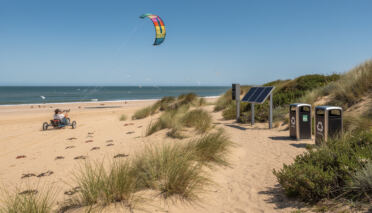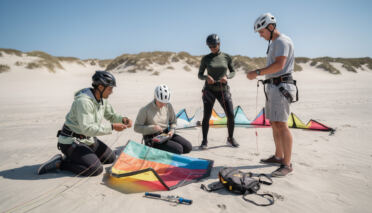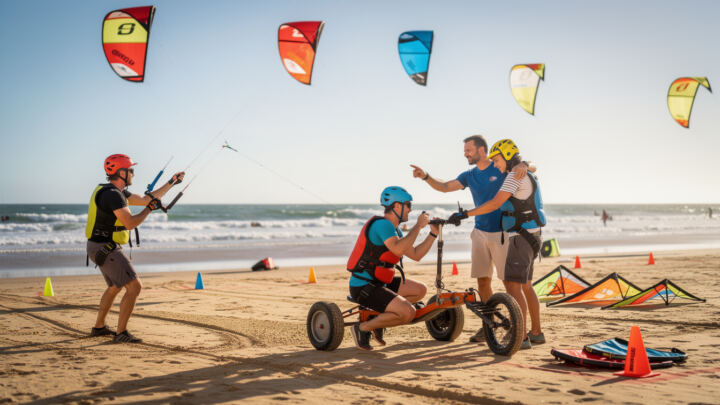
On a breezy weekend, traction kiting can look deceptively simple: someone hooks in, the kite climbs, and suddenly they’re gliding across sand or skimming over shallow water like it’s second nature. What you don’t see is the quiet, repeatable practice behind that “effortless” look—little drills that build kite control, habits that keep wind safety front and center, and routines that turn chaotic pulls into predictable power. If you’re new, the biggest win isn’t brute strength; it’s learning what the kite is trying to tell you, and how your hands, feet, and stance translate into clean inputs.
This article lays out suggested training routines for traction kiting beginners in a way that feels like a real progression, not a random pile of tips. You’ll follow a simple storyline—meeting a fictional beginner named Maya—as she goes from nervous first launches to smooth figure-eights, controlled power strokes, clean exits, and confident sessions shaped by weather awareness. The goal is practical: you should be able to pick a routine, show up, and know exactly what to do for 45–90 minutes without guessing. And yes, we’ll keep it real: the fastest learners are usually the ones who practice the boring stuff on purpose. 🪁
En bref
- ✅ Build beginner training around short, repeatable drills instead of “just flying around” 🧠
- 🌬️ Prioritize wind safety and weather awareness before you even unroll your lines
- 🧵 Treat line management like a skill, not a chore—most beginner errors start there
- 🧍♀️ Use athletic body positioning to reduce yanks and make steering smoother
- 🚀 Practice launch techniques and landing skills every session (not “once you’re good”)
- 🎯 Learn controlled power strokes only after you can park the kite and stop it on command
Beginner Training Routine for Traction Kiting: Session Structure That Actually Sticks
If you’re starting traction kiting, the most useful routine is one that feels almost boring—because it’s consistent. Maya’s first month looked like this: two short sessions during the week (45–60 minutes), and one longer weekend session (75–90 minutes). She didn’t chase “big pull” days. She chased repeatability. That’s the secret sauce in beginner training: build a stable base so you can safely add power later.
Warm-up flow: five minutes that prevent forty minutes of chaos
Before touching the bar, Maya did a quick scan: wind direction on grass, flags, or drifting sand; people and obstacles downwind; and an “exit line” (where she’d walk if things got weird). This isn’t dramatic, it’s practical wind safety. Then she warmed up shoulders and wrists—kiting is a lot of small steering inputs, and stiff joints make you overcorrect.
Next came a “dry run”: she mimed steering left/right, sheet in/out (if applicable), and practiced letting go with one hand while keeping the other stable. Why? Because beginners often death-grip the bar and accidentally steer while panicking. A calm grip is a skill, not a personality trait.
The 3-block session plan (and why it works)
Her routine was split into three blocks. Block A was kite control at the edge of the window: gentle steering, parking at 10 and 2 o’clock, and holding still for 10 seconds. Block B was movement with the kite stable: walking crosswind while keeping the canopy parked. Block C was a controlled “spice” drill: a few clean figure-eights or light power strokes—only if Blocks A and B were smooth.
This structure matters because traction kiting punishes skipping steps. If you can’t hold the kite steady, adding dynamic loops just turns the session into survival mode. Maya noticed something funny: when she nailed Block A, everything else felt easy. That’s your sign you’re training the right way.
A simple weekly progression (no rush, no ego)
Week 1 focused on launching, parking, and landing. Week 2 added walking drills and better line management. Week 3 introduced steady figure-eights and gentle pull generation. Week 4 mixed in short bursts of stronger power strokes with strict “stop-on-command” rules. The insight: progress isn’t linear, but routines make it resilient.
Kite Control Drills for Traction Kiting Beginners: From Parking to Precision Steering
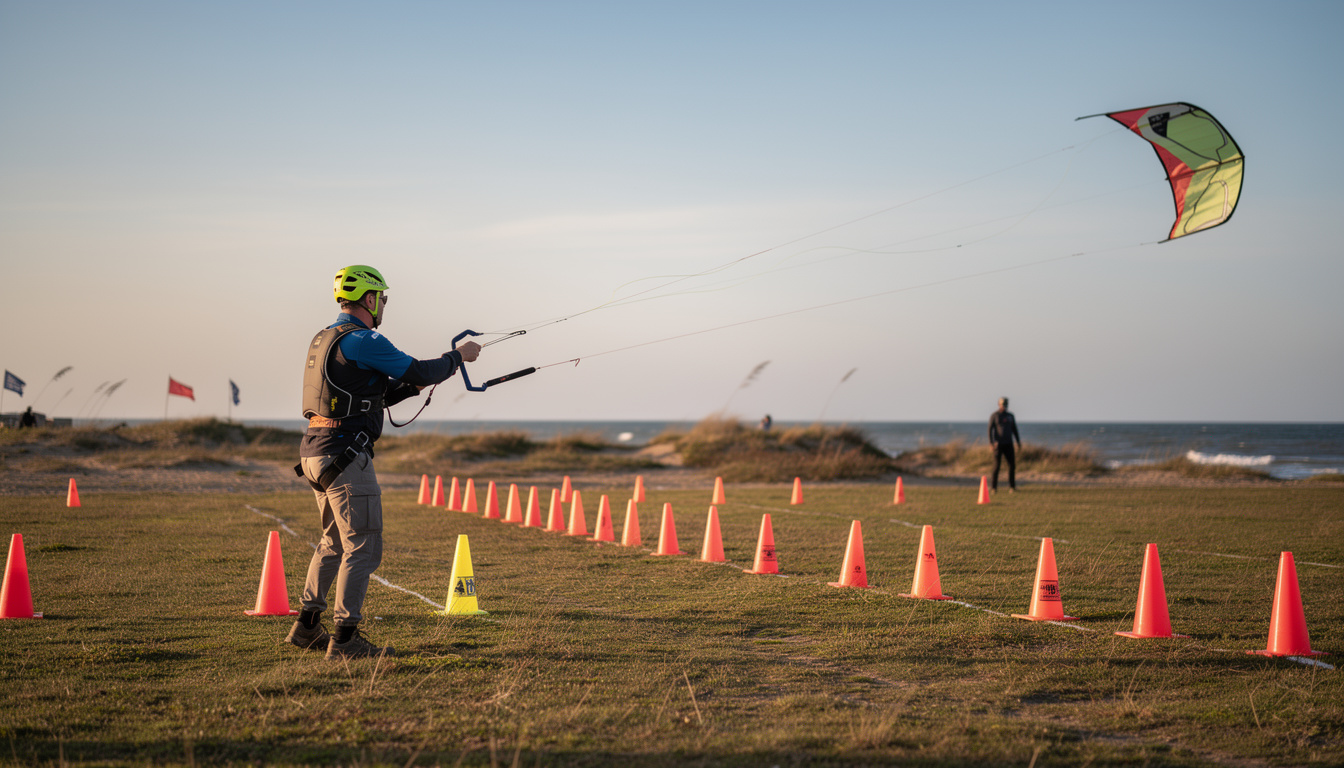
Most beginners think the hard part is handling power. The real hard part is handling precision. Maya’s biggest breakthrough came when she stopped trying to “fly everywhere” and started trying to “hit targets” in the wind window. That shift turns random flying into deliberate kite control.
The clock-face parking drill (your calm button) 🕒
Set a rule: you must be able to park at 10 o’clock and 2 o’clock for 10 seconds each, without drifting into the power zone. If you can’t do that, you’re not ready for bigger pulls or faster kites. Maya used landmarks: a cloud edge, a tree line, or a light pole. She’d align the kite tip with that landmark and hold it.
Common mistake: micro-yanking the bar. Instead, use tiny wrist inputs and then neutral hands. Think “steer, then relax.” That rhythm prevents oscillation and builds confidence fast.
Figure-eight accuracy: paint lines in the sky
Figure-eights are the bread and butter of traction kiting, but beginners often make them too big, too low, and too fast. Maya practiced “skinny eights” first: keep the crossover high (above 45 degrees) so the kite stays manageable. Then she introduced “tempo”: count “one-two” per turn to avoid frantic steering.
Try this: do five clean eights, then stop and park for five seconds. That teaches you to exit motion on purpose, which is essential for landing skills later. It also builds the habit of stopping power, not just creating it.
Edge-of-window walking: control while your feet move
New kiters often get good at flying while standing still, then lose it when they start walking. Add a drill: park the kite at 2 o’clock and walk 20 steps crosswind, then back. Keep shoulders relaxed and eyes alternating between kite and downwind space. This is where body positioning matters: knees slightly bent, hips square, and weight slightly back like you’re bracing against a gentle tug.
Maya treated it like training a camera stabilizer: your feet can move, but the “frame” stays stable. Once that clicked, she felt less yanked and more in charge.
Once you can park, steer precisely, and move your feet without chaos, you’re ready to talk about the less glamorous—but absolutely decisive—topic: lines, setup, and avoiding the classic beginner snags.
Line Management for Traction Kiting Beginners: Setup Routines That Prevent Most Accidents
If traction kiting had a “hidden level,” it would be line management. Maya learned this the hard way when she spent 25 minutes untwisting a set of lines while the wind picked up and her patience disappeared. After that day, she made a promise: she’d treat setup like pre-flight checks, not like busywork.
The clean layout rule: upwind anchor, downwind discipline
Start with your kite positioned correctly for your wind direction. Lay lines straight downwind with tension, no loops. Maya used a simple trick: she’d walk the lines out while lightly pinching them together, feeling for snags. If something felt “sticky,” she stopped immediately instead of dragging the problem 20 meters.
Then she checked connection points with a slow, boring routine: left to left, right to right, brakes to brakes. Boring is good here. When beginners rush, they create surprises—and surprises in traction kiting usually come with a yank.
Quick visual checks that save sessions
- 🧵 Are lines parallel with no crossovers near the bar?
- 🔁 Are there twists between bar and leaders after you unwound?
- 🪢 Are knots and pigtails seated properly (no half-caught loops)?
- 🧤 Are gloves/helmet on before you hook in (not after)?
- 📍 Is your downwind area clear enough for your kite size and wind strength?
That last point is pure wind safety. Plenty of competent flyers get into trouble simply because the downwind buffer wasn’t respected.
Table: Beginner-friendly routine for setup and breakdown
| Phase | What to do | Why it matters | Beginner cue |
|---|---|---|---|
| Setup 🧩 | Lay kite, then walk lines straight downwind | Prevents tangles that cause mis-steer | Lines look like rails, not spaghetti |
| Hook-in 🔗 | Connect left/right carefully, do a tension test | Catches crossed steering before launch | Kite responds correctly to tiny inputs ✅ |
| Session 🎯 | Pause every 5–10 minutes for a quick scan | Wind changes, crowds move, you get tired | Ask: “Can I still park calmly?” |
| Landing 🛬 | Land early, then secure kite and wind lines neatly | Avoids flapping damage and future tangles | Finish with zero knots for next time |
Maya noticed her learning speed doubled when her setup became automatic. Less time fixing mistakes means more time actually training—and that sets up the next step: launching, landing, and practicing power in a controlled way rather than “sending it.”
Launch Techniques and Landing Skills in Traction Kiting: Practical Routines for Safe Repetition
Beginners often treat launch and landing like the boring parts you do to “get to the fun.” Flip that mindset. In traction kiting, launch techniques and landing skills are the fun—because they’re where control becomes real. Maya’s coach told her, “If you can’t launch and land cleanly, you’re borrowing luck.” That line stuck.
Assisted vs self-launch: when to choose which
If you have a buddy or a local community, assisted launch is usually the better training option early on. It lowers cognitive load: you can focus on bar inputs and stance. Self-launch routines are valuable, but only once you’ve proven you can park the kite reliably at the edge without drifting into the power zone.
Maya practiced a “verbal checklist” with her helper: thumbs up, lines clear, tension even, kite stable, and a clear downwind path. It sounds formal, but it keeps sessions calm—especially when the wind is gusty.
Body positioning: the anti-yank stance 🧍♀️
Your body positioning is basically suspension. Maya learned to stand with feet shoulder-width, knees soft, hips slightly back, and shoulders facing the kite—not twisted away. When the kite pulled, she didn’t stiffen up. She absorbed it, like taking a small wave on a surfboard.
Here’s the key: beginners often lean forward when nervous, which makes them easier to pull off balance. Leaning slightly back with a stable core keeps your hands calmer, which improves steering immediately.
Landing routines: “land early” is a skill, not a slogan
Practice landing when things are easy, not when they’re already sketchy. Maya set a rule: the moment she felt her arms getting tired or the wind building, she’d land and reset. That’s where weather awareness becomes a habit, not just a concept.
She also trained “dead kite” control: after landing, she kept tension low and walked toward the kite while managing slack carefully. This is where good line management prevents accidental relaunches or line wraps.
With launches and landings dialed, you can finally train power on purpose—without turning every pull into a surprise rodeo.
Power Strokes, Weather Awareness, and Wind Safety: A Beginner Routine for Controlled Pull
Power strokes are where traction kiting starts to feel like traction kiting. But the best beginners treat them like a controlled lab experiment: one change at a time, plenty of space, and a clear abort plan. Maya’s “power day” routine was still conservative—she just added structure.
Weather awareness before you rig: reading the day like a local 🌬️
First, she checked a forecast and then verified it with real-world signs. Forecasts are helpful; reality is decisive. She looked for gust cycles (trees pulsing, sand lifting in bursts), watched what other kites were doing, and noted if the wind was side-on or side-off relative to the training area.
In 2026, plenty of riders use high-resolution wind apps, but the old-school cues still win: sudden temperature drops, dark cloud lines, and rapid direction shifts are classic “go smaller or go home” signals. That’s not fear—it’s wind safety with experience baked in.
The power ladder: a drill that scales up safely
Maya used a simple ladder:
- 🟢 Park the kite high at the edge; confirm you can hold it for 15 seconds.
- 🟡 Do a half-stroke down toward the middle, then return to edge—slow and deliberate.
- 🟠 Do a full power stroke through the window once, then immediately park and breathe.
- 🔴 Repeat only if your feet and hands stayed calm (no stumbling, no oversteer).
This routine builds the reflex of “generate power, then neutralize.” That neutralization step is where many beginners fail; they keep the kite moving because they’re excited, and the pull compounds.
Case story: the day Maya chose to stop (and got better)
One afternoon the wind climbed and became punchy. Maya noticed she was gripping harder and her turns were getting jerky. Old her would’ve pushed through. Instead, she landed, packed up, and watched for 10 minutes. She saw two other beginners struggling to land cleanly and one kite tumble into a rough relaunch attempt.
That choice built real competence: she learned to end sessions proactively. The insight here is simple—good kiters don’t just know how to start; they know when to stop. And that’s the difference between “I tried traction kiting” and “I’m becoming a traction kiter.”
How long should a traction kiting beginner training session be?
Aim for 45–60 minutes on weekdays and up to 75–90 minutes on a weekend day. Shorter sessions keep your focus sharp and reduce sloppy inputs, which improves kite control faster than marathon sessions.
When should I start practicing power strokes?
Start only after you can park the kite at the edge of the wind window and stop it on command. A good rule: if you can’t hold a stable park for 10–15 seconds, postpone power strokes and drill precision steering first.
What’s the biggest line management mistake beginners make?
Rushing setup and dragging tangled or crossed lines downwind. Use a slow, repeatable layout routine, check left/right connections carefully, and do a tiny tension test before launch to confirm the kite responds correctly.
What body positioning helps most with traction kiting?
Keep feet shoulder-width, knees soft, hips slightly back, and shoulders oriented toward the kite. This athletic stance absorbs pull and reduces oversteering caused by panic gripping or leaning forward.
What should I look for in weather awareness to stay safe?
Watch for gusty cycles, fast-changing wind direction, dark cloud lines, sudden temperature drops, and crowded or obstructed downwind areas. If conditions trend upward or feel unpredictable, choose a smaller kite or end the session early for better wind safety.