Traction kiting looks simple from far away: a kite, a breeze, and someone gliding like they’ve got a remote control for gravity. Up close, it’s a very different story—lines under tension, gusts that show up uninvited, and a sport that can switch from “smooth cruise” to “why am I running?” in seconds. That’s why choosing safe locations matters as much as choosing the right kite. The best practice areas aren’t just “pretty” or “popular”—they’re predictable, roomy, and built for learning, with clear access points and a culture that respects wind safety. Some places shine for beginner-friendly sites on grass or sand; others are famous kiteboarding spots where water adds a whole new layer of complexity, especially around water safety.
In 2026, the good news is that it’s easier than ever to find solid info: local clubs post launch rules, parks publish kiting regulations, and communities are quicker to call out sketchy behavior. Still, the basics haven’t changed. Read the manufacturer warnings, start in lighter wind conditions, and give yourself generous open spaces. Below, we’ll map out what “safe” actually means in real terrain—fields, beaches, frozen lakes, and managed parks—using a simple thread: follow how a fictional new rider, Maya, picks locations that let her learn without rolling the dice 🎯.
En bref
- 🧭 Pick open spaces first: room to make mistakes is your best safety feature.
- 🌬️ Favor steady wind conditions (clean wind) over “strong wind” (exciting but unforgiving).
- 🏖️ For beach kiting, time it right: low crowds, wide tidal flats, clear launch lanes.
- 🌊 Water sessions demand extra water safety: depth, currents, exits, and rescue plans.
- 📜 Respect kiting regulations: they’re usually written in response to real accidents.
- 🪖 Use safety gear early (helmet, gloves, pads) and learn releases before you “need” them.
- 🎓 If you skip lessons, at least master stunt control first: fly shapes standing still before letting the kite tow you.
Safe locations for traction kiting: what “safe” really means on the ground
Before Maya even thinks about chasing famous kiteboarding spots, she does something boring (and smart): she defines what “safe” means for traction kiting. Safety isn’t a vibe; it’s a checklist that makes surprise events survivable. The most important ingredient is space—real, measurable space. If you’re stunt flying, your kite can sweep a wide arc left and right, and you need nothing in that entire zone except forgiving ground. If you’re doing traction, add the fact that the kite can pull you across that zone fast, especially when a gust hits.
Maya’s first rule: if there are obstacles, it’s not a training location. Trees, fences, parked cars, rocks, signposts, volleyball nets—these aren’t “features,” they’re impact points. She’s heard enough stories: people getting clipped by lines, or taking a kite to the head. High-performance kites can move shockingly fast; even smaller stunt kites can smack hard enough to draw blood. So she chooses a flat, open area where an unplanned drag ends with sliding on grass or sand, not bouncing off something solid.
Second rule: start in lighter wind conditions. It’s tempting to go out when it’s howling because the kite “really pulls,” but that’s how beginners get launched. Maya begins in modest wind so she can practice basic control without fighting constant over-power. She also keeps her first sessions short—fatigue makes people sloppy, and sloppy handling is how you miss a gust warning sign.
Third rule: know your kite size and don’t “upsize” to compensate for skill. Maya learns that choosing the right kite isn’t macho; it’s risk management. Shops, local groups, and online communities can help, but she double-checks the manufacturer range and reads the safety slip that comes with the kite. The old cliché holds: when in doubt, read the instructions 📌. It takes minutes and can prevent a season-ending mistake.
Fourth rule: treat safety systems like primary controls, not accessories. If she’s on a harness, she tests the quick release until it’s muscle memory. If she’s using a depowerable setup, she practices letting go of the bar to neutralize power. The time to learn this is not when you’re about to meet a picnic table at speed.
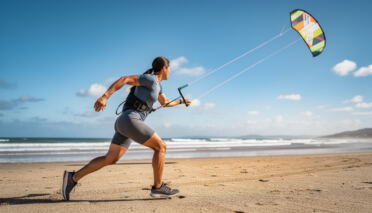
Finally, Maya separates skill-building phases. She becomes a “stunt pilot” first: parking the kite, flying clean figure-eights, controlling speed, and stopping power spikes. Only after that does she allow the kite to tow her. One thing at a time is not just easier—it’s safer, because your brain isn’t juggling traction, steering, balance, and panic all at once. The insight she writes in her notes: the best training location is the one that forgives your worst timing.
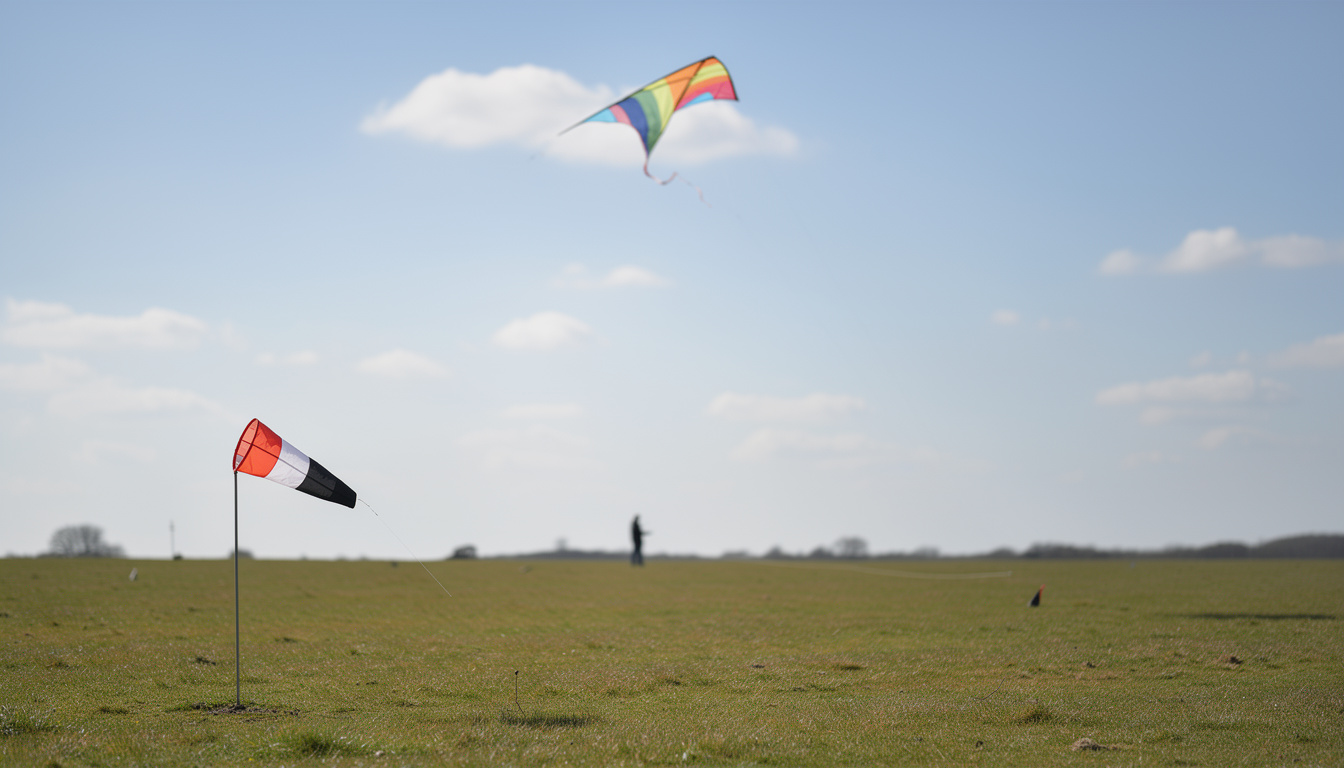
Beginner-friendly sites on land: fields, dry lake beds, and parks built for control practice
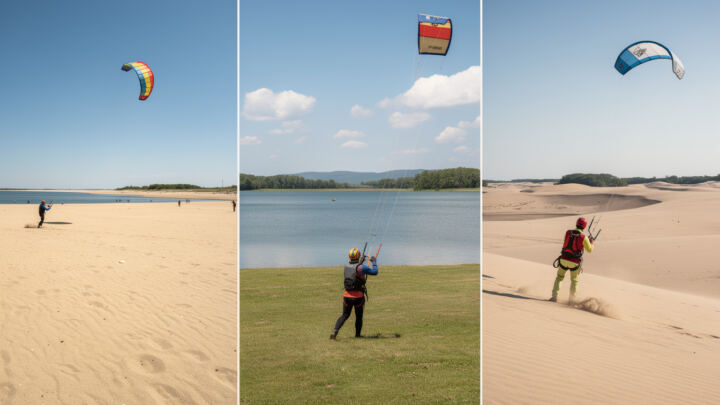
Land-based practice is where Maya makes the fastest progress, because it strips away a bunch of variables. No waves, no current, no deep-water relaunch drama—just kite control and your footing. The best beginner-friendly sites on land share a few traits: huge open spaces, clean wind exposure, and ground that’s predictable when you stumble. Think big grassy athletic fields (when permitted), wide meadows, or expansive dry lake beds where the horizon is basically empty.
She starts with a trainer kite in light wind, using a field that’s at least a few football pitches across. The key is not the exact size, but the “error margin”: if the kite dives, where does it go? If she gets pulled unexpectedly, what does she hit? A good field has an empty downwind buffer. “Downwind” is the direction you’ll travel if things go wrong—so Maya sets up with the widest clear zone in that direction, not behind her where it feels psychologically safer.
Managed parks can be fantastic, but they come with kiting regulations. Some parks designate specific areas or time windows, especially near multi-use trails. Maya checks signage and local bylaws before she unrolls her lines. She also watches how experienced riders set up: launch lanes, line management, and how they keep spectators out of the danger zone. In 2026, many communities post rules online or via QR codes at access points, so it’s usually easy to confirm what’s allowed.
Ground choice matters more than people admit. Grass is forgiving for early drags, while gravel is basically sandpaper at speed. Maya wears a helmet and gloves even for “just practicing,” because the weird accidents happen when you’re not taking it seriously. For buggying or landboarding, she adds pads because getting yanked into a slide is a normal part of learning—not a rare event.
How Maya tests a land spot in 10 minutes (before rigging up)
She does a quick walk and a wind check. She looks for turbulence markers: a treeline upwind, buildings, or cliffs that create rotor and sudden holes in wind. Clean wind isn’t about strength; it’s about consistency. A moderate breeze that’s smooth is easier than a strong breeze that’s gusty. She watches leaves, flags, and a windsock if there is one, then decides whether it’s a “trainer day” or a “go home day.”
She also sets a social boundary. If kids are playing soccer nearby or dog walkers are cutting through, she doesn’t try to “share” the space with an active traction kite. She chooses another field or waits. That one decision prevents a lot of the ugly stories that lead to bans and stricter rules. The closing thought she keeps repeating: a perfect field is useless if people keep drifting into your lines.
To see the basics of four-line control and why land practice builds safer habits, this is a helpful watch:
Beach kiting and coastal safe locations: tides, crowds, and clean wind lanes
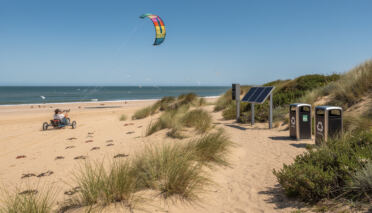
Beaches are the poster child for traction kiting, and for good reason: sand can be forgiving, the wind is often cleaner than inland, and there’s usually a big open launch zone. But “beach” doesn’t automatically mean safe. Maya quickly learns that beach kiting safety is mostly about timing and geography. A wide empty beach at low tide can be ideal; the same beach at high tide with families, umbrellas, and dogs becomes a hazard maze.
She scouts a spot that has a broad tidal flat and an obvious wind window free of obstacles. If dunes or buildings sit upwind, they can cause turbulence. If the beach is narrow, she passes—because when something goes wrong, you don’t drift into “more beach,” you drift into parking lots, seawalls, or crowds. Maya also avoids beaches with hard barriers downwind. A seawall looks harmless until you’re sliding toward it.
Crowd management is huge. She picks off-peak hours, like early morning, and she sets up far from entrances where foot traffic funnels through. She also respects any marked kite zones and asks locals about unwritten norms. Many coastal areas have explicit kiting regulations driven by prior incidents: set distances from swimmers, no launching near lifeguard towers, or seasonal closures for wildlife. Breaking these rules doesn’t just risk a ticket; it risks access for everyone.
Wind safety on the beach: why “steady” beats “strong” every time
Maya looks for consistent wind and avoids storms, squalls, and frontal days where wind swings direction fast. Coastal wind can ramp up quickly, and beginners often underestimate how much extra power arrives with a small increase in speed. She starts underpowered on purpose, focusing on control rather than speed. When she does increase kite size or wind range later, she does it gradually so her reactions keep up with the pace.
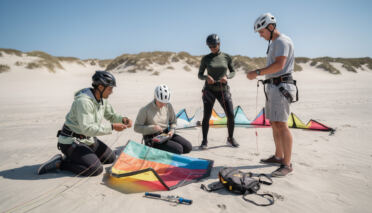
She also practices safe launching and landing with help. Solo launching is possible, but early on it’s where a lot of mistakes happen: lines crossed, kite overpowered at the edge of the window, or a sudden gust turning a calm setup into a sprint. A simple assisted launch, done correctly, is one of the easiest ways to reduce risk.
One more beach-specific piece: sand can hide debris. Maya checks for driftwood, shells, and litter that can snag lines. She keeps her lines organized, because tangles under tension can behave like a whip. Her end-of-section takeaway: the safest beach is the one that gives you space, rules, and a predictable rhythm.
Water practice and kiteboarding spots: choosing safe launches, exits, and rescue-friendly zones
Water adds glamour—and complexity. The best kiteboarding spots are often famous for steady wind and smooth water, but Maya doesn’t chase fame; she chases water safety. She picks locations with easy exits, shallow training areas, and room downwind where a failed tack doesn’t send her into a marina.
Her first sessions happen in waist-deep water with a sandy bottom. That depth is a sweet spot: shallow enough to stand and reset, deep enough to reduce impact if she falls. She avoids rocky bottoms and reefs until she has reliable control. She also checks currents and tide flows, because being “pulled” by wind is one thing—being pulled by wind and current is where people get separated from launch areas fast.
Maya makes a habit of looking for three things before rigging: where she can safely launch, where she can safely land, and what happens if she loses power. A good practice area has multiple bailout points downwind: beaches, gentle shoreline, or open shallows. A bad one has cliffs, jetties, private property, or boat channels downwind. She also stays well away from swimmers and paddlers. Lines under load can seriously injure someone, and nobody on a paddleboard signed up to be part of your learning curve.
Safety systems on water: releases, depower, and the “panic-proof” routine
On water, a harness release can be life-changing. Maya drills her quick-release routine on land, then repeats it in shallow water so it’s automatic. If she rides a fully depowerable kite, she practices dropping the bar to kill power quickly. These are not “advanced techniques”—they’re the emergency brake.
She also thinks about protective gear differently. Some riders skip helmets because it looks cooler, but Maya has seen enough wipeouts to know that high-speed water hits can be brutal. At speed, water stops feeling soft. A low-profile water helmet and impact vest are common in rougher conditions, and they make sense even in training if it helps you stay calm and confident.
Finally, she doesn’t train alone in new places. Even a buddy on shore who can call for help is a safety upgrade. Many modern spots have community groups that coordinate sessions and share live wind readings. In 2026, that “local intel” is one of the best risk reducers you can get for free. Her final line here: water sessions are only fun when the exit plan is obvious.
Want a visual breakdown of traction kite mechanics and why different environments change risk? This is a solid primer:
Rules, gear, and a practical checklist for wind conditions at safe locations
Once Maya has a shortlist of safe locations, she treats each session like a mini risk assessment—not dramatic, just practical. This is where many people mess up: they find a great spot, then ignore the day’s reality. A “safe beach” can become unsafe with gusts, storms, or crowds. A “perfect field” can become sketchy if the wind is blowing over a new construction site, adding turbulence and debris.
She follows a simple decision chain: check weather, check site rules, check equipment, then check herself. If any piece is off, she adjusts the plan or goes home. That last part—going home—is a skill. People get hurt because they feel committed after driving an hour. Maya refuses to let sunk cost dictate risk.
Kiting regulations and local norms: how access gets protected (or lost)
Kiting regulations exist for a reason, and usually it’s because somebody got dragged into something expensive or someone else got injured. Maya reads posted rules, looks up municipal guidance, and asks locals where the launch corridor is. She respects buffer zones near roads, airports, and protected wildlife areas. Many coastal regions also enforce seasonal restrictions near nesting sites. Ignoring that isn’t “rebel energy”—it’s how you lose a spot for everyone.
Gear choices that match wind safety, not ego
Maya’s gear rule is straightforward: dress for the slide, not the selfie 😅. If she’s buggying or landboarding, she wears a helmet, gloves, and pads because gravel rash is instant and miserable. If she’s on water, she considers a helmet and impact vest, especially in stronger wind or choppier water. And she never rigs a kite size that “might work” if the wind picks up; she rigs for the wind that’s actually there, plus a little margin for gusts.
| ✅ Factor | What “Good” Looks Like | Red Flag 🚩 | Quick Fix / Safer Choice 🛠️ |
|---|---|---|---|
| 🌬️ Wind conditions | Steady, clean airflow with manageable gust spread | Gale-force gusts, sudden direction swings | Downsize kite, switch to trainer, or postpone |
| 🧱 Obstacles | Wide open spaces with clear downwind buffer | Trees, poles, cars, seawalls downwind | Move to a larger zone or change angle/launch point |
| 👥 People density | Low traffic and clear kite area | Crowded beach, busy park, dog walkers crossing lines | Go early/late, use designated kite zone, relocate |
| 🌊 Water safety | Shallow training area, easy exits, no strong current | Rip currents, boat channels, rocky shore | Choose a supervised lagoon or a known learner area |
| 📜 Local rules | Clear kiting regulations and community norms | Confusing access, frequent conflicts, “no kites” signs | Contact local club, follow posted guidance, pick another spot |
A checklist Maya actually uses (and you can steal)
- 📖 Read the kite’s safety notes and line plan before the first flight (yes, every new kite).
- 🧪 Test releases and depower on land with zero pressure.
- 🧭 Identify your downwind “crash lane” and keep it empty.
- 🪖 Wear a helmet when you’re likely to get dragged; add pads if the surface is rough.
- 🤝 Ask one local question: “Where do beginners rig and launch here?”
- ⏱️ Keep early sessions short; quit before fatigue turns you sloppy.
By the time Maya is comfortable, she realizes “best location” is rarely a single famous place. It’s a pattern: space, consistency, rules, and an exit plan. Next time you pick your practice zone, ask yourself one blunt question: if the kite surges right now, does this place still feel smart?
What are the best safe locations for traction kiting when you’re brand new?
Look for beginner-friendly sites with huge open spaces, smooth ground (grass or firm sand), and clean wind exposure. Avoid obstacles downwind, avoid crowds, and prioritize places with clear kiting regulations or established local norms so you’re not guessing where it’s acceptable to launch.
How do I judge wind conditions quickly before setting up?
Use simple signals: a windsock/flag behavior, consistent direction, and whether gusts feel sharp and frequent. If the wind is swinging a lot, pulsing hard, or you see signs of incoming weather, treat it as a no-go for learning. Stable, moderate wind is better than strong, gusty wind for wind safety.
Is beach kiting safer than inland fields?
It can be, because beaches often have cleaner wind and soft sand, but only if the beach is wide, not crowded, and doesn’t have hard barriers like seawalls downwind. In peak hours, a beach can be less safe than a quiet field because people wander into your launch area.
What makes a kiteboarding spot safer for practicing on water?
A safer water spot has shallow training zones, easy exits downwind, minimal current, and plenty of space away from swimmers and boats. Add a culture of mutual help (locals who assist launches/landings) and clear access rules, and you’ve got a much safer place to progress.
Do I really need lessons if I’m only doing traction kiting on land?
Lessons aren’t mandatory, but they reduce risk fast because you learn launch/landing, emergency releases, and wind window control correctly from day one. If you skip instruction, build skills in stages: master stunt control while standing still first, then move to being towed—one task at a time.