En bref
- 🌬️ Traction kiting turns ordinary wind into controllable pull by managing lift, drag, and line tension.
- 🧠 The “secret sauce” is apparent wind: fast kite motion multiplies usable force way beyond the true breeze.
- 🧭 The wind window isn’t just a diagram; it’s a map of where power comes from and where safety lives.
- 🪢 Your lines are sensors: changes in tension tell you about speed, angle of attack, and impending stalls.
- 🧰 Technique matters as much as equipment: edging, sheeting, and steering shape the aerodynamics in real time.
- ⚠️ Most scary accidents come from misunderstanding how quickly power scales with kite speed.
On the surface, traction kiting looks like a simple trade: you bring a canopy to the beach, the wind shows up, and you get pulled. But once you actually hook in and feel the lines load up, you realize the real engine is not the breeze you’re standing in—it’s the fast-moving wing you’re flying. The kite isn’t passively “catching wind”; it’s actively building its own airflow, and the resulting physics is closer to piloting a small aircraft than holding a toy.
This is why a rider can cruise in what feels like a mild day, then suddenly get yanked when the kite sweeps through the power zone. The same canopy, the same true wind, but a totally different story in terms of force. That shift comes from aerodynamics: how lift and drag scale with speed, how angle of attack changes with bar input, and how the lines translate wing forces into human motion. If you’ve ever watched someone “send” a kite and boost effortlessly, you’ve seen applied physics with a grin.
Understanding the physics behind traction kiting: lift, drag, and the real source of pull
Let’s get one thing straight: traction kiting isn’t powered by “wind pushing you.” The pull you feel comes from an aerodynamic wing generating lift and drag, with the lines converting that into tension you can ride against. The kite behaves a lot like a simplified airplane wing, except you’re the fuselage and your harness is the “mount.”
The core physics pieces are familiar: air moving over the canopy creates pressure differences, generating lift (roughly perpendicular to the airflow) and drag (roughly along the airflow). The combined aerodynamic result is a net force vector. Your lines point toward the kite, so the only thing you can “feel” is tension along that line direction—yet that tension is born from the kite’s lift/drag balance.
Why “lift” can pull you sideways (and why that surprises beginners)
People hear “lift” and think “up.” In traction kiting, lift is better thought of as “sideways relative to airflow,” which can be up, down, forward, or sideways depending on where the kite is in the wind window and how it’s moving. If the kite is parked high, the pull has a bigger upward component, which can lighten you. If it’s low and fast, the pull becomes more horizontal, which is prime for speed.
This is one reason early kiteboarding pioneers in the late 20th century could scale up kite area and suddenly have enough pull to move a rider on water, snow, or land. Bigger wing, more potential lift, more usable traction—simple idea, but not simple consequences.
Angle of attack, sheeting, and how you “tune” aerodynamics mid-ride
When you sheet the bar, you’re changing the kite’s angle of attack. Increase it and you typically get more lift—until you don’t. Past a certain point, airflow separates and the wing stalls, which can spike drag, kill smooth pull, and make the kite behave unpredictably. The trick is that the rider isn’t just adjusting power; they’re adjusting the wing’s aerodynamic regime.
Imagine a fictional rider, Maya, learning in steady sea breeze. When she over-sheets, the kite feels “grunty” but sluggish. When she eases off slightly, the canopy accelerates, lines smooth out, and the pull becomes efficient. Same true wind, different aerodynamic efficiency—this is the practical face of physics.
Table: quick aerodynamics map for traction kiting decisions
| Situation | What’s happening in aerodynamics | What you feel in tension & motion |
|---|---|---|
| 🪁 Kite parked near zenith | More vertical component of net force; typically lower apparent wind | ⬆️ Lighter board pressure; steadier tension, less speed |
| ⚡ Fast dive through power zone | Apparent wind rises; lift and drag climb quickly with speed | 💥 Sudden load-up; strong forward pull and acceleration |
| 🧯 Over-sheeted / near stall | Flow separation; drag increases; lift becomes inefficient | 😬 Jerky pull; canopy feels “sticky,” may back up |
| 🧭 Smooth crosswind cruise | Stable angle of attack; efficient lift-to-drag ratio | 🏄 Consistent speed; manageable tension and control |
The takeaway is brutally simple: the kite’s aerodynamics decide whether your ride feels like a mellow tow or a turbo boost. Once you accept that, it’s natural to ask the next question—where does that “extra power” come from if the wind feels the same?
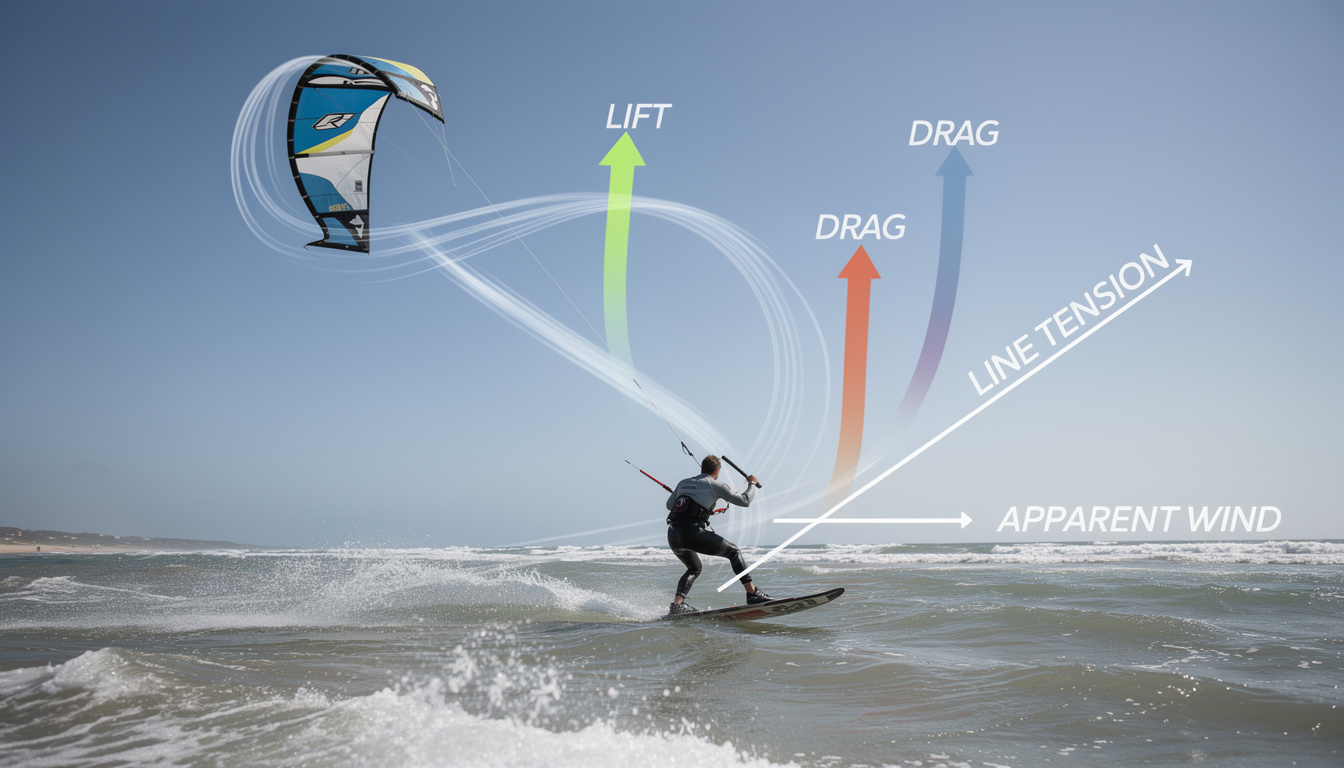
Understanding apparent wind in traction kiting physics: why kite speed multiplies force
The biggest mental unlock in traction kiting is apparent wind. A windsurf sail mostly works with the wind that hits it. A kite, on the other hand, mainly needs wind to stay flying; once moving, it manufactures faster airflow across itself. That self-created airflow is what turns “nice breeze” into “whoa, that’s power.”
Here’s the key relationship riders feel before they can explain it: aerodynamic forces scale strongly with speed. In simplified terms used in coaching and safety briefings, if the airflow speed over the kite doubles, the resulting aerodynamic force can rise about fourfold because dynamic pressure scales with the square of velocity. That’s why a kite that’s gently parked can feel tame, but the same kite swooped aggressively can feel like someone hit fast-forward.
How apparent wind actually forms during a kite loop or dive
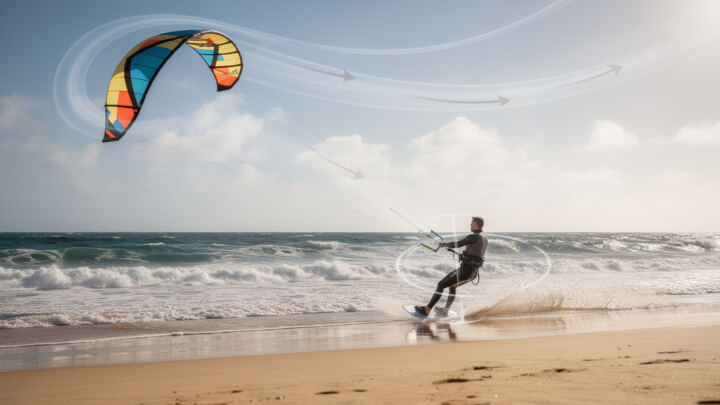
Think of two velocities adding together: the true wind and the kite’s own motion through the air. The kite “sees” the vector sum. When you steer the kite across the window, you increase its airspeed, which increases the apparent wind. The kite then generates more lift and drag, which increases line tension, which can accelerate you—so you start moving faster too, further reshaping the apparent wind at the system level.
That feedback loop is why traction kiting is so addictive and so unforgiving. It’s also why many first-timers historically got injured: they judged power by standing wind, not by kite speed. A trainer kite lesson today (especially with modern depower systems and better instruction culture) is basically a controlled way to feel that scaling without getting launched.
Example: two riders, same wind, totally different power
Picture Maya again, now riding next to her friend Leon. Same beach, same 18-knot side-on breeze. Leon keeps his kite moving in smooth S-turns to build apparent wind, then edges hard to convert pull into board speed. Maya parks her kite high because she feels safer there. Leon is planing fast; Maya is slogging. That isn’t “fitness”; it’s different use of physics and aerodynamics.
And it goes the other way too: an advanced rider can intentionally kill power by slowing the kite down, parking it, and reducing apparent wind, even if the true wind is steady. It’s like downshifting a manual car: you’re managing system speed to manage available torque, except here it’s airflow and lift.
Practical checklist: cues that apparent wind is spiking
- ⚠️ Line tension rises sharply during a dive, even before your board accelerates.
- 🎯 The kite feels “crisp” and responsive rather than mushy, indicating higher airspeed.
- 🌊 Your spray increases and the board starts to hum—classic signs your motion is catching up to the pull.
- 🧤 You need more edging force to resist being pulled downwind.
Once apparent wind clicks, the wind window stops being a beginner diagram and becomes a power map. That’s where we’re headed next: how geometry and vectors decide what you can do safely and efficiently.
If you want a visual explainer that matches what you feel on the water, it helps to watch a slow-motion breakdown of kite sweeps and loops.
Wind window physics for traction kiting: vectors, power zone, and controlled motion
The wind window is basically the kite’s 3D playground, but it’s also a diagram of force direction. Where the kite sits determines the direction of line tension; how it moves determines the magnitude. Riders talk about “edge of window,” “deep in the window,” “zenith,” and “power zone” because those are shorthand for vector math you can feel through your harness.
At the edge of the window, the kite flies closer to where the airflow aligns with the lines, often reducing effective pull. As you steer it deeper across the window, the kite can generate a stronger component of lift that translates into higher tension. The “power zone” is not a magical place; it’s a region where the geometry and speed combine to deliver big loads.
Vector thinking without the headache: where does the pull point?
Imagine drawing an arrow from you to the kite—that’s line direction. The kite’s net aerodynamic force must be balanced by line tension (ignoring small effects), so the tension points along the lines. When the kite is low and to the side, that arrow is more horizontal, which tends to accelerate you downwind unless you counter with board edging or buggy steering. When the kite is high, the arrow tilts upward, which can reduce your contact force with the ground or water.
This is why a simple kiteboarding description still holds up: you’re connected to both kite and board, and your body is the only “link” managing both. Your hips and legs resist the kite; your hands steer the wing. That coordination problem is the sport.
Edging: converting kite force into speed instead of downwind drift
Edging is basically your way of creating an opposing hydrodynamic (or frictional) force so that the kite’s pull turns into forward motion rather than sideways sliding. On water, your board and fins generate resistance; on snow, it’s the edge bite; on land with a buggy, it’s tire grip. In all cases, you’re managing the balance of forces: kite tension versus ground reaction.
When Leon wants to go upwind, he doesn’t need a different kite; he needs a different vector balance. He keeps the kite slightly higher, maintains speed to keep apparent wind alive, and increases edge pressure so the resultant pulls him forward rather than downwind. It’s a constant negotiation between lift, drag, and the forces at your board.
Micro-mistakes that cause macro-problems
A small steering input can cause the kite to accelerate, raising apparent wind and multiplying force. A moment of hesitation can leave the kite too deep, yanking you off edge. This is why coaching emphasizes smooth control: you’re not just “turning the kite,” you’re modulating an aerodynamic engine.
It also explains why modern safety systems matter: quick release, effective depower, and predictable relaunch reduce the consequences when the vector math goes wrong. Still, physics doesn’t negotiate—if you send the kite hard through the power zone, the lines will tell the truth immediately.
The next step is to zoom into those lines themselves, because they’re more than string. They’re the transmission, the steering column, and the warning alarm all at once.
Seeing the wind window drawn over real riding footage can make the geometry feel obvious in minutes.
Line tension and control physics in traction kiting: stability, oscillations, and feedback
If the kite is the wing, the lines are the drivetrain. They carry tension, communicate kite position, and enforce stability (or amplify instability) depending on how you fly. A lot of “good kite feel” is really your nervous system learning to interpret line load as data: speed, angle of attack, and whether the kite is about to surge or stall.
In physics terms, the rider-kite system is a coupled dynamic setup: the kite has mass and aerodynamic damping, the rider has mass and stance, and the lines behave like tensioned springs with very low stretch (modern materials help) but still enough elasticity to matter. Add gusty wind and wave impacts, and you get a system that can oscillate if you excite it the wrong way.
Why “tension goes slack” is a big deal
When lines go slack, steering authority drops and the kite can drift, backstall, or surge unpredictably once tension returns. Slack can happen if you ride toward the kite too fast, if the kite is too high and you stop moving, or if you dump power abruptly while the kite still has momentum.
Maya’s coach gives a simple rule: aim for “loaded but not yanked.” That means enough tension to keep the canopy flying cleanly, but not so much that you’re one gust away from losing edge control.
Depower systems as applied mechanics
Modern depower isn’t magic; it’s leverage and geometry. By changing the relationship between front and back line lengths, you change the kite’s angle of attack and therefore its lift/drag balance. The practical effect is that you can reduce peak loads while keeping the kite stable. That’s especially relevant in 2026 riding culture, where more people ride varied disciplines—foil, surfboard, twin-tip—and expect smooth control across different apparent wind ranges.
But depower has a catch: reducing angle of attack too much can make the kite fly forward and feel “light,” which is comfortable until you realize you’ve also reduced the buffer against lulls. The system stays safe when the rider actively manages speed, position, and steering—again, it’s a feedback problem, not a set-and-forget appliance.
Safety physics: why quick releases exist (and when they matter most)
In the worst-case scenario—unexpected gust, kite accelerating through the window, rider losing edge—the line tension can climb faster than your ability to react. Quick releases are designed to cut the mechanical connection before the situation becomes a high-energy accident. This is directly tied to the earlier apparent-wind scaling: high kite speed can create massive loads quickly.
A grounded way to think about it: your job isn’t to be fearless; it’s to keep the system’s stored energy (speed + line load) within a range you can dissipate through edging, steering, or depower. That’s not just safety talk—it’s basic energy management.
To wrap this section with a usable insight: the smoother your inputs, the smoother your line loads, and the more predictable the kite’s aerodynamics become. With that in mind, it’s time to connect physics to technique—because skill is basically physics you can execute.
Applying traction kiting aerodynamics to technique: edging, loops, jumps, and efficient motion
Technique is where the physics stops being theoretical and starts paying rent. Every classic move—waterstart, upwind tack, transition, jump—comes down to controlling kite speed (apparent wind), managing lift/drag, and shaping line tension so your body can handle it.
Waterstarts: the cleanest example of force timing
A good waterstart is basically a timed impulse. You position the kite, then dive it to generate a ramp-up in tension. If you dive too aggressively, you get pulled over the board. Too gently, and you sink. The sweet spot is a smooth increase in pull that lets you stand while the board begins moving, which increases apparent wind and sustains the ride.
Maya’s breakthrough came when she stopped staring at the canopy and started feeling the timing through her harness. She learned to wait for the moment the lines load, then extend her front leg and edge slightly, converting pull into forward motion.
Loops and aggressive steering: controlled risk via aerodynamics
Kite loops are the clearest demonstration of apparent-wind multiplication. A looping kite can maintain high airspeed throughout the turn, keeping dynamic pressure high. That can be amazing for generating pull in light conditions, or for landing support in jumps. It can also be violent if you’re not ready, because the force peak can arrive mid-loop when the kite accelerates through the power zone.
The aerodynamic trick advanced riders use is managing radius and timing: a tighter loop can spike pull quickly; a wider loop can spread the load. Bar input changes angle of attack, which affects whether the kite accelerates cleanly or bogs down in drag.
Jumping: turning line tension into airtime
A jump is just vector management. You build speed (apparent wind), then redirect the kite upward so the line tension has a strong vertical component. Your board edge provides a brief “platform” to store energy, then you release it. The kite’s lift supports you while you float, and steering determines where you land.
It’s why riders talk about “send it” and “catch it.” Sending increases upward tension; catching means moving the kite forward again to generate forward pull for a soft touchdown. This is also why beginners sometimes get dropped: they create lift but don’t reintroduce forward pull at the end.
A practical drill list that’s basically physics training
- 🧭 Fly figure-eights at the edge of the window to learn low-power control while keeping steady tension.
- ⚡ Do small, progressive dives and recoveries to feel how apparent wind builds with kite speed.
- 🏄 Practice edging harder without steering more—separating board control from kite control improves system stability.
- 🪢 One-handed riding (in safe conditions) to feel micro-changes in line load and prevent over-input.
The recurring theme is simple: don’t fight the kite’s aerodynamics—shape them. That sets up the last piece people always ask about: how to translate all this into safer gear choices and smarter sessions.
Why does a traction kite feel exponentially stronger when I steer it faster?
Because the kite creates higher apparent wind as it speeds up. Aerodynamic force depends on airflow speed strongly (commonly taught as roughly scaling with the square of speed), so a fast sweep through the window can multiply lift, drag, and line tension even if the true wind stays the same.
Is the pull from the kite mostly lift or drag?
It’s a combination. The kite generates both lift and drag; the lines transmit the resulting net force as tension. Efficient kites and efficient riding aim for a high lift-to-drag balance so you get strong, controllable traction with less wasted drag.
What’s the quickest way to reduce power without panicking?
Slow the kite down and move it toward the edge of the wind window while maintaining control. Easing the bar (reducing angle of attack) can lower lift, and parking higher can change the force direction. If you’re genuinely overpowered, use your depower and be ready to activate the quick release.
Why do my lines sometimes go slack during transitions?
Slack happens when your board motion briefly moves toward the kite or when the kite is positioned in a way that reduces tension (often near zenith in a lull). Keeping a bit of speed, steering smoothly, and avoiding abrupt bar dumps helps maintain consistent tension and kite stability.