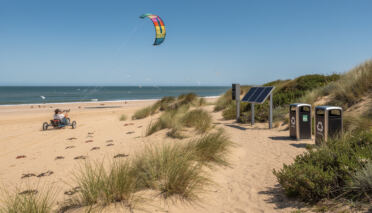
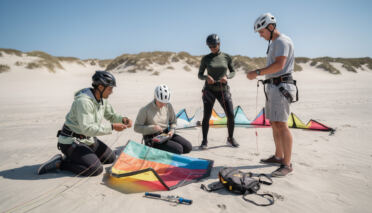
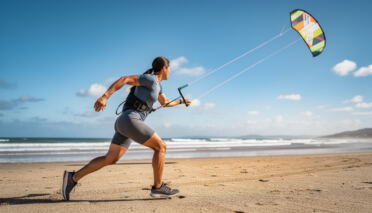
On paper, traction kiting looks simple: hook in, send the kite, feel that sweet pull, and cruise. In real life, weather is the invisible co-pilot that decides whether your session feels like a controlled glide or a chaotic tug-of-war. The same kite can feel buttery smooth one day and weirdly “grippy” the next, even if the forecast claims the wind speed is identical. That’s the sneaky part of weather impact: it’s not just how hard the wind blows, but how it flows—gusts, lulls, direction shifts, thermals, and turbulence from terrain all shape your kite performance and your ability to manage kite control.
To make this concrete, follow a rider we’ll call Sam. Sam rides on a beach, a grassy field, and occasionally a snow spot up in the hills. Sam’s “best sessions” aren’t always the windiest—they’re the ones where the air is clean, the direction is steady, and the gusts don’t punch like a boxer. And Sam’s “sketchiest sessions” aren’t always storms; sometimes it’s a sunny afternoon with a thermal switch that turns the launch into a mess. If you want a better kiting experience, it helps to treat the forecast like a story, not a number. Let’s break down how conditions change your traction, your power, your safety margins, and how you plan a session that feels fun instead of frantic.
En bref
- 🌬️ Wind conditions matter more than raw wind speed: steadiness beats “average” numbers.
- ⚠️ Gusts and turbulence can wreck kite control even with a “safe” forecast.
- 🧭 Wind direction + terrain = hidden rotor zones that change traction kiting risk fast.
- 🌡️ Temperature, pressure, and thermals shift kite performance and timing windows.
- 🌧️ Rain, humidity, and cold affect grip, line handling, and kiting safety choices.
- 🧠 Good sessions come from a plan: site selection, kite size, and a clear abort option.
Reading Wind Conditions for Traction Kiting: Gusts, Lulls, and the Real Story Behind Wind Speed
Most riders start by checking wind speed, but that’s like judging a movie by the poster. What you actually ride is the moment-to-moment airflow at your launch and along your path. In traction kiting, those micro-changes decide whether the kite sits calmly in the window or yanks you off-edge when you least expect it. Sam learned this the hard way on a day that read “18 km/h, steady.” The beach felt fine—until random 5-second spikes hit 28 km/h. That difference isn’t trivia; it’s the difference between cruising and being overpowered.
The first layer is the gust factor: the spread between lulls and peaks. A “15–25” day rides totally differently than a “18–20” day, even though the average looks similar. Gusty airflow forces constant correction, and that can drain your focus faster than a long run. It also increases the chance of accidental lofting on land, because a punchy gust can load the kite suddenly, especially near the edge of the window.
Why gusts mess with kite control (and how to feel it early)
Gusts don’t just add power; they change how the kite responds to input. When a spike hits, your lines tension up, the kite accelerates through the window, and you get that “snatch” feeling. If you’re edging on a board or digging heels on land, you may hold it—but your margin shrinks. Sam’s trick is simple: if the kite starts surging forward unexpectedly, that’s a cue to depower and bring it higher, because the next gust might be worse.
Meanwhile lulls are their own problem. In a lull, the kite can backstall or fall out of the sky, especially with heavier kites or sloppy trimming. Riders then over-steer to “save” it, and when the wind returns, the kite rockets. That sequence—stall, over-correct, slam—is a classic setup for a dragging incident. Clean technique helps, but so does picking conditions that aren’t constantly switching moods.
A practical wind-speed-and-stability table you can actually use
Here’s a quick way Sam frames a session plan. It’s not a substitute for your kite’s chart, but it keeps the decision grounded in reality rather than ego.
| Wind range & quality | What it feels like | Impact on kite performance | Safety call |
|---|---|---|---|
| 🟢 8–14 km/h, smooth | Light pull, lots of walking/working | Needs efficient flying; relaunch may be slower | Good for skills; avoid crowded spots |
| 🟢 14–22 km/h, steady | Comfortable power band | Responsive handling, predictable loops | Best window for progression |
| 🟠 14–22 km/h, gusty (big spread) | Random punches, sudden slack | Inconsistent pull, higher correction load | Rig smaller; shorten session; watch launches |
| 🟠 22–30 km/h, steady | Fast, exciting, easy to get overpowered | High apparent wind; mistakes amplify | Only if you’ve got space + experience |
| 🔴 Any speed with storms/violent squalls | Unstable, shifting, “itchy” air | Potential for extreme spikes and direction swings | Don’t launch—period ⚠️ |
The key takeaway is simple: wind conditions define the “character” of the session. Numbers matter, but stability is the difference between riding and reacting. Next up: how terrain and direction quietly reshape the wind you think you’re getting.
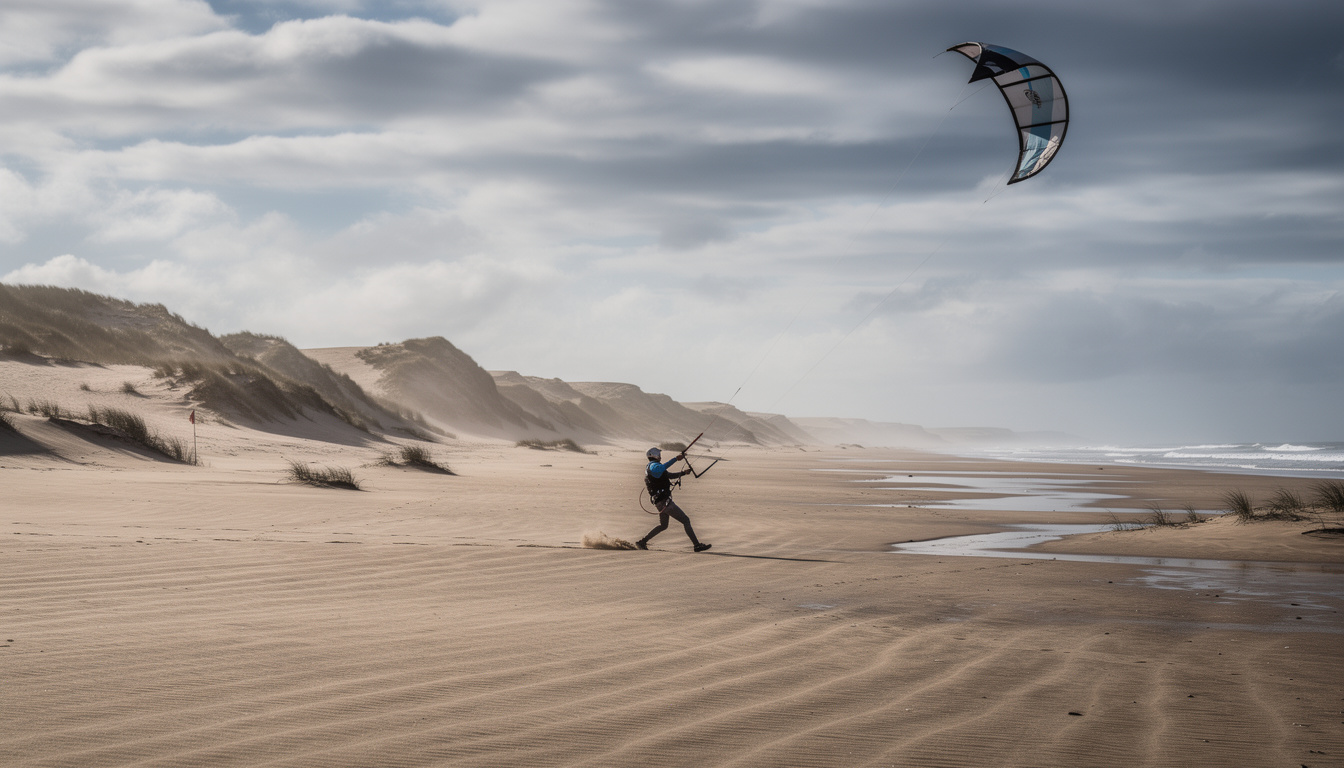
Weather Impact on Traction and Terrain: How Wind Direction, Obstacles, and Surface Change Your Pull
Sam used to assume that if the beach flag points sideways, the wind is “side-on” and everything’s fine. Then Sam tried the same setup at a grassy field bordered by trees and got rocked by invisible turbulence. Here’s the blunt reality: weather impact is always filtered through terrain. Wind that’s clean over open water can become choppy over dunes. Airflow that’s perfect on a frozen lake can turn nasty near a ridgeline. In traction kiting, that filtering changes both the kite’s behavior and your ground traction—literally how well your feet, board, or skis bite.
Let’s talk about traction itself. On sand, you can edge and slide; on grass, the grip might be higher, so a gust loads your body harder. On snow, the surface can be fast but inconsistent—powder drags, crust skitters, ice is basically a skating rink. Same kite power, totally different consequences. Sam’s “15 km/h grass session” felt more intense than a “20 km/h beach session” because the ground didn’t give as much.
Wind direction: the quiet kingmaker
Wind direction controls your safety buffer. Side-on or side-shore gives you room to drift downwind without instantly meeting something solid. Offshore on water is a rescue problem; on land it’s a “good luck stopping” problem. Even slight shifts matter. A 20° veer can turn a safe launch lane into a downwind hazard zone. Sam now checks not just direction but direction stability—if the forecast shows frequent swings, the session plan changes.
Terrain creates acceleration and dead zones. Wind compresses around headlands, funnels through gaps, and tumbles behind obstacles. That tumble is rotor: chaotic air that can make a kite hindenburg or surge unexpectedly. If you’ve ever felt the kite suddenly lose pressure near a dune and then slam back to life, you’ve met rotor.
A field checklist Sam uses before even unrolling lines
- 🧭 Identify the downwind “nothing zone”: open space where you can safely get dragged if things go wrong.
- 🌲 Look for turbulence makers: trees, buildings, cliffs, dunes, parked cars—anything that breaks airflow.
- 🧱 Note hard consequences: fences, rocks, roadways, waterline, ice patches ⚠️
- 👀 Watch other kites/flags for 5 minutes: are they pulsing (gusty) or stable?
- 🦶 Test the surface: can you stop on it? Can you pivot? Is it slick, grabby, or rutted?
That last point—testing the surface—gets overlooked. Weather changes surfaces fast. A warm morning can soften snow into sticky slush by noon. A quick shower can turn sand into a firmer, faster runway. A cold snap can glaze a lake with slick ice. Those changes modify your speed and stopping distance, which should feed right back into kite size and risk tolerance.
Once you understand how direction and ground interact, you can start planning sessions around “clean wind corridors” instead of just “windy places.” The next step is dialing in what different weather patterns—thermals, fronts, pressure changes—do to your kite and timing.
Want a quick visual refresher on wind windows, gust handling, and setup basics? This video search is a solid starting point before you geek out on forecasts.
Choosing Timing and Kite Setup: Thermals, Fronts, Pressure, and Their Effect on Kite Performance
If you’ve ever had a session where the wind “turns on” like a switch, you’ve felt thermals. If you’ve ever had a day where the forecast was okay but the air felt angry and unpredictable, you’ve probably been near a front. These patterns are where weather goes from background detail to main character, because they shape consistency—arguably the #1 driver of good kite performance and relaxed decision-making.
Sam’s favorite sessions often happen on clear afternoons at the coast. The reason is simple: land heats up faster than water, warm air rises over land, and cooler air flows in to replace it. That sea-breeze cycle can create a steady, buildable wind that’s smoother than a random gradient day. The catch? Thermals can also shift direction and increase speed quickly. If you rig for the early lull and the thermal fills in hard, you’re suddenly overpowered.
Fronts and pressure gradients: when “average wind speed” lies
Weather apps love averages. Fronts don’t care. Ahead of a cold front, you can get pre-frontal gusts and unstable direction. Behind it, wind may be strong but cleaner—unless showers keep cycling through. Pressure gradient wind (tight isobars on a chart) can mean sustained strength, but add local terrain and you might get jet-like bursts. Sam’s rule: if there’s a front line or squall risk, the session becomes “short and conservative” or “not today.” That’s not being dramatic; it’s practical kiting safety.
Another subtle factor is air density. Cooler air is denser, which can make the kite feel a bit more “solid” for the same measured speed. Warm, thin air can feel softer. It’s not magic; it’s physics. You don’t need to calculate it on the beach, but it helps explain why a crisp winter day can feel punchy even when the numbers look moderate.
Trimming and tuning: small moves that change everything
When conditions are variable, trimming becomes your best friend. Depower strap, bar throw, and brake inputs (especially on foils) help keep the kite in a controllable range. Sam started treating trim like gearing on a bike: you wouldn’t climb a hill in the wrong gear just because you “usually” do. Same logic here—set the system to match the day.
Here are setup habits that improve control without killing the fun:
- 🪢 Pre-flight line check: equal lines reduce weird turning bias when gusts hit.
- ⚙️ Trim for the peaks, not the lulls: you can work the kite in light moments, but you can’t undo a surprise punch.
- 🧤 Choose gloves/grip for the weather: cold hands reduce reaction time, which is a real safety factor ⚠️
- 🧠 Decide your “stop point”: a clear condition where you land the kite (wind building past X, direction shifting, dark clouds approaching).
That stop point is huge. Weather changes are normal; ignoring them is optional. And because planning matters, the next section gets practical about forecasts, on-site observation, and simple red flags that keep your sessions from turning into stories you don’t want to tell later.
For forecasting and reading clouds/fronts in a kiting context, this search pulls up helpful explainers that connect meteorology to actual session decisions.
Kiting Safety in Changing Weather: Red Flags, Smart Abort Plans, and Safer Launch Choices
People love to talk about tricks and speed, but the riders who keep progressing are the ones who stay uninjured. That’s why kiting safety is basically “weather literacy + humility.” Sam’s biggest improvements didn’t come from buying a new kite; they came from learning when to pause, when to rig smaller, and when to call it. The hard truth: most bad incidents start before the kite even leaves the ground.
Weather-related hazards tend to stack. Gusts plus obstacles plus a crowded launch equals chaos. Rain plus cold equals numb hands and slower reactions. A direction shift plus limited downwind space equals a dragging scenario. The safest plan is the one that assumes conditions might deteriorate and gives you options.
High-signal red flags you shouldn’t negotiate with
Some signs are basically the weather yelling at you. Dark, fast-moving cloud lines. Sudden temperature drops. Wind that swings 30–60 degrees in minutes. Dust or sand lifting in pulses. Whitecaps suddenly exploding across water. Those aren’t “spicy conditions,” they’re instability indicators. Sam once watched a line of showers approach, told himself he had “ten minutes,” and then got hit by a gust that turned ten minutes into ten seconds. He now treats approaching squalls as a hard stop.
- ⛈️ Visible squall lines or thunder risk: don’t launch ⚠️
- 🌪️ Rotor/turbulence at launch (kite flapping, stalling): move spot or stop
- 🔁 Repeated strong gust-lull cycles: rig down or switch to training mode
- 🧍 Crowded downwind area: your margin is gone—choose another place
Abort plans that actually work under stress
An abort plan isn’t “I’ll just be careful.” It’s a specific sequence you can execute when your brain is busy. Sam keeps it simple: if the kite becomes hard to park, if he’s repeatedly forced to sheet out fully, or if he sees classic storm visuals, he lands. No debate. He also practices quick release handling in calm conditions so it’s not a mystery move when adrenaline hits.
Launch and landing deserve extra respect because that’s when you’re close to obstacles and not yet in your riding rhythm. In sketchy air, assisted launches help, but only if the assistant knows what they’re doing. Otherwise, it can add confusion. Self-launching in gusty weather is where lots of “I was fine for months” stories end badly.
One more underrated factor: other people’s decisions. If experienced riders are packing up while you’re rigging, that’s data. It doesn’t mean you must leave, but it means you should double-check the sky, the forecast trend, and your own motivation. Pride is not an anemometer.
With safety habits dialed, you can start enjoying weather variety instead of fearing it. The final section turns that into session strategy—how to pick spots, match kites, and build a routine that makes your kiting experience consistently good across seasons.
Building a Better Kiting Experience: Matching Kite Size, Spot Choice, and Goals to the Weather
Once Sam stopped chasing “big wind days” and started chasing “good flow days,” everything got easier: smoother power delivery, cleaner edges, and fewer sketchy moments. That’s the upgrade most riders want—more time actually riding, less time wrestling. The trick is building a simple strategy that links wind conditions to kite choice, location, and realistic session goals.
Start with goals. If you want to practice transitions or controlled jumps, you’ll learn faster in steadier air where kite control feels consistent. If you want to build strength and handle higher pull, you can choose stronger days—but only with space and a conservative setup. If you’re working on landboarding or buggying, surface friction becomes a bigger deal; what feels manageable on wet sand might be too much on grippy grass.
Spot selection as “weather filtering”
Think of a spot as a filter. Wide open beaches and frozen lakes tend to give cleaner airflow. Fields with tree lines create turbulence and lulls. Urban waterfronts can create weird venturi effects between buildings. Sam keeps a short list of “gust-friendly” places (open, consistent, lots of downwind room) and “light-wind-friendly” places (thermal spots, smooth surfaces, fewer obstacles). It’s not about one perfect location; it’s about matching place to day.
If you only remember one thing: pick the spot that gives you the most options if things change. Weather rarely stays perfectly stable for hours. A place with multiple safe landing zones and an easy exit route makes you calmer, and calm riders make better decisions.
Dialing kite size and style to conditions
Kite charts help, but your comfort range matters more. If the day is gusty, a slightly smaller kite often increases overall control because you’re not constantly dumping power. If the day is light and smooth, a larger kite can be enjoyable because the pull is predictable. Sam also considers kite type: some designs handle gusts more gracefully, others deliver more “on/off” power. Knowing your gear’s personality is part of reading the day.
Here’s a simple routine Sam uses to keep sessions consistent:
- 📲 Check forecast trend (building, dropping, swinging?) not just the current number.
- 👁️ Validate on site: flags, water texture, tree movement, cloud speed.
- 🪁 Choose kite for the top end if it’s unstable; choose for the middle if it’s steady.
- 🧯 Rehearse one safety action: where you’ll land, where you’ll ditch power if needed.
- 📝 After: note what you felt vs what the app said—your personal calibration grows fast.
That last step is underrated. Over a few weeks, you’ll notice patterns: maybe your local “18 km/h” always feels gustier due to terrain, or thermals always peak at a certain hour. That’s how you turn “random weather” into a predictable playbook—and that’s when traction kiting becomes less like gambling and more like craft.
How do I know if gusts are too much for traction kiting?
Look at the spread between lulls and peaks (the gust factor). If the wind repeatedly jumps hard enough that you’re forced to fully depower, the kite surges forward, or you can’t comfortably park it, conditions are pushing your control margin. In gusty weather, rig smaller, choose a cleaner spot, and prioritize safe launches and lots of downwind space ⚠️.
Is the same wind speed always the same power on the kite?
No. Temperature and air density can change how “solid” the pull feels, and terrain can add turbulence or acceleration. Two days with the same reported wind speed can deliver totally different kite performance depending on stability, direction, and local obstacles.
What wind direction is safest for land-based traction kiting?
Generally, side-on or side-shore style winds (relative to your riding area) give more room to manage drift and recover. Avoid directions that push you into hazards downwind. Also watch for direction instability—frequent swings can turn a safe setup into a bad one quickly.
How does rain or humidity affect a traction kiting session?
Rain can reduce visibility, cool your hands (slower reactions), and change surface grip—wet grass can get slick, sand can pack and speed up. Humidity and wet lines can also feel different in handling. Treat rain bands as a sign to reassess, because they often come with gust fronts and sudden shifts.
What’s the most important weather habit for better kite control?
Stop relying on a single wind number and start watching consistency: gust spread, direction stability, and visible signs like cloud movement and surface texture. When you build the habit of matching kite size and spot choice to real wind conditions, your control improves and your overall kiting experience gets smoother.