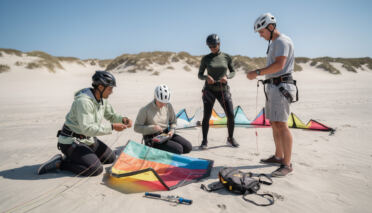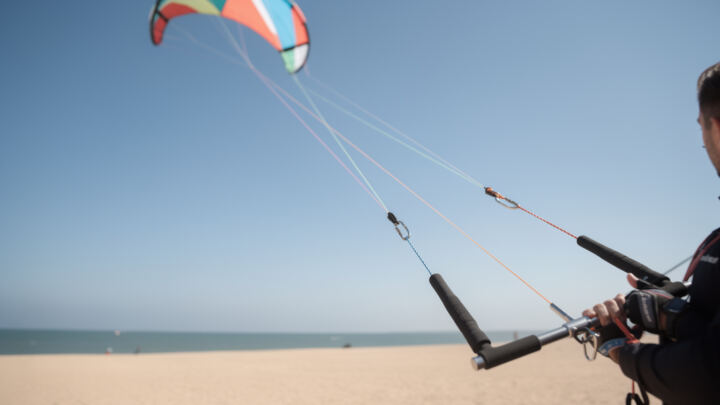
In traction kiting, the kite is the celebrity, but the kite lines are the quiet crew running the whole show. They’re the link that turns wind into pull, pull into speed, and speed into clean, predictable control. When things feel “off” on the beach or snowfield—random surges, sloppy steering, delayed response—it’s often not the canopy at all. It’s line tension, uneven stretch, worn fibers, or a setup that doesn’t match the day’s conditions. And because traction kiting lives closer to the edge than casual kite flying, small line issues can snowball into big moments fast.
What makes lines so important isn’t just strength; it’s how they manage power. Lines decide your kite control range, how well the kite sits at the edge of the window, how quickly it pivots, and how safely you can dump power. Add in variables like line length, wind resistance, pulley friction, knots, and different line materials, and you’ve got a system that’s basically a precision tool. Let’s walk through how these threads shape performance, safety, and technique—using real-world scenarios, not gear-shop mythology.
- 🧵 Kite lines are your power transmission: tiny changes in stretch and trim reshape the whole ride.
- 🧭 Balanced control lines keep steering crisp; mismatched lengths create drift, backstall, or surprise turns.
- ⚠️ Kite safety depends on clean depower travel, reliable quick-release behavior, and predictable line behavior under load.
- 📏 Line length changes power delivery, turning speed, and the size of your wind window.
- 🌬️ Wind resistance and drag matter more with longer sets and thicker lines—especially in light wind.
- 🧪 Choosing the right line materials (and caring for them) is how you prevent “mystery failures”.
- 🎯 Your kiting technique improves faster when your lines are tuned, equalized, and matched to your spot.
How kite lines transmit power in traction kiting (and why tension is everything)
Think of traction kiting as a conversation between wind and rider, and kite lines are the language. The kite generates force, but it’s the lines that deliver that force to your harness, arms, and stance. If that delivery is delayed, spiky, or inconsistent, the kite feels “moody.” That’s rarely personality; it’s physics—mostly line tension and how it changes while you move.
Meet Nate, a fictional but very real type of rider: solid on a mountainboard, decent on snow, and always chasing stronger wind. On a gusty day, Nate notices that his kite surges hard in the middle of the window and then feels oddly dead when he tries to edge away. What’s happening is classic: when he carves, his apparent wind shifts, and if his rear control lines go slack for a second, the kite loses its “steering bite.” Then, when tension snaps back, the kite re-engages aggressively. That “whip” feeling is often a tension management problem, not a kite size problem.
Understanding line tension: slack is not neutral
In traction sports, slack isn’t just a pause. Slack is uncertainty. When lines lose load, the kite can drift forward, overfly, or pivot oddly, and when tension returns it can do so abruptly. The goal isn’t “always tight”; the goal is predictable line tension that matches your movement and wind rhythm.
A simple example: when you send the kite for a jump on snow, you’re momentarily reducing your board pressure. That can soften tension. If your bar input is late and the lines go mushy, the kite may not climb cleanly and instead hovers, wasting lift. Riders often blame timing, but consistent tension makes timing easier.
The wind window, angles, and why front/back load balance matters
The front lines (power lines) carry most of the load, while the back lines fine-tune angle of attack and turning. If the front lines are effectively “shorter” (from stretch differences or trim), the kite sits more powered and may pull like a tractor. If the rear control lines are too tight, the kite can stall, fly backward, or feel twitchy.
Here’s the key insight: kite control is basically controlled imbalance. You steer by changing tension distribution. When that distribution is skewed before you even touch the bar, you’re fighting the setup all session. The next section gets practical: materials, lengths, and how to choose lines that behave the way you want.

Line materials, stretch, and wind resistance: choosing kite lines that behave under load
Most traction kiting lines look similar until you ride them hard. Then you start noticing how line materials behave: some feel crisp and direct, others feel slightly “rubbery,” and some age in a way that quietly steals performance. You’re not imagining it. Materials dictate stretch, creep, abrasion resistance, and even how much wind resistance (drag) you’re dragging through the sky.
The mainstream choice is UHMWPE fiber (often branded like Dyneema or Spectra). It’s strong, light, and low-stretch. But “low-stretch” isn’t “no stretch,” especially once lines heat up under load cycles or get sanded by grit. Meanwhile, some training or entry-level sets use thicker, more forgiving constructions that are easier to handle but create more drag. That drag can be the difference between staying up in marginal wind and walking back with a kite that refuses to stay parked.
Stretch vs creep: the sneaky performance thief
Stretch is elastic change (it can recover). Creep is permanent lengthening over time. In traction kiting, creep matters because it changes relative line lengths, and that changes the kite’s trim. Nate’s second season on the same lines? He starts needing more and more depower strap just to stop getting yanked. That’s a classic sign that the front lines have crept more than the rears, shifting the kite toward a more powered baseline.
That also affects kite safety. If you need extreme trim to make the kite manageable, your depower system has less “reserve” for gusts. You’re closer to the edge of the adjustment range, and that’s not where you want to be when a squall line rolls in.
Wind resistance: why line diameter and length show up in light wind
Wind resistance is basically aerodynamic drag, and lines contribute more than people expect. Longer lines mean more surface area, and thicker lines mean more drag. In strong wind you barely notice; in 10–12 knots on a foil kite, you’ll feel it immediately as sluggishness and poor window penetration.
If you’re optimizing for efficiency (snowkiting on a frozen lake, for example), a thinner, lower-drag set can make the kite sit farther forward and create smoother pull. But there’s a trade: thinner lines can be less abrasion tolerant when you’re launching off crusty snow or rocky beaches.
| Factor | What it changes | What you feel on the ride |
|---|---|---|
| 🧪 Line materials (UHMWPE type & weave) | Stretch/creep, abrasion, longevity | More “direct” steering vs a softer, delayed response |
| 📏 Line length | Window size, power development, turning arc | Bigger pull and hangtime vs quicker, tighter turns |
| 🌬️ Wind resistance (diameter/drag) | Efficiency, especially in light wind | Less stalling and better upwind drive when optimized |
| 🪢 Knots/splices & pigtails | Micro-length changes, weak points | Mysterious pulling to one side or uneven bar pressure |
The practical takeaway: the “best” lines are the ones that match your terrain, discipline, and how you like power delivered. Now let’s talk about control lines specifically—because steering quality is where most riders notice line problems first.
If you want a visual breakdown of bars, trim, and line routing, this search is a solid starting point:
Control lines and kite control: tuning steering, response, and trim for real conditions
Steering in traction kiting isn’t just “pull left, go left.” It’s about how fast the kite initiates a turn, how it finishes the arc, and whether it keeps power smooth through the maneuver. That’s all governed by your rear control lines, their equality, and how they work with the front lines under changing line tension.
Let’s go back to Nate. He swaps spots: now he’s on a wide beach with side-on wind. His kite keeps wanting to drift right, and he’s constantly correcting. The common culprit is uneven rear line length (or uneven stretch). Even a small mismatch can turn “neutral bar” into a constant steering input. Over an hour, that’s fatigue, sloppy technique, and a higher chance of making a bad call when wind spikes.
How to tell if your control lines are out of sync (without guesswork)
You don’t need a lab. You need a calm moment and a consistent method. Hook in, sheet the bar to a known position, and compare line endpoints under light load. If one side is longer, your bar won’t be centered when the kite flies straight. You’ll compensate with your arms, which masks the issue until you try something technical—like carving hard upwind or looping.
Also pay attention to turning feel. If the kite turns faster one way and feels “mushy” the other, that can be a rear-line mismatch, a sticky pulley, or a worn leader line that changes effective length under load.
Trim strategy: using line setup to match your kiting technique
Your kiting technique should decide your trim, not the other way around. If you ride powered and fast (buggy racing, for example), you might prefer a setup that keeps the kite forward, with clean depower and minimal back-line drag. If you’re practicing jumps on snow, a slightly deeper position with stable pull can be more forgiving.
One helpful approach is to treat tuning like adjusting a guitar: small changes, then test. Move one knot on rear pigtails, ride for 10 minutes, note what changed. Did the kite sit deeper? Did it backstall when you sheeted in? Did it regain edge-of-window stability? Those observations are more useful than copying someone else’s settings.
- 🎯 Centered bar + straight flight = baseline kite control you can trust.
- 🪢 Adjust rear pigtails in small steps to avoid accidental backstall.
- 🧭 If the kite constantly drifts, check rear line equality before blaming the canopy.
- 🧴 Rinse and inspect bar hardware; friction changes effective steering under load.
Once steering is dialed, you’re ready for the bigger question: what line length should you actually run for traction kiting in different disciplines and wind strengths?
For technique-focused visuals (launch, steering, trimming), this is a useful video search to explore:
Line length in traction kiting: power delivery, turning speed, and spot-specific setups
Line length is one of the biggest “feel” variables you can change without buying a new kite. It affects how much wind the kite can access, how wide the wind window feels, how fast it turns, and how you manage line tension during transitions. It also interacts with wind resistance: longer lines add drag, but they can reach cleaner wind higher up, which sometimes more than compensates.
Nate has two sets: 20 m and 27 m. On 27 m, the kite feels like it has more time to build pull; on 20 m, it’s snappier and easier to place precisely. Neither is “better.” The trick is matching length to purpose and terrain.
Shorter lines: faster handling and tighter power management
Short lines are popular for tight spaces, gusty inland spots, and riders working on precise control. The kite sits closer, loops tighter, and responds quickly to bar input. That’s great for freestyle and for avoiding overpowered moments because the kite’s power stroke happens over a shorter path.
The flip side is that short lines can feel twitchy when you’re learning. And in light wind, the kite may struggle to generate sustained pull because it spends less time accelerating across the window.
Longer lines: smoother pull and more access to cleaner wind
Long lines can make power feel more progressive. The kite has more room to accelerate, which can help with low-end pull, cruising, and certain jump styles. On snowfields or wide beaches, this can feel amazing—like the kite is on rails.
But longer lines can also increase lag in steering input and amplify drag. In wet snow or rain, lines can get heavier, and that extra weight matters more on longer sets. That’s where smart maintenance and choosing appropriate line materials become performance upgrades, not just safety habits.
Practical setups by discipline (rules of thumb, not rigid laws)
For buggy cruising: medium to long can feel smooth and fast, but only if you’ve got space and stable wind. For mountainboard in gusts: shorter can help you “catch” the kite quickly. For snowkiting on a frozen lake: longer can tap cleaner wind and make upwind cruising easier, as long as you respect the bigger power window.
The insight to keep: line length doesn’t just change “power,” it changes how power arrives. That’s why it’s such a big lever for improving your day without changing kites.
Kite safety and line care: preventing failures, keeping releases reliable, and avoiding sketchy surprises
If there’s one place to be boring and consistent, it’s kite safety. In traction kiting, your lines are both performance gear and safety equipment. A frayed section near a knot, a nick from a sharp shell on the beach, or a worn leader line at the bar can become the weakest link—literally—when a gust hits. And because load spikes can be brutal, “it looked fine” isn’t a strategy.
Nate learns this the hard way when a front line starts looking fuzzy near a pigtail. He ignores it for two sessions because the kite still flies. On the third, during a strong gust, the line finally gives. The kite doesn’t just lose power; it becomes unpredictable, pulling sideways and forcing an emergency response. He gets away with it, but it’s the kind of lesson that sticks.
Daily checks that actually matter (and don’t take forever)
Start at the bar and work outward. Look where lines bend, rub, or knot. Pay attention to discoloration, flat spots, and “hairy” fibers. Run your fingers lightly along a few meters—your hands can feel damage your eyes miss. Check that the quick release travels cleanly and that your safety line isn’t wrapped, gritty, or kinked.
Also, watch for sand intrusion in bar hardware. Sand turns smooth movement into friction, and friction changes steering feel and depower response. That’s not just annoying; it alters kite control in ways that can surprise you under load.
Line management habits that reduce tangles and failures
Good line handling is a skill, not just housekeeping. Always wind lines with consistent tension, avoid stepping on them in shells or gravel, and keep them out of direct sun when you’re taking long breaks. UV exposure slowly degrades fibers, and it’s cumulative. If you ride salty beaches, rinse lines and bar occasionally; salt crystals can increase abrasion inside sleeves and around knots.
- 🔎 Inspect high-wear zones: pigtails, knots, bar exits, and safety line runs.
- ⚠️ Replace lines when fuzzing turns into thinning; don’t “wait and see”.
- 🧼 Reduce friction: rinse sand out of bar hardware to protect control lines.
- 🧵 Store dry and shaded to slow UV aging of line materials.
Safety systems and line behavior under load
Modern setups are designed so that activating the safety release flags the kite onto a single line, dramatically reducing pull. For that to work, the flag-out line must be clear, long enough, and free of knots and friction points. If it binds, the kite may not fully depower, and that’s a serious risk.
The final insight here is simple: safety isn’t only about having a release—it’s about keeping your line system clean enough that it works instantly when you need it most.
How do traction kiting kite lines differ from regular kite lines?
Traction kiting lines are built to handle higher, sustained loads and repeated shock spikes, with low-stretch line materials (commonly UHMWPE). They’re also tuned for predictable line tension and reliable safety flag-out behavior, which matters more than in casual kite flying.
What line length is best for traction kiting?
It depends on your spot and goals. Shorter line length tends to give quicker steering and tighter loops (useful in gusty or crowded areas). Longer lines often provide smoother pull and can reach cleaner wind, but add wind resistance and slower response.
How can I tell if my control lines are uneven?
If your kite pulls to one side with the bar centered, turns faster one way, or needs constant correction, suspect uneven control lines. The quick check is to compare line endpoints under light tension and confirm left/right symmetry.
When should I replace kite lines?
Replace when you see thinning, deep fuzzing, nicks near knots, or when your trim has drifted due to creep (for example, needing much more depower than before). If you’ve had a major tangle under load or a hard shock event, inspect carefully and replace any questionable section.
Does wind resistance from lines really matter?
Yes, especially in light wind or with longer setups. More drag can reduce efficiency, make the kite sit deeper, and worsen upwind ability. Thinner, lower-drag lines help, but you still need enough durability for your terrain.