There’s a weird moment right before every traction kite session: you’re standing in a place that looks totally harmless—empty beach, open field, clean breeze—and yet your gear can turn that calm into chaos in about three seconds. Most “sketchy” stories don’t start mid-ride; they start during setup, when someone rushed the preparation, ignored wind conditions, or assumed the lines were “probably fine.” The good news is that a solid routine makes all of this boring in the best way. You don’t need superhero instincts—you need repeatable checks, a clean launch plan, and the kind of habits you can do even when you’re distracted or excited.
To keep it real, we’ll follow Mia, a fictional rider who’s smart about progress and stubborn about safety. She’s not the most talented person on the beach; she just refuses to skip steps. And that’s the secret: the riders who look “naturally confident” usually built that confidence during pre-flight checks, not during big sends. If you want sessions that feel dialed instead of dramatic, it starts before the kite even leaves the ground.
En bref
- 🧭 Pick a spot with space, clean airflow, and a clear downwind buffer before you unpack your traction kite.
- 🌬️ Match your kite size to real wind conditions, not your optimism; gusty days punish shortcuts.
- 🧵 Lay out and verify lines like you’re solving a puzzle—straight, untangled, and correctly oriented.
- 🧰 Treat the bar, leash, and quick-release as a system you can use under stress; practice the release on land.
- 🚦 Do a final check and a controlled launch plan with a buddy before every session.
- 🪖 Keep safety gear non-negotiable: helmet, gloves, hook knife, and a simple abort plan.
Choosing the Right Spot for Traction Kite Setup and Safe Launch Angles
Mia’s rule is simple: if the spot isn’t forgiving, she doesn’t rig. A traction kite can generate serious pull even in moderate wind conditions, and the environment decides whether that pull is manageable or a mess. The best riders aren’t the ones who “handle anything”; they’re the ones who quietly choose places where problems have room to stay small.
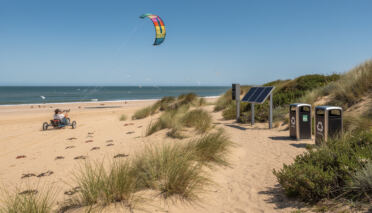
Start with space. You want enough room to lay out your kite, walk your lines fully, and still have a big downwind buffer if something goes wrong. Mia mentally rehearses the worst case: “If I get dragged 20 meters, what do I hit?” If the answer is a fence, a parking lot, rocks, or people, she moves. Social awkwardness is cheaper than an ambulance ride.
Surface, obstacles, and why ‘clean wind’ is a real thing
Surface matters more than people think. Sand and short grass are forgiving during setup and less likely to puncture fabric or bladders. Gravel, shells, and sharp scrub can turn a normal inflation into a slow leak that ruins the whole session. Mia keeps a small ground tarp in her bag for sketchy areas, but she treats that as a backup—not a reason to rig on junk.
Then there’s airflow. Buildings, dunes, tree lines, and cliffs create turbulence—wind that hits you in pulses. If the breeze feels “on-off-on-off” on your face while you stand still, your kite will feel it amplified. That’s how you get surprise surges during launch. Mia walks upwind a bit and checks wind quality again, because moving 30 meters can be the difference between smooth and chaotic.
Downwind setup positioning (the detail that prevents dumb accidents)
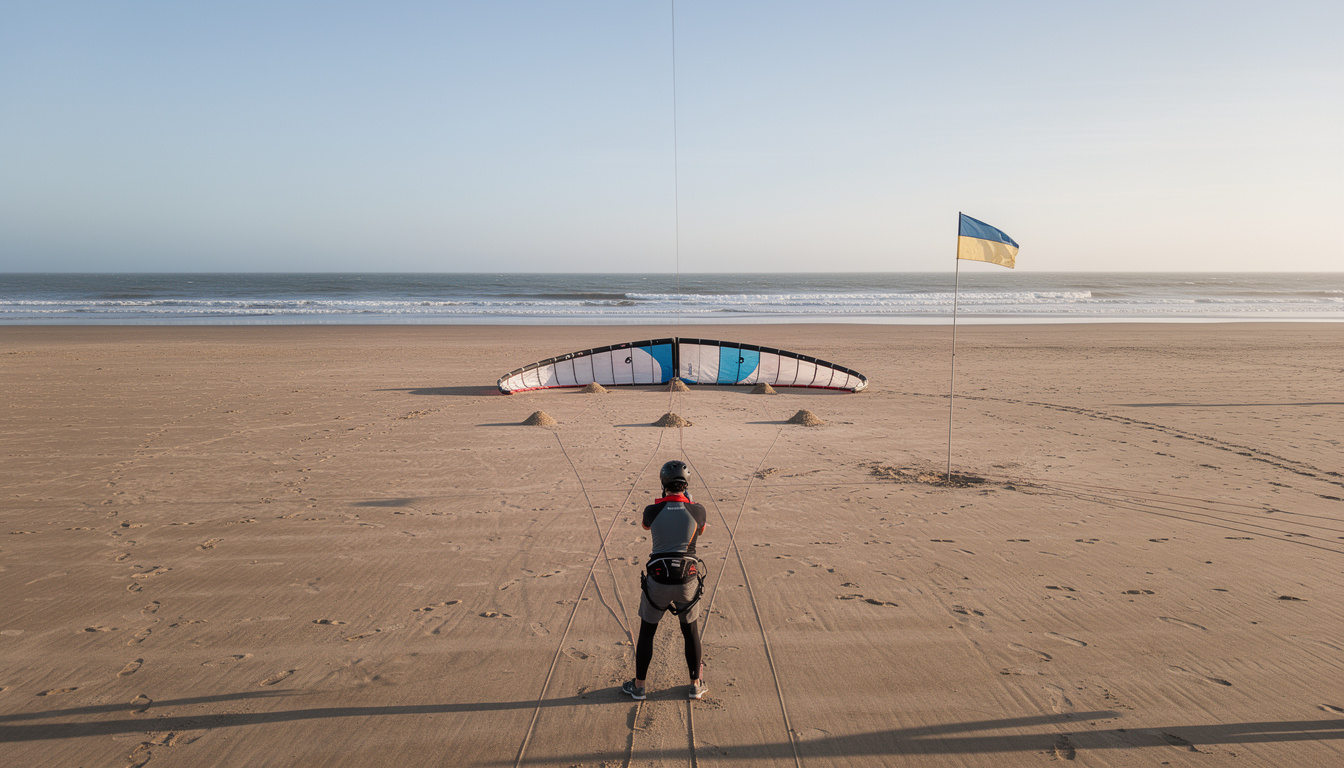
During preparation, the kite should sit downwind of you so it doesn’t accidentally roll into the power zone. That sounds obvious until you watch people rig sideways, then spend five minutes wrestling a canopy that keeps trying to flip. Mia places the kite leading edge into the wind, weighted at the center, with the rest of the canopy cleanly spread. If her spot doesn’t allow that without endangering others, she treats it as a “no rig” location.
She also manages people. Spectators drift. Dogs sprint. Kids chase kites. Mia sets a simple rule: nobody steps over the lines, nobody stands downwind, and if someone wanders into the zone, she pauses the setup. It’s not being rude; it’s controlling variables. The insight she repeats is: your launch starts with your location, not your hands.
Wind Conditions and Kite Sizing: Practical Preparation Before You Connect Anything
If there’s one thing that makes traction kiting feel “random,” it’s wind. Mia learned early that wind conditions aren’t just about strength; they’re about consistency, direction, and what the sky is about to do next. In 2026, most riders check at least two sources before rigging: a forecast model and a real-time reading from a nearby weather station or beach sensor. Forecasts tell the story; live readings tell the truth.
She looks for steady wind with a tight gust range. A day that reads 12–16 knots is usually workable for skill-building, while 12 gusting 22 is where beginners get yanked. Gusts aren’t just “more wind”; they’re abrupt power spikes that show up during launch and first steering inputs—exactly when your margin is smallest.
A conservative wind-to-kite table you can actually use
This isn’t a substitute for coaching or local knowledge, but it’s a sanity check for early sessions. Mia uses it as a “maximum comfort” guide—meaning she downsizes or skips sooner than her ego wants.
| 🌬️ Wind conditions | 🪁 Conservative traction kite choice | ✅ Session goal | ⚠️ Red flags to notice |
|---|---|---|---|
| 6–10 knots (steady) | 1.5–2 m trainer kite | Window edges, gentle turns, line awareness | 🧊 Kite stalling or dropping constantly (too light) |
| 10–16 knots (clean) | 2–3 m trainer / small traction kite | Controlled pulls, walking drills, safe launch practice | 🌪️ Gust spread > 6 knots, wind swinging directions |
| 16–22 knots (building) | Downsize heavily or don’t go (beginner) | Only with coaching + huge open area | 🏜️ Sand blasting, canopy snapping violently |
| 22+ knots | Pack up | Watch, learn, or do something else | 😬 “Just one quick run” thoughts |
How Mia reads the beach like a local (without overcomplicating it)
She checks visual clues: whitecaps appearing quickly, sand streaming low across the beach, flags cracking hard rather than fluttering. She also watches experienced riders: are they rigging smaller than usual, landing often, or looking upwind with that “meh” face? That’s free information.
Most importantly, she chooses a kite that matches her plan. If today’s plan is drill work—clean steering, smooth control, safe launch reps—she rigs smaller. Because the fastest way to progress is staying uninjured. Her key takeaway: wind decides the session, and you decide whether to accept it.
Once wind and sizing make sense, the next step is turning that calm decision into correct hardware—because the cleanest forecast won’t fix crossed lines.
Step-by-Step Traction Kite Setup: Kite Layout, Inflation, and Damage Checks
Mia treats setup like a ritual: same order, every time. That’s not being obsessive—it’s how you make mistakes less likely when you’re distracted, cold, or excited. She starts by placing the kite with the leading edge facing into the wind and fully unrolling the canopy so there are no hidden folds. Folds can trap sand and stress seams when the kite powers up.
Before she touches the pump, she does a quick inspection. She runs her eyes along the leading edge, struts, and bridle attachment points. Tiny tears near stitching can grow fast under load; a pinhole in a bladder can turn into a soft leading edge mid-session, which changes how the kite flies and how safely it lands.
Inflation: rigid, not rock-hard
Inflation is where a lot of people get sloppy. Mia anchors the kite first—sand on the center of the leading edge, or a bag—so a gust doesn’t cartwheel it while she’s bent over the valve. Then she connects the pump hose, confirms the deflation system is closed, and inflates until the leading edge feels firm and supportive.
Over-inflating can stress seams and valves, especially on hot days when air expands. Under-inflating is worse in a different way: the kite can taco, flutter, or behave unpredictably during launch. Mia does a simple squeeze test: it should feel rigid enough that it holds shape, but not so hard it feels brittle. She also checks struts (if applicable) and makes sure each is properly secured, because a half-inflated strut can make the kite twist when you least want it to.
Small habits that stop big failures
She keeps sand out of valves by placing the pump and cap where they won’t blow away. She also avoids dragging the canopy—lifting and repositioning instead—because abrasion is cumulative. These aren’t dramatic safety moves, but they extend kite life and prevent weird failures that show up “randomly” later.
If something looks off—frayed bridle, popped stitching, sticky valve—she doesn’t “see if it’s fine.” She fixes it or swaps gear. The insight she ends this phase with: a calm session is built on boring discipline.
Now the kite is ready; next comes the part that causes most launch incidents: the lines and the bar.
Connecting Lines and Bar Correctly: Avoid Crosses, Inversions, and Uneven Steering
When riders talk about a kite “going psycho” at launch, it’s often not the wind—it’s rigging. Lines crossed, swapped front-to-back, or unevenly connected can cause immediate looping or a dead, unresponsive feel. Mia’s approach is slow and methodical: she’d rather spend two extra minutes on the beach than ten minutes doing damage control.
Line layout: straight, separated, and treated like delicate hardware
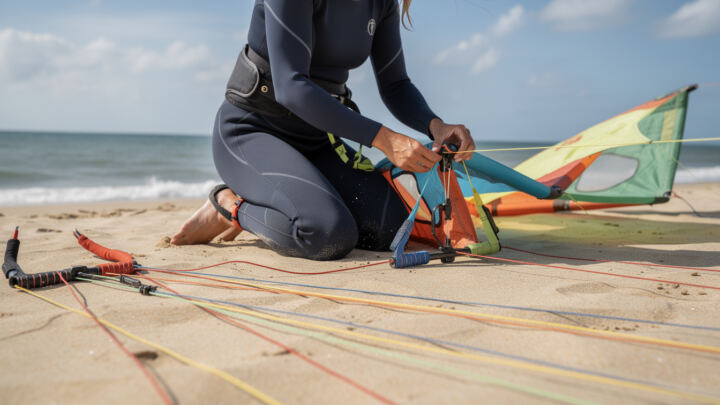
She walks the lines fully out downwind of the kite, making sure they’re not wrapped around each other or snagged on debris. She keeps them separated with small lateral spacing rather than stacking them in one ropey bundle. If she finds a knot, she stops and works it out—knots weaken lines and create uneven tension.
Most modern bars use color cues to help orientation, but Mia doesn’t rely on color alone. She checks left-right consistency and confirms that steering lines attach to the correct points. Her favorite quick test is symmetry: does the bar look centered and “square” relative to the kite when lines are lightly tensioned? If it looks weird, something’s wrong.
Front vs back connections: the classic beginner trap
Front lines (power lines) and back lines (steering lines) must go to the correct bridle/pigtail points. Swapping them can make the kite feel overpowered, backstall, or respond opposite of what you expect. Mia attaches each connection, then gives it a gentle tug to confirm it’s seated. Not a heroic yank—just enough to ensure it won’t slip.
She also checks for inversions: bridles flipped over themselves, or a line routed around a wingtip. These issues don’t always look obvious until the kite is loaded, which is exactly why she does a “visual sweep” from bar to kite, following each line with her eyes like tracing a route on a map.
A short, repeatable pre-flight check (the one you actually remember)
Before any launch attempt, Mia runs a compact checklist that fits in her head even when her heart rate is up.
- 🧵 Lines straight, no knots, no wraps on bridles
- 🎛️ Bar oriented correctly; left is left, right is right
- 🔗 Attachments seated and matched; no accidental swaps
- 🧨 Quick-release accessible; leash connected correctly
- 👀 Downwind zone clear; buddy briefed for launch and abort signals
Her closing thought here is blunt: if your rigging is wrong, your skill doesn’t matter. And that sets up the final piece—how to actually launch and handle surprises without panic.
Final Safety Check and Controlled Launch: Turning Setup Into a Smooth Session
Mia’s last stage is where preparation becomes reality. This is also where people rush because they’re excited to start the session. She slows down instead. A good launch is boring: no yanking, no sprinting, no “save it” moments.
Safety gear and release practice (not just wearing it)
Her non-negotiables are a helmet, gloves, and a hook knife. The hook knife isn’t there for style; it’s for the rare but serious scenario where a line pins you or wraps unpredictably. She also treats the quick-release as a skill. Before launching, she practices touching it and simulating the motion—eyes open and eyes closed—so her hands know where to go under stress.
She checks her harness fit: snug, comfortable, and not sliding up. Then she connects the chicken loop (or equivalent connection) and confirms the leash is clipped to the correct point for her system. Mis-clipping the leash can turn a release into a different kind of problem.
Assisted launch mechanics: calm signals, calm hands
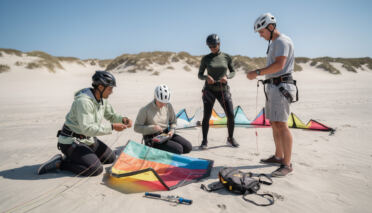
Mia prefers assisted launches early on because a buddy can spot problems you miss: a bridle snag, a partial wrap, or a wingtip folded under. They agree on clear signals: thumbs-up to launch, palm-out to abort, pointing to the landing side if needed. If anything feels off, she aborts immediately—no debating mid-launch.
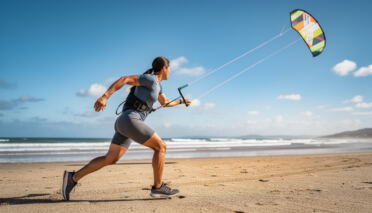
When the kite comes up, she keeps it low power at the edge of the window, not straight overhead as a default. Overhead can be stable, but it can also be a surprise tug if a gust hits. She feels for predictable response: left input turns left, right input turns right, and the kite doesn’t surge oddly. That’s her “green light” to continue.
Micro-drills right after launch (the secret to staying in control)
Instead of blasting off, she does 20–30 seconds of simple control: park at the edge, small steering corrections, slow figure-eights if space allows. These tiny drills reveal issues fast. If the kite drifts backward, front lines might be off; if it turns aggressively one way, a steering line might be uneven.
She also rehearses the “two-second rule”: if she stumbles and can’t recover quickly, she depowers by steering to the edge and stepping toward the kite. If she’s being dragged toward anything risky, she releases immediately. The insight she keeps repeating is: the best save is the one you don’t attempt—because you stopped early.
And once that’s dialed, you’re not just launching—you’re managing risk like it’s part of the sport, because it is.
How do I know my traction kite lines are connected correctly before launch?
Do a full visual trace from the bar to the kite: each line should run cleanly without crossing, steering lines must go to the correct left/right attachment points, and front vs back lines must not be swapped. Then lightly tension the lines and confirm the kite responds predictably to small bar inputs before committing to a full launch.
What’s the safest way to launch during a beginner session?
Assisted launch is usually the safest choice. Brief your helper on signals, keep the kite at the edge of the wind window during takeoff, and abort immediately if anything looks wrong (bridle snag, crossed lines, people downwind). A clean launch should feel slow and controlled, not explosive.
What wind conditions are a hard ‘no’ for proper setup and safe riding?
Highly gusty wind (big gaps between average and gusts), rapidly shifting direction, storms approaching, or wind distorted by buildings/trees/cliffs near the launch. If you see sand blasting, sudden whitecaps building fast, or your kite surging unpredictably during pre-flight tension checks, it’s smart to pack up.
What should I check on the bar and safety system every single time?
Confirm the quick-release is assembled correctly, moves freely, and can be activated instantly; verify the leash is clipped to the correct attachment point; and make sure the depower/trim system runs smoothly. Practice finding the release with your eyes closed during preparation so it’s automatic under stress.
If I’m being dragged right after launch, what’s the correct response?
First try to depower fast by steering the kite to the edge of the wind window and stepping toward it to reduce line tension. If you’re still moving toward hazards or losing control (especially if the kite loops), activate your quick-release immediately, then secure the kite safely from upwind when conditions allow.