From the beach, traction kiting can look almost suspiciously chill: a rider cruising, canopy steady, turns happening like muscle memory, no drama. Up close, it’s a different story—wind gradients messing with line tension, tiny steering errors amplifying into big wobbles, and that familiar spike of “uh-oh” when a gust hits at the worst moment. The good news is that confidence on a traction kite isn’t some personality trait you’re born with. It’s mostly the result of building predictable habits: repeatable drills, smarter decision-making, and a calm “plan B” that’s ready before things get spicy.
To keep it real, we’ll follow Mia, a fictional rider who’s comfortable with the basics and wants steady skills improvement without collecting scary stories. She’s not chasing chaos; she’s chasing control: cleaner upwind, smoother transitions, and the ability to ride in changing wind conditions without feeling like she’s negotiating with a wild animal. The thread running through everything here is simple: practice techniques that make your kite feel “locked in,” body mechanics that reduce surprises, and safety tips that keep every session fun enough that you actually want to come back tomorrow.
En bref
- 🪁 Build kite control with short, repeatable drills before you chase speed or tricks.
- 🌬️ Read wind conditions like a local: gust lines, terrain turbulence, and direction shifts.
- 🧍♂️ Use better body positioning so power goes into glide, not panic.
- ⚡ Manage pull with the wind window (kite placement) instead of “yanking the bar.”
- 🧯 Make safety tips automatic: checks, signals, and a clear landing plan.
- 🏄 Improve board handling through micro-adjustments and progressive edging.
- 🎥 Use video for progress tracking: copy one fix at a time, not ten.
Traction kite confidence starts with kite control drills that actually stick
When people say they want more confidence on a traction kite, they often mean, “I want the kite to stop surprising me.” That’s fair. A canopy that drifts, surges, or snakes around the window can make even a strong rider feel behind the curve. Mia’s biggest jump in confidence happened when she started treating the first five to ten minutes of every session like a warm-up routine, not “wasted riding time.” The goal wasn’t flair. It was building a reliable mental map of where the kite is, where it’s going next, and what the pull will feel like when it gets there.
The key detail: she practiced in a power range that let her stay calm. Slightly underpowered is perfect for learning because you can do more reps without fear-braking your brain. This is exactly how a lot of kiteboarding schools structure training—control first, then intensity, not the other way around.
Anchor your hands: turn the bar into a dial, not a panic button
One of the fastest ways to lose control is “bar hand chaos”: hands sliding, death grip, steering too big, then overcorrecting. Mia learned to place her hands symmetrically and steer with small forearm rotations. If her shoulders started creeping up toward her ears, she took it as a warning light: she was about to overdo it.
Try this: pick a stable reach and keep your elbows soft, almost heavy. If you can keep your wrists relaxed while still commanding the kite, you’ll notice your lines stay cleaner and the canopy stops hunting for tension. It’s not mystical—it’s simply reducing accidental input.
The clock-face parking drill for precision (and calmer transitions)
This drill is boring in the best possible way. Park at 11 o’clock for 10 seconds, then 12, then 1. Don’t let it wander. Correct using tiny input, then release back to neutral so you’re not “holding” the turn. Mia added a rule: if she couldn’t hold a position for 10 seconds, she wasn’t allowed to start practicing transitions yet.
Why it works is simple: a traction kite has inertia. It keeps moving after your input. Parking practice teaches you to steer early and softly, which is exactly what you need when you later time a carve, a direction change, or a speed dump.
Window sweeps for predictable pull (power management without drama)
Next, Mia did controlled sweeps from roughly 10 to 2 and back, keeping the kite high enough that the pull ramps smoothly instead of punching. She counted “one-two-three” on each sweep so she didn’t rush. That counting sounds silly until you realize it builds a consistent tempo—consistent tempo becomes consistent riding, and consistent riding is where confidence lives.
As you sweep, notice where the pull increases (approaching the power zone) and where it softens (near the window edge). You’re basically learning the throttle positions without touching any trim system. That’s the moment where kite control stops being theory and becomes instinct.
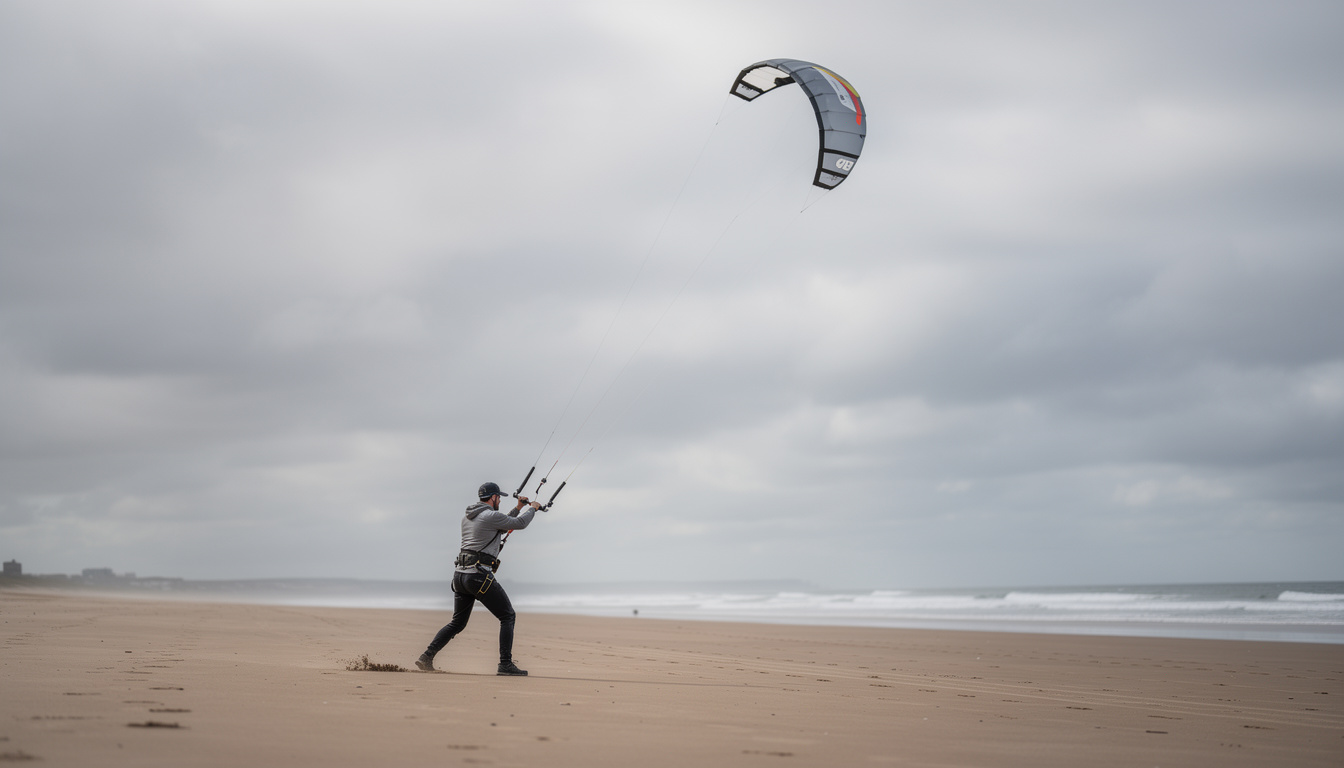
Reading wind conditions like a local: the fastest way to feel in control
You can’t negotiate with the wind, but you can absolutely get better at predicting it. Riders with real confidence aren’t necessarily braver; they’re usually better at spotting patterns early enough to adjust calmly. Mia’s change was mindset: every spot is a system—beach shape, dunes, buildings, trees, thermals, and approaching fronts all shape what your traction kite feels like in your hands.
Instead of rushing to rig, she started watching for a few minutes. That tiny pause gave her better decisions on kite size, launch angle, and what she’d actually practice that day. When the wind is messy, it’s not a “send it” day—it’s a “control and exit clean” day.
Gust lines, surface texture, and the “dark patch” habit
On water, darker patches often mean stronger wind. On land, you’ll see rippling grass, drifting sand, dust streaks, or even hear a change in line hum before the gust hits. Mia began calling gusts out loud—“in 3…2…1”—not because it’s cool, but because timing is a trainable skill. Soon her body was braced and her kite placement was slightly higher before the surge arrived.
That one-second head start is huge. Instead of getting yanked and reacting late, you preemptively depower by positioning: edge the kite closer to the window edge and keep your stance stacked. Confidence often looks like calm, but calm is usually preparation.
Terrain turbulence: why “perfect flat space” can still be sketchy
Wind flowing over obstacles creates turbulence and wind holes downwind. That smooth-looking area behind a dune can feel friendly—until your kite drops into dead air and then reloads hard. Mia made a rule: if she’s working on launches, landings, or first attempts at something new, she chooses clean airflow and a big buffer downwind.
Also watch indicators at different heights. If flags, tall grass, or streamers point one way while your kite at 20–30 meters feels like it’s being pushed another way, you’re dealing with gradient or shear. That’s not “bad,” but it demands extra margin and simpler goals.
A practical decision table: match the day to the plan
Mia keeps a simple decision framework in her head. It stops her from “forcing” a session when conditions are clearly trending weird.
| Condition cue 🌦️ | What it often means 🧠 | Smarter move ✅ |
|---|---|---|
| 🌬️ Frequent sharp gusts | Unstable flow, frontal edges, or turbulence | High-kite control drills, shorter tacks, prioritize exits and safety tips |
| ☁️ Fast-moving dark cloud base | Possible squall line approaching | Land early, don’t squeeze “one more run” |
| 🧭 Wind shifts 20–30° | Thermal switching or directional instability | Choose a bigger downwind buffer, simplify goals |
| 📉 Deep lulls | Risk of stall and slack lines | Keep kite slightly higher, avoid aggressive steering |
| 🌪️ Dust devils / swirling debris | Convective turbulence pockets | Pause and reset; conservative plan only |
This kind of wind awareness doesn’t just prevent incidents—it boosts confidence because you stop feeling “ambushed.” Next up is the part most people underestimate: how your stance can either smooth the power or amplify it.
If you want a clean visual breakdown of wind window behavior and control inputs, watching a technique-focused session helps more than random highlight clips.
Body positioning and power management: stop wrestling the traction kite
“I got yanked” is often a body mechanics problem disguised as a wind problem. Yes, wind can spike. But your stance determines whether that spike becomes speed, lift, or chaos. Mia used to lean back with straight legs and locked arms, basically letting the harness take everything. She could ride, but she was tired fast and always one gust away from a sketchy moment.
Her confidence improved once she learned to “stack” her body so the pull traveled through her structure instead of her lower back. It’s not about being stronger; it’s about being aligned.
The stacked stance: hips in, ribs down, knees alive
Think about the force line: kite → lines → harness → your hips → board edge. If your hips drift behind your heels, you get that waterski skip and your edge becomes inconsistent. Mia’s cue was simple: “belt buckle toward the kite.” That tiny pelvic adjustment helped her engage the edge without overloading her arms.
Keep knees soft, not squatted to death. Soft knees absorb gusts and chop like suspension. If you’re rigid, every gust becomes a full-body event. If you’re springy, it becomes background noise.
Power management using the window (not the bar)
Here’s the confidence hack most riders wish they learned earlier: your main throttle is kite placement, not pulling harder. Higher kite usually reduces lateral pull and increases lift; lower kite increases drive. Sweeping through the power zone adds acceleration; parking toward the window edge steadies you.
Mia used to pull the bar in when nervous, thinking it would “lock” the kite. Often it did the opposite—stalling the canopy and creating jerky reloads. She trimmed so her normal riding bar position was comfortable, then used steering and kite height to regulate power. The bar became fine-tuning, not survival.
Micro-adjustments that prevent big mistakes
Advanced riding looks relaxed because it’s built on tiny changes. Mia focused on three micro-moves:
- 🦵 Pre-bend slightly before a gust hits to absorb it instead of resisting it.
- 😮💨 Exhale during transitions so shoulders stay low and steering stays clean.
- 👀 Head level: if her head bobs, it’s a sign her edge is inconsistent.
Film a short run and watch your hips and elbows. If your arms are locked and your hips are drifting back, you’re letting the kite decide. If you’re stacked with quiet hands, you’re the one making the calls. That’s where confidence becomes durable—and it sets you up perfectly to sharpen board handling without brute force.
To see how strong riders combine stance, edging, and kite placement in real time, a breakdown video that shows the rider’s hands (not just drone shots) is gold.
Board handling for traction kite riding: edging, transitions, and calm speed control
It’s easy to blame the kite when things feel messy, but a lot of “I can’t hold my line” is actually board handling. The board (or buggy, or skis) is your rudder; the kite is your engine. Mia’s upwind progress didn’t come from more power—it came from cleaner pressure control. Once she understood that, her confidence shot up because she stopped feeling dragged around and started feeling like she was driving.
Progressive edging: not digging in, not sliding out
Over-edging throws spray and kills speed; under-edging turns every reach into an accidental downwinder. The sweet spot is a progressive edge that loads smoothly. Mia practiced a drill: hold steady kite position, then slowly increase edge pressure until she felt the board “bite,” hold three seconds, then soften slightly without moving the kite.
This trains your legs to modulate pressure instead of going on/off. When the wind bumps, you’ll instinctively adjust in small increments, which keeps your line steady and your brain calm.
Simpler transitions: one clean sequence beats five rushed ideas
Mia’s transitions were messy because she tried to do everything at once. She simplified into a repeatable order:
- 👀 Look where you want to go (eyes lead shoulders).
- 🪁 Move the kite smoothly to support the turn (not to yank you around).
- 🏄 Flatten the board briefly so it can pivot without fighting the edge.
- ✅ Re-engage the new edge gradually, then settle the kite.
Notice what’s missing: panic steering. Once you trust the kite to be where it needs to be, your feet have time to do their job. That’s why kite control drills earlier matter so much—they buy you time.
Speed control without “emergency moves”
When overpowered, many riders send the kite up abruptly, lose drive, wobble, then overcorrect. Mia practiced a calmer alternative: steer the kite slightly toward the window edge while increasing edge pressure progressively. The power bleeds off without a dramatic change in balance.
On chop, she kept the board flatter than she thought she should and used ankles for micro-corrections. On snow, she kept the kite a touch higher to lighten the board over rough patches. On landboards, she stayed extra conservative because traction changes can be abrupt—confidence isn’t worth a faceplant.
Progress tracking that doesn’t fry your brain
Mia’s secret weapon was progress tracking through “one variable” sessions. One day: only edging. Another day: only transitions. Another day: only speed control. She filmed one reach and one transition, then picked a single fix for next time. That’s how you build repeatable skill instead of chaotic “kinda worked” memories.
By the time she went back to more ambitious kiteboarding goals, she didn’t feel braver—she felt more certain. And that certainty is exactly what makes your next topic—launching and landing—way less stressful.
Safety tips, launching, and landing skills that make confidence real (not just vibes)
The best riders often look like they’re doing less, because they are: fewer surprises, fewer rushed decisions, fewer “save it!” moments. That’s not luck. It’s routine. Mia’s confidence jumped when she treated safety tips like a system she runs every time, not a list she remembers only after a close call.
Pre-flight checks that prevent the dumb problems
Mia uses a quick pattern: gear, lines, area, people, plan. It takes under a minute and catches the stuff that ruins sessions.
- 🔍 Bridle/pulleys: twists, sand, ice, anything that adds friction.
- 🧵 Lines: knots, crossed leaders, uneven tension.
- 🧯 Quick release: clean, reachable with either hand, tested mentally (you know where it is without looking).
- 📍 Downwind buffer: identify the “oh-no zone” (rocks, road, crowd).
- 🗣️ Signals: clear launch/abort cues with your helper.
Most sketchy launches aren’t “bad wind.” They’re miscommunication plus impatience. Fix those two and your confidence improves instantly.
Launching tips for boring, clean takeoffs
Mia’s goal is always the same: a launch that looks uneventful. She sets the kite on the edge of the window, not overhead, so power ramps gradually. She keeps one hand closer to center to avoid accidental over-steer, and she waits for a steady moment rather than launching mid-gust.
If she feels rushed—by friends, by crowds, by ego—she pauses. Ten seconds of waiting beats ten minutes of sorting out lines, apologies, or worse.
Landing skills that work when you’re tired
Landings fail most often at the end of the session, when fatigue makes people sloppy. Mia approaches the landing area with the kite stable and high, reduces speed early, then moves the kite to the edge with clear signals. If she’s practicing any solo technique, she does it first in lighter wind, in a wide-clear zone, until it’s boring.
Her personal rule is blunt: if she can’t say her landing plan in one sentence, she doesn’t start it. Simple plans survive stress. That’s how confidence becomes something you can trust, not something you “feel” right up until the wrong gust arrives.
To tighten your routines further, it helps to watch a launch/land tutorial that shows communication and body mechanics, not just the kite in the sky.
How can I improve traction kiting faster without constantly riding overpowered?
Pick one focus per session (like clock-face parking or progressive edging) and aim to ride slightly underpowered so you get more clean repetitions. More reps with less panic builds timing, better kite control, and real confidence.
What’s the simplest way to build wind awareness at a new spot?
Watch for 3–5 minutes before rigging: look for gust lines (water texture or dust), identify turbulence behind obstacles, and notice direction changes. Then choose a conservative launch area with a big downwind buffer in case wind conditions shift.
Why do I keep getting pulled off my edge even when the kite is high?
It’s usually body positioning: hips too far back, knees too straight, or arms locked. Stack your stance (hips slightly forward, knees soft) and steer the kite toward the window edge to reduce lateral pull instead of pulling the bar in.
What are the most important launching tips to avoid sketchy starts?
Launch at the edge of the window, keep your hands calm and symmetrical, and wait for a steady moment instead of launching during a gust. Confirm your quick release access and agree on clear signals with your helper—those safety tips prevent most avoidable problems.
How do I know if board handling is my bottleneck, not the kite?
If the kite feels stable but you still skid downwind, bounce in chop, or stall in transitions, it’s likely edging and pressure control. Practice progressive edging (increase/release pressure smoothly) and use a simple, repeatable transition sequence.