En bref
- 🖐️ Learn the hand signals that matter most for kite safety during launches, landings, and tricky moments.
- 🌬️ Match safety signals to wind strength and space—because the same gesture means nothing if the setup is wrong.
- 🧠 Build habits from kite safety training: signal early, confirm visually, and keep messages simple.
- 🧯 Know your emergency signals and what to do right after you send them.
- 🤝 Improve kiting communication with a spotter so traction sessions don’t turn into guesswork.
There’s a moment in every traction kiting session when the wind is humming, lines are tight, and you realize your biggest risk isn’t the kite—it’s the misunderstanding. A perfectly tuned traction kite can still become chaos if your helper thinks you said “send it” when you meant “hold it,” or if a rider downwind can’t tell whether you’re about to launch, land, or dump power. That’s why learning safety signals isn’t a cute add-on; it’s the closest thing this sport has to a shared language. On busy beaches, snowfields, or landboarding spots, you don’t get the luxury of long explanations. You get a few seconds, a few gestures, and the responsibility to make those gestures unambiguous. The best riders I’ve watched aren’t the ones doing the flashiest jumps—they’re the ones whose kite control is matched by clean, calm signaling. This article breaks down the signals, the situations, and the habits that make them actually work when the wind decides to test you.
Core kite safety signals for traction kiting: the “no-confusion” hand signals 🖐️
If you only learn a handful of hand signals, make them the ones that prevent the classic disasters: accidental launches, dropped kites in the power zone, and “I thought you were ready” moments. In kiteboarding culture, a lot of common signals have been standardized through instructor systems (like IKO-style teaching). Even if your crew has its own slang, the smartest move is to stick with signals that most kiters already recognize.
Launch, land, and “wait”: the three signals that save sessions
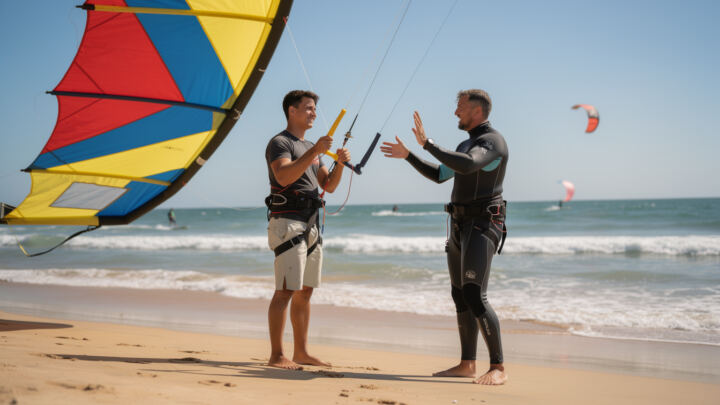
Launch is typically communicated with a clear thumbs-up or a deliberate “send it” motion depending on local norms. The key is not the exact gesture—it’s the confirmation loop. You signal, your helper acknowledges, and only then do you commit. That loop is what turns a gesture into real kiting communication.
Land is often shown by patting the top of your head (or a “come to me” motion plus pointing where you want the kite placed). On crowded beaches, add a directional cue: point to the sand spot you want, then repeat the land signal. This reduces the helper’s need to improvise.
Wait / hold is where people get sloppy. A flat palm facing your partner (like a stop sign) is simple and readable. If you’re dealing with a noisy shoreline or helmets, a strong stop-palm held steady for two seconds beats frantic waving every time.
Power management signals: “depower,” “more power,” and “keep it steady”
When you’re learning kite control, you’ll feel how tiny changes create big pull. Signals can help a coach or buddy keep you safe without yelling. A common “depower” cue is a downward pressing motion with one hand, telling the rider to sheet out or park the kite closer to the edge. “More power” often looks like pulling a hand toward your body, mimicking sheeting in.
For “keep it steady,” use a flat hand held horizontally and stable, like you’re telling someone to keep a level altitude. It sounds basic, but it’s gold when you’re body-dragging, practicing board starts, or simply managing gusts on a landboard.
A quick reality check: signals are only useful if they’re visible
On a bright day, a black glove against a dark wetsuit can vanish. On snow, everything is white and glare-heavy. If you want your safety signals to work, exaggerate the movement, use high-contrast gloves if you have them, and face your partner square-on. The final insight: clarity beats creativity every single time.
Next up, let’s talk about when signals fail—not because the gesture was wrong, but because the environment made it hard to read.
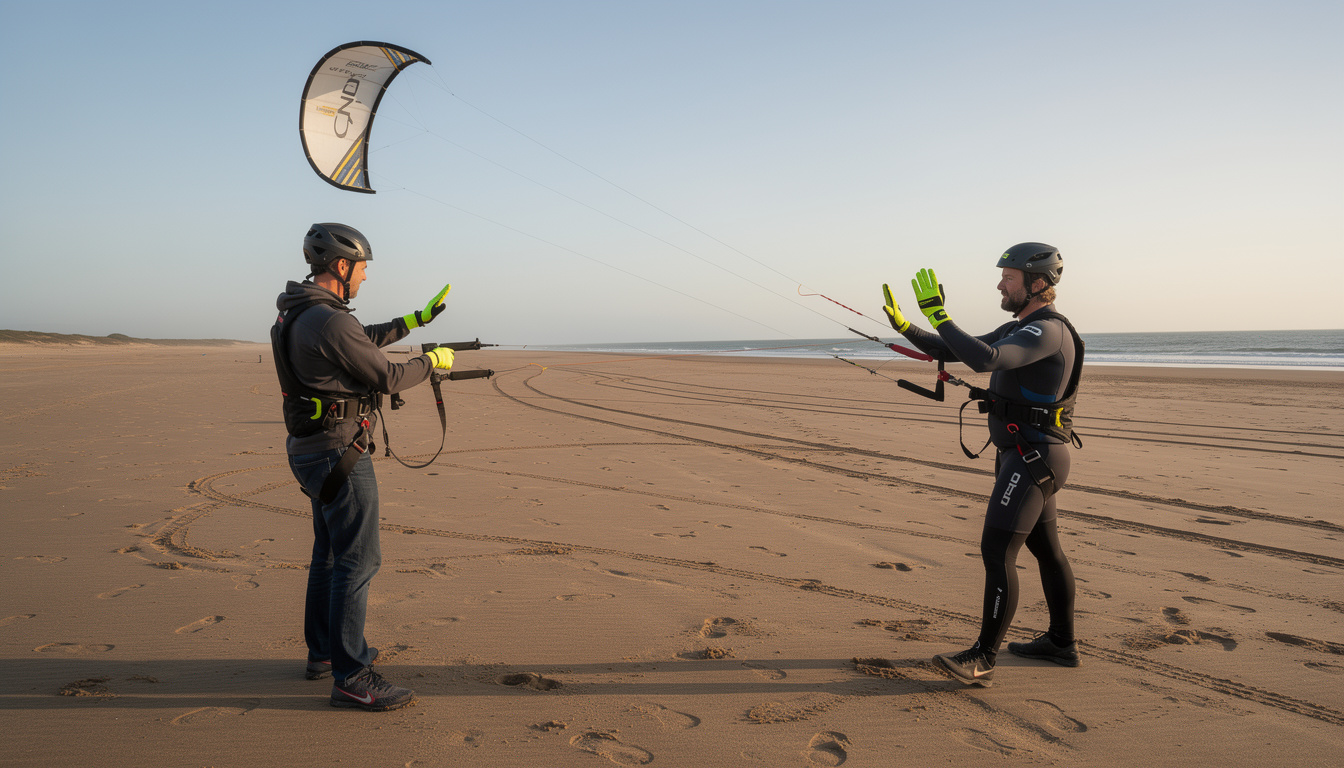
Reading the wind window and using kite safety signals at the right moment 🌬️
Most miscommunication in traction kiting isn’t about people being careless; it’s about people being rushed by the wind window. When the kite drifts toward the power zone, your brain goes into “fix it now” mode. That’s exactly when you need structured kite safety habits: signal early, pause, and only then act.
Wind window basics: why timing changes everything
Imagine your wind window as a big dome in front of you. Near the edges, power is lower; near the center, it’s stronger. The same “launch” signal means very different things depending on whether the kite is parked safely at the edge or half-floating toward the middle. So, a smart helper doesn’t just watch your thumbs—they watch the canopy position too.
Here’s a simple scenario. Maya (a fictional beginner landboarder) is practicing with a mid-size traction kite in 18 knots. She gives a thumbs-up while her kite is still slightly forward of the edge. Her helper launches anyway. The kite surges, Maya gets yanked, and the whole thing becomes a scramble. Same signal, different timing, totally different outcome.
Pre-launch signaling: building a mini checklist without speaking
The cleanest launch is the one that looks boring. Use a micro-sequence: point to your lines to show “checking,” then give a clear stop-palm while you verify there’s no wrap. After that, look at your helper and give the launch sign only when you’re ready to resist pull. This is basically silent kite safety training in real time.
If your partner is new, teach them to respond with an acknowledgment gesture (a nod, a thumbs-up back). That tiny “receipt” reduces assumptions. And assumptions are what break ribs, boards, and friendships.
Landing in gusty wind: signals plus positioning
In gusty conditions, landing is where things get spicy. A “land” signal alone isn’t enough—you also want to show where you want the kite parked after capture. Point to a safe patch of sand (or snow), away from obstacles and other lines. Then repeat the land cue. If the helper approaches from downwind, wave them around with a directional motion so they come in from the correct side.
The key insight here: signal + environment awareness is what keeps landing calm when the wind isn’t.
Now that timing and wind window awareness are clear, let’s get practical with a table that maps common signals to situations and typical mistakes.
Traction kiting safety signals cheat sheet: meanings, best use, and common mistakes ✅
A cheat sheet helps because stress makes people forget. And in kiteboarding-adjacent sports, stress arrives fast: a gust hits, someone walks into your lines, your kite starts to backstall, or the launch angle slips. The goal isn’t to memorize a hundred gestures. It’s to own a core set and use them consistently.
| Signal 🧭 | Meaning 💬 | Best moment to use ⏱️ | Common mistake ⚠️ |
|---|---|---|---|
| Stop palm ✋ | Wait / hold position | Before launch, during line check, if unsure | Waving wildly (looks like “help” to some) |
| Thumbs-up 👍 | Ready / launch (if locally accepted) | Only when kite is stable at the edge | Signaling while still adjusting bar/strap |
| Pat head 🧢 | Land the kite | When you have space and a helper is engaged | Not pointing to landing spot, causing drift |
| Downward press ⬇️ | Depower / reduce pull | Gusts, learner being overpowered | Helper thinks it means “bring kite down” |
| Point + sweep 👉↩️ | Move/approach from a direction | Organizing landing or clearing area | Pointing without the sweep (too vague) |
Make signals “local-proof” with a 30-second pre-session agreement
Different spots have different habits. Some crews use thumbs-up for “I’m good,” others use it strictly for “launch now.” Before you connect lines, take half a minute and agree on 5–7 signals you’ll use today. It sounds almost too simple, but it prevents the weirdest kind of accident—the preventable kind.
A practical list of the signals to master first (and why) 🧠
- 🛑 Stop/Wait: gives you time, and time is safety.
- 🚀 Launch: only meaningful if paired with clear acknowledgment.
- 🧤 Land: avoids uncontrolled drops and tangled lines.
- ⬇️ Depower: helps manage a learner who’s getting dragged.
- 📍 Directional cue: reduces confusion on crowded beaches.
Micro case study: a crowded beach launch done right
On a summer afternoon, a rider named Jules wants to launch while a family walks downwind. Instead of rushing, Jules throws the stop-palm to the helper, points downwind to the pedestrians, and waits. Once the space clears, Jules repeats the launch signal, the helper nods, and the kite goes up clean. No shouting, no drama, just solid kite safety behavior.
Up next: what to do when things go wrong fast—the emergency signals and the actions that must follow them.
Emergency signals in traction kiting: when to bail, when to shout, and when to signal 🧯
Let’s be honest: emergencies don’t feel like a neat checklist. They feel like sudden pull, loud flapping, and your attention shrinking to a tunnel. That’s why emergency signals should be stupid-simple and tied to immediate actions. A signal that doesn’t change behavior is just interpretive dance.
The “I need help now” signal and what helpers should do
A widely understood distress cue is waving one arm overhead in a big, repeated motion. To keep it from being confused with a casual wave, make it large, urgent, and continuous. If you’re being dragged, your helper (or nearby riders) should prioritize clearing the downwind area and preparing to assist with a controlled landing—only if it’s safe to approach.
In many real incidents, the best help is not grabbing lines randomly. The best help is creating space, keeping spectators back, and getting a competent person ready to secure the kite once it’s depowered or released.
Signal versus action: the golden rule of bailing out
When you’re truly losing control, the priority is to execute your practiced safety actions—like letting go to a primary safety, then using the quick release if needed (depending on your setup). The signal is secondary if you don’t have bandwidth. This is where kite safety training matters: your hands should know what to do without a committee meeting in your brain.
Equipment-related emergencies: line tangles and inverted kites
A line tangle close to launch is one of the most underrated hazards. If you see crossed lines or a wrap, signal stop immediately and step toward a safe reset. If the kite is already powered, don’t “hope it sorts itself out.” You’re not gambling with pocket change—you’re gambling with knees, shoulders, and everyone downwind.
For inverted or bow-tied canopies, use a clear “hold” signal to stop helpers from yanking, because that often worsens the mess. Then communicate with pointed gestures: show the line you want tension on, show the direction to walk, and keep the movements slow. Calm hands create calm solutions.
When the crowd becomes the hazard
Sometimes the emergency isn’t the wind—it’s people. Kids run at kites. Tourists step over lines. Dogs chase flapping fabric like it’s a toy. Use strong directional pointing to move your helper and to warn others away. If needed, abandon the “polite” wave and use a firm stop-palm toward bystanders too. Safety beats social comfort.
The takeaway insight: your best emergency signal is the one your crew has practiced responding to. Which leads perfectly into building a communication routine.
Kiting communication routines that actually work: building habits for safer sessions 🤝
Good kiting communication isn’t a single moment. It’s a routine you run every session until it becomes automatic. The cool part is that routines make you look more confident even when you’re still learning, because you’re predictable in the right ways.
The “buddy protocol”: a simple pre-flight flow
Before lines go tight, do a quick visual sweep together. Point to your quick release, then to your leash attachment, so your partner knows you’ve checked them. Point to the wind direction and then to the safe downwind zone, so you’re aligned on where “bad” would happen if things went wrong. This shared mental map is an underrated part of kite safety.
Then run a silent confirmation: you show stop-palm (hold), you finish checks, you make eye contact, you give the launch sign, they acknowledge, and only then does the kite rise. If either person breaks eye contact, you reset. It’s not dramatic; it’s disciplined.
Coaching signals for learners: making kite control progress faster
Signals aren’t just for emergencies. They’re also a coaching shortcut. A coach can show “depower” while you’re getting pulled too hard, or “steady” when you’re oversteering. This helps you learn kite control without the delay of yelling across wind.
A fun example: Maya is practicing figure-eights near the edge of the window. Her coach uses the steady-hand sign whenever she starts to “saw” the bar too aggressively. Within ten minutes, she’s flying smoother, not because she got stronger, but because she got clearer feedback at the exact moment it mattered.
Handling mixed-experience groups without confusion
On popular spots, you’ll have beginners, experts, and curious onlookers sharing the same space. If your group is mixed, assign one experienced person as the primary signal contact for launches and landings. Too many helpers is how you end up with two people grabbing different parts of the kite.
Also, keep your signals consistent across sports. If you landboard one day and snowkite the next, don’t reinvent gestures. Your muscle memory will thank you when the wind spikes and you’re running on adrenaline.
One last practical drill (yes, it feels goofy—and yes, it works) 🎯
Do a “dry run” with your buddy: stand five meters apart, simulate the full launch sequence with no kite, and confirm you both interpret each signal the same way. It takes two minutes, and it can prevent the one mistake that ruins the day. Final insight: the safest riders aren’t lucky; they’re consistent.
What are the most important safety signals to learn first for traction kiting?
Start with ✋ stop/wait, 👍 launch/ready (only if your spot uses it), 🧢 land (often patting the head), ⬇️ depower, and a clear directional point-and-sweep. These cover the majority of real-world kite safety situations during launches, landings, and coaching.
Are kiteboarding hand signals the same for all traction kiting sports (landboarding, snowkiting, buggy)?
Most core hand signals are shared because the risks are similar: accidental launch, power spikes, and crowded zones. Still, local habits vary, so do a quick pre-session agreement on what each gesture means to avoid mixed interpretations.
When should I use emergency signals versus activating my safety systems?
If you have time and control, signal first so others can clear the area and prepare to assist. If you’re losing control, prioritize actions (depower/let go/quick release depending on your setup) and signal only if you can do it without delaying the safety step.
How can I make sure my helper actually saw my signal?
Use big, deliberate gestures, face your helper, and require acknowledgment (a nod or signal back). If you don’t get confirmation, assume they didn’t see it and repeat the stop/wait signal until you reconnect visually.