In brief
- 🪁 Traction kiting turns wind into a full-body training tool that complements running, cycling, gym work, and kiteboarding.
- ❤️ Built right, it boosts endurance, stamina, and cardiovascular health without feeling like “just cardio.”
- 🧠 It sharpens balance and focus through constant micro-adjustments, making it legit outdoor fitness with skill.
- 💪 Your grip, posterior chain, and trunk get a sneaky-hard core workout plus practical strength training.
- 📈 Progress happens faster when you treat sessions like workouts: zones, intervals, recovery, and technique cues.
- 🧰 Simple gear choices and wind-awareness keep you safe and consistent (and consistent beats heroic).
When people talk about endurance training, it usually sounds like a punishment: long runs, endless laps, “zone 2 until your soul leaves your body.” Traction kiting flips that vibe. You’re still building engine and resilience, but you’re doing it with a kite pulling you across sand, grass, snow, or water-edge hardpack, forcing your body to coordinate power and control in real time. It’s playful, a little chaotic, and surprisingly precise once you learn to read the wind. The best part? It doesn’t just “add cardio.” It stacks skills that carry over into kiteboarding, trail running, skiing, and field sports: reactive footwork, trunk stability under load, and the ability to keep moving efficiently when conditions aren’t perfect.
To make this real, let’s follow a fictional but very believable athlete: Maya, a busy professional who loves board sports and wants better stamina without sacrificing her weekend fun. She uses traction kiting as cross-training twice a week: one session focused on technique and easy aerobic work, the other built around short, spicy intervals. Over a couple of months, her resting heart rate drops, her legs stop burning on long tacks, and—this is the underrated win—her confidence goes up because she feels “in charge” of the pull instead of surviving it. That’s the promise here: a method that’s athletic, scalable, and actually enjoyable.
Traction kiting for cross-training: why wind-powered workouts build real endurance
Traction kiting sits in a sweet spot between sport and conditioning. You’ve got an external force (the kite) that changes second by second, and your job is to manage it while moving efficiently. That combo makes it a killer cross-training tool because it stresses multiple systems at once: aerobic capacity, neuromuscular coordination, and muscular endurance. Unlike steady treadmill work, you’re constantly adjusting stance, edging, and hand position, which keeps your nervous system engaged and your technique honest.
For endurance, the big win is that traction kiting can keep you in a productive heart-rate range for long stretches without the “I’m bored” factor. When Maya does a 60–90 minute session on firm sand with moderate wind, she’s basically doing an outdoor version of tempo-meets-skills practice. She’s breathing hard enough to matter, but because she’s focused on flying and body position, the effort feels lighter than the numbers suggest. That mental dissociation—thinking about tasks instead of suffering—often lets athletes accumulate more quality minutes.
There’s also a mechanical advantage: traction kiting creates a core workout under unpredictable load. When the pull shifts, your trunk has to resist rotation, your hips have to stabilize, and your shoulders have to stay connected without shrugging up into your ears. That’s not “six-pack” training; it’s the kind of bracing that makes you more durable for long runs, long rides, and long kite sessions. Over time, this translates into better posture under fatigue, which is basically the hidden currency of stamina.
And if you’re into kiteboarding, traction kiting is like dry-land (or snow/grass) rehearsal. The kite skills—steering, power control, and keeping a clean line to the wind window—transfer directly. The more automatic your kite handling becomes, the less energy you waste on the water. That’s not just technique; it’s a direct upgrade in efficiency, which is the heart of endurance performance.
One more layer: traction kiting builds “elastic toughness.” You learn to handle surges without panicking, then settle back into smooth cruising. That pattern—respond, absorb, reset—is exactly what you need in endurance events when terrain, pacing, or conditions change. Insight: traction kiting isn’t a substitute for your main sport; it’s a smarter way to make your engine and your skill set grow together.
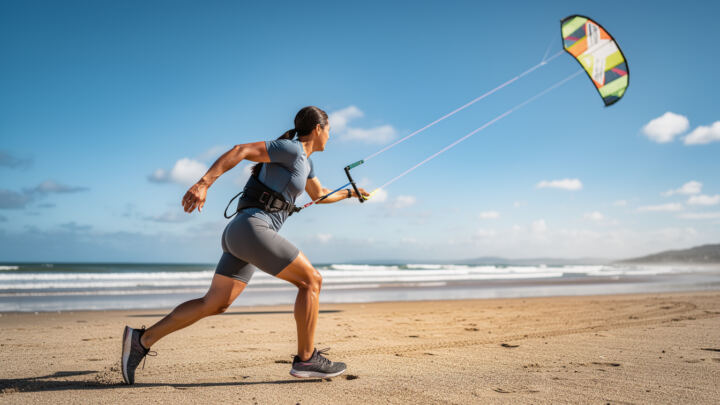
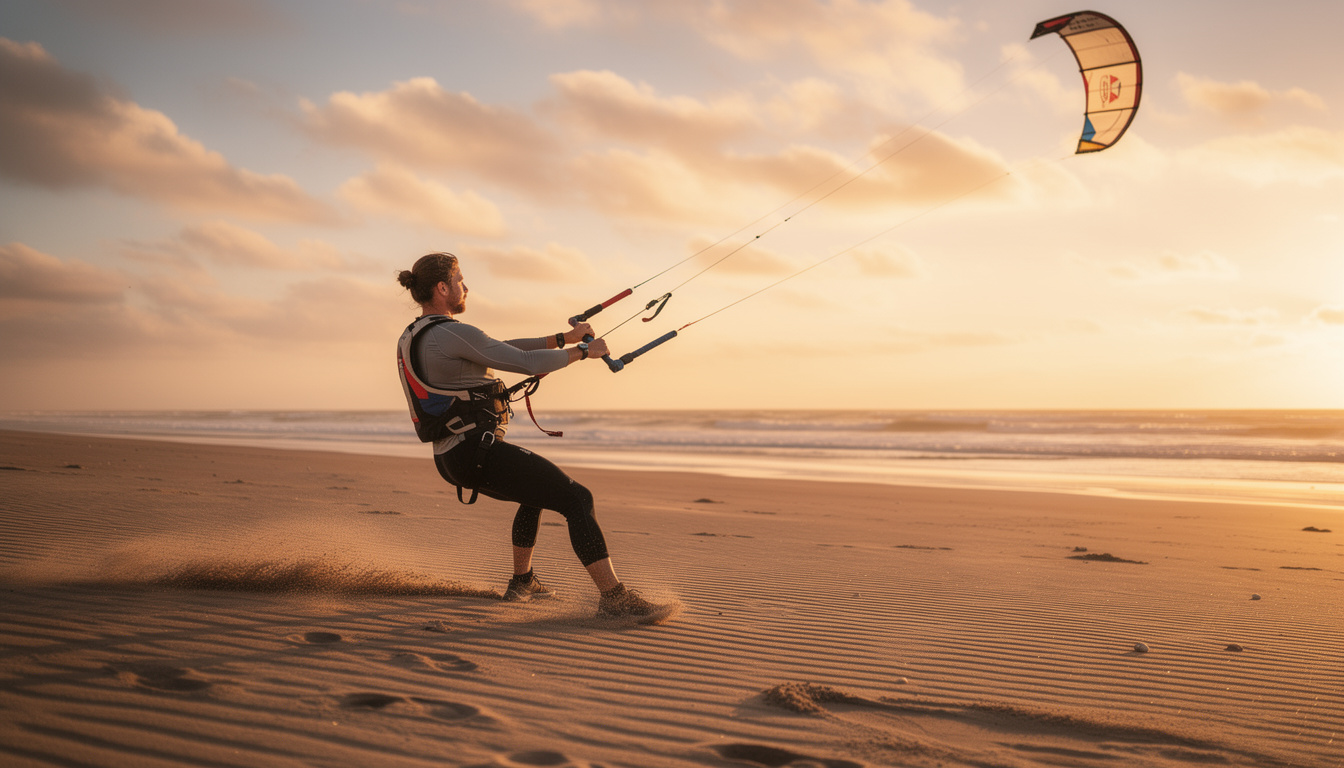
Before we get tactical about technique, it helps to picture what good movement looks like when the wind is doing half the talking.
Technique and balance: the secret sauce that turns traction kiting into outdoor fitness
If you treat traction kiting like “just getting pulled around,” you’ll still get tired, but you’ll also get yanked, over-grip the bar, and wonder why your lower back feels grumpy. The moment you treat it like outdoor fitness with technique, it becomes smoother, safer, and way more effective for endurance. Think of technique as your efficiency multiplier: the cleaner you move, the longer you can hold power without wasting energy.
The first pillar is balance. Not the cute kind where you stand on one leg, but the athletic kind where your body stays stacked while force tries to fold you. A solid stance looks like this: ribs down, pelvis neutral, knees soft, and weight distributed so you can steer with your legs instead of your spine. Maya learned this the hard way. Early on, she leaned back like a lawn chair, which felt strong for five minutes and then cooked her quads. Once she started “sitting into the harness line” (even if she’s using handles on land), keeping shoulders relaxed and hips engaged, she could ride the pull for much longer.
Flying the kite with less drama (and more training value)
There’s a myth that harder pulls mean better training. Not really. The better metric is controlled pull. When the kite is parked too high, you lose forward drive and end up doing awkward isometrics with your arms. When it’s too low and you can’t manage it, you’ll spike your heart rate and technique collapses. The sweet spot is learning to place the kite where you can generate steady traction while still breathing rhythmically.
A practical drill Maya uses: pick a landmark downwind, then fly the kite through small figure-eights while maintaining the same pace. If her speed changes a lot, she knows she’s over-powering or under-powering. Over time, her movements get smaller and more economical, which is exactly what you want for endurance sports: same output, lower cost.
Footwork patterns that build athletic stamina
Traction kiting can be “cruise mode,” but for training it shines when you vary movement patterns: side steps, diagonal runs, controlled stops, and relaunch-like movements. Each pattern challenges coordination differently and teaches you to keep form under fatigue. That’s why it pairs so well with cross-training—it’s not repetitive pounding, yet it still taxes the system.
One of Maya’s favorite sets is 8 minutes easy cruising, then 2 minutes of quick footwork (short choppy steps) while keeping the kite stable. It’s a sneaky way to raise intensity without losing control. Insight: when your kite handling gets quieter, your fitness gets louder.
Now that the movement basics are clear, let’s plug traction kiting into an actual plan so it improves your engine instead of just stealing your afternoon.
Endurance programming with traction kiting: sessions, intervals, and measurable progress
To improve endurance, you need structure—at least a little. The wind already adds randomness, so your job is to keep the training dose consistent. Maya follows a simple weekly approach: one longer, easier session for aerobic development and one shorter, sharper session for power-endurance. She tracks time in zones using a heart-rate strap and a note on wind conditions (because 18 knots is not the same stress as 10 knots).
Here’s the key: traction kiting is naturally interval-ish. Gusts and lulls create intensity spikes. Instead of fighting that, you can “ride” the variability with intention. On gusty days, Maya treats gusts like work intervals: she stays composed, leans efficiently, and pushes pace for 20–40 seconds. In lulls, she resets posture and breath, keeping the kite moving but staying calm. This ends up mimicking fartlek training—perfect for building real-world stamina.
A simple progression that doesn’t wreck you
Progression is about adding one stressor at a time. First add duration (more minutes), then add density (less rest), then add intensity (harder pulls or faster footwork). If you do all three at once, your technique gets sloppy and the “training” turns into survival. Maya made her biggest jump when she committed to staying under control even when the kite felt spicy. That control kept her consistent week to week.
Workout menu (pick one)
- 🟦 Aerobic cruise: 60–90 minutes at conversational effort, focus on smooth kite placement and relaxed shoulders.
- 🟥 Threshold blocks: 3 x 8 minutes “comfortably hard” with 4 minutes easy between; try to keep speed steady during gusts.
- ⚡ Short intervals: 10 x 45 seconds hard pull / 75 seconds easy; keep footwork quick and posture stacked.
- 🧠 Technique + cardio: 30 minutes easy plus 20 minutes of kite-control drills (small figure-eights, controlled stops, relaunch practice on land).
Tracking improvements beyond “I felt tired”
Because conditions vary, you want metrics that survive variability. Maya uses: average heart rate for the same route, perceived exertion, and “form score” (how often she loses stance). When the same wind requires less effort and fewer corrections, that’s endurance and skill improving together. And yes, your watch might call it “other,” but your lungs and legs know what’s happening. Insight: if you can keep technique clean at the end of a session, you’re building the kind of fitness that lasts.
Programming is only half the story; the other half is building the strength base so your body can handle the pull without compensations.
Strength training + core workout carryover: building durability for traction kiting and kiteboarding
Traction kiting looks like cardio, but the limiting factors often aren’t your lungs—they’re your grip, trunk stability, and the ability to produce force repeatedly without collapsing into bad positions. That’s where smart strength training comes in. The goal isn’t to bodybuild; it’s to create a chassis that can handle long sessions while keeping good mechanics.
Maya’s first bottleneck was her forearms. She could feel her heart still ready to go, but her hands wanted to quit. Instead of doubling down on more kiting, she added two short gym sessions per week. Within a month, she stopped death-gripping the bar because her shoulders and back could share the load. That’s the hidden trick: when you’re stronger in the right places, you relax more, and relaxed athletes last longer.
The “anti-rotation” core that actually matters
A lot of people do crunches and call it a day. But traction sports demand anti-rotation and anti-extension: resisting twisting and arching when the pull changes. Think Pallof presses, suitcase carries, dead bugs, and side planks with reach. These moves teach your ribcage and pelvis to stay stacked while your limbs work—exactly what happens when you’re flying a kite and moving your feet at the same time.
On the beach, you’ll notice it immediately. With better trunk control, Maya stops getting pulled into awkward spinal shapes during gusts. That reduces fatigue and lowers the risk of overuse issues. It also improves her balance because balance is basically controlled alignment under changing force.
Leg and posterior chain: your endurance “engine room”
Your legs don’t just propel you; they absorb and redirect force. Split squats, Romanian deadlifts, and step-ups build that “springy” capacity. For traction kiting, unilateral strength matters because your stance isn’t perfectly symmetrical, and you’re constantly biasing one side based on direction and pull. When that side-to-side capacity improves, you stop leaking energy.
Practical weekly layout (Maya’s template)
| Day | Focus | Example session | Why it helps |
|---|---|---|---|
| Mon | 💪 Strength training | Split squats + rows + Pallof press | More pulling endurance, better trunk control |
| Wed | 🪁 Traction kiting (easy) | 70 min aerobic cruise | Builds base endurance with low stress |
| Fri | 🏋️ Core + posterior chain | RDL + carries + dead bug | Durability + cleaner form under pull |
| Sun | ⚡ Kiting intervals | 10 x 45/75 hard/easy | Boosts stamina and pacing control |
Notice what’s missing: endless max-effort days. The plan respects recovery so your adaptations stick. Insight: strength makes traction kiting feel lighter, and when it feels lighter, you can train longer and better.
All that training is only valuable if you stay safe and can show up consistently, so let’s talk risk management without killing the vibe.
Cardiovascular health, safety, and longevity: training hard without getting humbled by the wind
Traction kiting is incredible for cardiovascular health, but it comes with a truth: wind sports punish ego. The safest athletes aren’t the most fearless; they’re the most methodical. Maya’s rule is simple: if conditions feel like a coin flip, she trains something else. That mindset keeps her consistent, and consistency is what improves endurance over months and years.
From a heart-health perspective, traction kiting can deliver a mix of steady aerobic work and high-intensity spikes. That blend is great—similar to sports like soccer or trail running—because it challenges both your base and your ability to recover. The caution is that high spikes can sneak up on you. If you’re new, it’s easy to drift into “redline panic” where breathing gets shallow and decisions get sloppy. That’s when mistakes happen.
Wind awareness as a training skill
Reading wind is like reading terrain. You’re scanning for gust lines, obstacles, and turbulence. Training-wise, this is underrated cognitive load. Your brain is working, which raises fatigue. Maya handles this by planning “easy skill days” in smoother wind and “hard conditioning days” only when the forecast is stable. It’s not about being timid; it’s about choosing the right environment for the goal.
Safety habits that also improve performance
Good safety is also good technique. For example, keeping a relaxed grip and bent elbows isn’t just comfortable—it makes sudden pulls easier to absorb, which protects shoulders and improves control. Similarly, maintaining a wide athletic stance boosts balance and reduces slips, which means fewer emergency recoveries and more steady aerobic work.
- 🧤 Wear gloves if grip fatigue changes your control.
- 🪖 Use appropriate protection (helmet on land, impact gear where relevant).
- 🌬️ Start underpowered and scale up; “slightly boring” is a training superpower.
- 📍 Pick open areas with clean wind to keep sessions smooth and repeatable.
- 🧠 Have a clear stop rule: fatigue + rising wind = call it.
A quick case study: the day Maya almost overcooked it
One afternoon, the forecast looked moderate, but the beach had turbulent wind because of nearby dunes. Maya tried to force an interval session anyway. Within 15 minutes, she was doing constant save-moves, her heart rate was pegged, and her form was gone. She stopped, walked it out, and swapped to a short bodyweight circuit at the car—still productive, no drama. A month later, she repeated the interval session on a flatter, cleaner spot and nailed it. Same athlete, smarter context.
That’s longevity: choosing conditions that match the session, keeping intensity intentional, and letting your body adapt instead of just survive. Insight: the best endurance gains come from sessions you can repeat, not sessions you can barely escape.
How is traction kiting different from kiteboarding for cross-training?
Traction kiting is usually done on land or snow with a traction kite, so you can focus on kite control, footwork, and conditioning without the added complexity of water starts and board handling. That makes it a cleaner cross-training tool for endurance and skill carryover, while kiteboarding adds more technical layers and impact demands.
What’s the best session type for improving endurance fast?
A weekly mix works best: one longer easy session (60–90 minutes) to build aerobic capacity, plus one interval session (like 10 x 45 seconds hard / 75 seconds easy) to raise stamina and recovery speed. The real accelerator is keeping technique controlled so you can accumulate quality time instead of chaotic effort.
Do I need strength training if traction kiting already feels hard?
Yes, because the hard feeling is often local fatigue (grip, shoulders, lower back) rather than true cardiovascular limitation. Two short strength sessions focused on posterior chain, pulling strength, and anti-rotation core work will make you more efficient, improve balance under load, and let your endurance sessions last longer with better form.
How do I avoid overuse injuries in my forearms and lower back?
Use a lighter grip, keep ribs stacked over pelvis, and prioritize kite placement so you’re not constantly muscling the pull with your arms. Build tissue capacity with carries, rows, and gradual volume increases. If wind is gusty and you’re fighting the kite, shorten the session or switch to technique-only work.